

● Stablecoin Shockwave-Digital Money Reshapes Finance
Key Points of the Stablecoin’s Advent and the Digital Currency Revolution Shaking Up This Year’s Financial Market
1. The Evolution of Past Currencies and the Genesis of Digital Transformation
In the past, humanity began transactions by directly exchanging gold nuggets.Subsequently, gold deposit certificates emerged to store and verify gold, leading to the development of currency.These certificates still contain the ‘promise to pay’ that forms the basis of currencies like the pound today.This historical background serves as an important starting point for understanding the fundamental concepts of digital currencies and stablecoins today.With the advent of the digital age, the concept of traditional currency remains, but the means of currency delivery are transforming into new blockchain-based systems.
2. The Birth of Digital Assets and the Limitations of Bitcoin
Virtual assets, including Bitcoin, are the first digital assets based on blockchain technology.However, Bitcoin has limitations as a practical currency due to its unclear issuing entity and severe price volatility.From the perspective of digital currency rapidly transforming the global economy and financial markets, new forms of assets that are more stable and can be regulated began to attract attention, replacing unstable Bitcoin.
3. The Emergence of CBDC and Stablecoins: Differences in Issuing Entities
To enhance the stability and convenience of financial markets, CBDC (Central Bank Digital Currency) issued by central banks and stablecoins issued by private companies have emerged.CBDCs are directly issued by central banks such as the Bank of Korea, the People’s Bank of China, and the U.S. Federal Reserve, reflecting government trust.In contrast, stablecoins are issued by private companies like Tether or Circle and have a structure that pegs them 1:1 to existing currencies.Both types naturally incorporate top SEO keywords such as “digital currency,” “global economy,” “CBDC,” “stablecoin,” and “blockchain,” forming major pillars of financial innovation.
4. Stablecoin Structure and the Mechanism of Government Bond Trading
Stablecoins are based on the principle of 1 coin per 1 dollar, where the issuer, instead of holding the received cash, purchases government bonds at a certain ratio.This structure acts as an important mechanism that supplies liquidity to the entire financial market by enabling the issuing company to purchase government bonds with the cash it holds as the number of coin purchasers increases.Furthermore, they form a link with the real economy for purposes such as inter-company trade settlements and wage payments, demonstrating strengths like real-time transfers and low fees.
5. Legalization and Prospects for Future Financial Market Changes
Along with the rapid proliferation of stablecoins, discussions on their legalization are also actively taking place.This will enable the issuance and distribution of stablecoins to occur within a clear legal framework, establishing a stable business environment.Particularly, through regulations such as reserve requirements, while ensuring 1:1 fiat currency pegging, they are expected to play a crucial role amid the global currency hegemony competition and the economic rivalry between the United States and China.Depending on the future utilization of CBDCs and stablecoins, significant changes are anticipated not only in financial innovation but also across international trade and payment systems.
6. Summary and Outlook
The history of currency, which began with gold deposit certificates in the past, is entering a new phase amidst the digital revolution.After the emergence of Bitcoin, stablecoins issued by private companies and CBDCs issued by central banks are gaining attention, instead of unstable virtual assets.Both digital currencies ensure stability by pegging 1:1 to existing currencies, provide liquidity to financial markets, and offer advantages such as real-time payments and low fees.Discussions on legalization and the establishment of regulations like reserve requirements will provide significant opportunities for the widespread adoption of stablecoins and their application in the real economy.Such changes are expected to have a major impact on the global economy, blockchain, and the digital currency revolution, fundamentally reshaping the financial system in our daily lives.
[Related Articles…]Stablecoin Investment StrategiesFuture Outlook for CBDC
*Source: 경제 읽어주는 남자(김광석TV)
올해 금융시장을 뒤흔들고 있는 ‘스테이블 코인’ 도대체 무엇일까? 디지털 화폐 혁명은 어떻게 일어나게 될까? [경읽남 199화-상편]
● Bitcoin Digital Gold – Financial Hegemony’s Reckoning
Bitcoin Commercialization and Financial Hegemony Shift, The Overture to the Last Chance
Bitcoin and Alchemy: A New Gold Substitute
Beyond a simple cryptocurrency, Bitcoin shows the potential to establish itself as a new digital gold.This system, designed by Satoshi Nakamoto, is akin to alchemy, building trust based on immutability and scarcity.Through initial incentives and halving mechanisms, it designed a process where value accumulates like a function of time, similar to the traditional principle of gold’s value.This mechanism is drawing attention as an innovative investment opportunity offered by Bitcoin in the global economy and investment markets.
Bitcoin Halving and the Flow of its Supply Structure Over Time
Bitcoin’s halving is a key element that simultaneously realizes mining incentives and supply control.In the early days, a low mining production cost was formed due to mass production, but over time, the production volume gradually decreases.This process, starting from the Genesis Block in 2009, is expected to continue until 2140, completing a structure where Bitcoin’s price inevitably rises sharply with increasing production costs.This supply structure provides investors with a signal of long-term and stable value appreciation.
Existing Currency System vs. Bitcoin: The Dollar System and Inflation
The current fiat currency system, especially the dollar system, possesses limitations such as infinite issuance and inflation.Bitcoin emerged as an alternative to overcome the problems of existing currencies, adopting transparent blockchain technology and a decentralized structure.Unlike the reality where a relatively small number of wealthy individuals own real assets like Gangnam apartments, Bitcoin offers investment opportunities accessible to everyone.Bitcoin, which complements the limitations of the dollar system, thus approaches investors with strong appeal within the cryptocurrency market.
The Paradox of Alchemy and the Reinterpretation of Gold’s Value
Unlike the paradox of Isaac Newton attempting to create gold through alchemy, Bitcoin created non-replicable value by imbuing ‘scarce properties’ into digital code.While gold is trusted based on its physical properties, Bitcoin guarantees immutability and scarcity through code and algorithms.This concept presents an investment strategy differentiated from traditional gold investment and becomes a core narrative in the shift of financial hegemony.Bitcoin, emerging as a core asset in the digital economy, offers investors new options within the global economic trend.
Key Indicators to Consider When Investing
To predict the future value of Bitcoin, one must pay attention to key economic indicators.First, given its correlation of approximately 94% with M2 money supply, an increase in money supply from three months prior acts as a signal for Bitcoin price appreciation.Second, by utilizing the MVRV indicator, which is on-chain data, one can identify periods of short-term trading and whether the market is overvalued or undervalued.Thus, systematic analysis and data-driven investment are essential for long-term cryptocurrency investment.
Future Outlook: Financial Hegemony Shift and Investment Points
Financial hegemony is entering a new phase of change amidst the side effects of the dollar system and inflationary pressures.Bitcoin is overturning the existing financial order, establishing itself as a new investment asset that provides equal opportunities to a broader range of investors, not just a wealthy few.Investing in Bitcoin is a strategic choice that leads long-term economic system changes, rather than merely short-term speculation.Core SEO keywords such as cryptocurrency, blockchain technology, global economy, investment, and the dollar system are at the heart of this transformation.
[Related Articles…]Bitcoin Future AnalysisDollar System Crisis and Outlook
*Source: 신사임당
곧 비트코인 상용화 된다 “지금이 마지막 기회입니다” (김창익 대표 / 4부)
● Kakao Pay’s KRW Stablecoin Bid Trust or Terra
Kakao Pay’s Push for Korean Won Stablecoin Issuance…Minimum Standards and Key Points for ‘Ensuring Trust’
1. Recent Policy and Market Trends
In the digital asset and cryptocurrency market, Korean Won stablecoins, which major companies are considering issuing, are emerging as a hot topic.Several large corporations, including Kakao Pay, are showing their intention to enter the Korean Won stablecoin business, drawing attention to a new market trend based on global finance and blockchain technology.This article concretely organizes the background of the Korean Won stablecoin issuance push, minimum standards, and key measures for ‘ensuring trust’ in chronological order.
2. Legal Standards and Reserve Management
Following the policy announcement, the biggest issues are the ‘100% physical collateral’ requirement and the bankruptcy remoteness clause.According to the Digital Asset Basic Act, more than 100% of the stablecoin issuance volume must be held in highly liquid assets that are easily convertible to cash.This standard was established to overcome the limitations of the algorithmic model exposed by the past Terra-UST incident.Reserve assets must be segregated from the issuer’s operating funds, protected separately from third-party creditors, and distributed across multiple high-credit financial institutions.
3. Global Cases and Domestic Application Methods
In the global market, the USDC model issued by Circle in the US is representative.USDC holds reserve assets consisting of cash and short-term US Treasury bonds, gaining market trust through management by global institutions like BlackRock and transparent information disclosure.On the other hand, due to differences in the scale and liquidity of the government bond market within Korea, perfect imitation is difficult, requiring the development of a ‘reality-reflecting portfolio’.Referring to international cases such as the European Union’s MiCA regulation, the systematic establishment of regulations for stablecoin issuance is required.
4. Technical Security and Regulatory Risk Management
Smart contract security is another important pillar of stablecoin issuance.Regular security audits and the introduction of emergency response systems like circuit breakers are essential.Furthermore, regulatory uncertainty among various policy agencies such as the Financial Services Commission and the Bank of Korea can act as a risk, requiring clear regulatory standards along with stable operation.These factors will play a major role in securing competitiveness in digital assets and global market trends.
5. Market Value Created by ‘Trust’
Ultimately, the success of a stablecoin depends on ‘trust’.Even major companies like Kakao Pay cannot guarantee trust solely through brand name; a conservative portfolio composition, transparent information disclosure, and a decentralized custody system are essential.Only when these measures are met can the value promise of ‘1 coin = 1 won’ be maintained, providing stability and confidence in the market.
[Related Articles…]Review of Stablecoin Issuance Standards |Physical Collateral Management Strategy and Market Outlook
*Source:

● Stablecoin Gold Rush – Korean Tech Giants Soar
Anticipation of Stablecoin Adoption and Surge in Related Stocks: Analysis of Key Issues Including Kakao Pay, Danal, and Samsung SDS
Recent Market Trends and Background of Stablecoin Growth
Share prices in related industries are surging as the government and ruling party recently accelerate the introduction of KRW-pegged stablecoins.
Notably, major companies such as Kakao Pay, Danal, and Samsung SDS are leveraging this opportunity to enhance their competitiveness in digital finance and blockchain sectors.
In the domestic simple payment market, Kakao Pay is gaining an edge in the stablecoin collateral asset competition, based on its large volume of prepaid rechargeable balances.
Furthermore, stablecoin-related issues are drawing attention in global stock markets, stimulating investor sentiment.
Strategies and Technology Utilization by Major Companies
As the largest simple payment service in Korea, Kakao Pay is building a stable collateral provision model based on its substantial holdings of prepaid funds, which are essential for stablecoin issuance.
Samsung SDS has been developing its blockchain platform ‘Nexledger’ since 2017, leading the way in stable payment services and digital asset processing through the establishment of digital financial infrastructure.
Danal, through its subsidiary Payprotocol, offers digital asset-based payment solutions such as stablecoins and is exploring connections with global card networks.
In addition, various fintech and game development companies, including Hecto Financial and Me2On, are attempting to create new revenue models by entering the stablecoin market.
Global Stock Market Trends and Policy Changes
The surge in stock prices of Circle, listed on Nasdaq in the U.S., demonstrates the potential stablecoins hold in global stock markets.
The ‘GENIUS Act’ bill passed by the U.S. Senate further highlights the growth potential of the stablecoin market, attracting interest from investors worldwide.
Domestically, policy support, such as the proposal of the Digital Asset Basic Act, is being strengthened, driven by the Lee Jae-myung administration’s commitment to introduce KRW-pegged stablecoins.
This trend is influencing the global economy as a whole and acting as a factor accelerating the development of digital finance and blockchain technology.
Risk Factors and Investment Precautions
When investing in stablecoin-related stocks, it is necessary to thoroughly analyze the differences in each company’s collateral asset structure and digital financial business model.
As there can be various external factors such as market regulation, technological competition, and global stock market volatility, it is advisable to approach investments from a mid-to-long-term perspective rather than focusing solely on short-term returns.
Experts recommend diversifying investment portfolios in preparation for risk factors related to global economic uncertainty.
Future Outlook and Key Points Summary
Driven by domestic and international policy changes and positive signals from global stock markets, the stablecoin market is expected to continue to grow.
Major companies such as Kakao Pay, Danal, and Samsung SDS appear poised to secure market leadership through their differentiated technologies, simple payment systems, and blockchain infrastructure.
It is crucial for investors to monitor market trends focusing on key economic keywords such as stablecoins, digital finance, blockchain, simple payments, and global stock markets, and to formulate mid-to-long-term investment strategies.
[Related Articles…] Stablecoin Analysis | Blockchain Innovation
*Source:
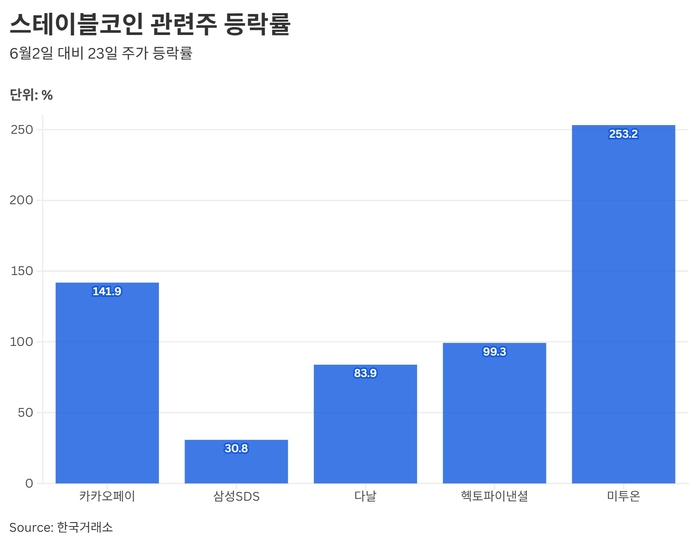
● Stablecoin Gold Rush – Korean Tech Giants Soar
Anticipation of Stablecoin Adoption and Surge in Related Stocks: Analysis of Key Issues Including Kakao Pay, Danal, and Samsung SDS
Recent Market Trends and Background of Stablecoin Growth
Share prices in related industries are surging as the government and ruling party recently accelerate the introduction of KRW-pegged stablecoins.
Notably, major companies such as Kakao Pay, Danal, and Samsung SDS are leveraging this opportunity to enhance their competitiveness in digital finance and blockchain sectors.
In the domestic simple payment market, Kakao Pay is gaining an edge in the stablecoin collateral asset competition, based on its large volume of prepaid rechargeable balances.
Furthermore, stablecoin-related issues are drawing attention in global stock markets, stimulating investor sentiment.
Strategies and Technology Utilization by Major Companies
As the largest simple payment service in Korea, Kakao Pay is building a stable collateral provision model based on its substantial holdings of prepaid funds, which are essential for stablecoin issuance.
Samsung SDS has been developing its blockchain platform ‘Nexledger’ since 2017, leading the way in stable payment services and digital asset processing through the establishment of digital financial infrastructure.
Danal, through its subsidiary Payprotocol, offers digital asset-based payment solutions such as stablecoins and is exploring connections with global card networks.
In addition, various fintech and game development companies, including Hecto Financial and Me2On, are attempting to create new revenue models by entering the stablecoin market.
Global Stock Market Trends and Policy Changes
The surge in stock prices of Circle, listed on Nasdaq in the U.S., demonstrates the potential stablecoins hold in global stock markets.
The ‘GENIUS Act’ bill passed by the U.S. Senate further highlights the growth potential of the stablecoin market, attracting interest from investors worldwide.
Domestically, policy support, such as the proposal of the Digital Asset Basic Act, is being strengthened, driven by the Lee Jae-myung administration’s commitment to introduce KRW-pegged stablecoins.
This trend is influencing the global economy as a whole and acting as a factor accelerating the development of digital finance and blockchain technology.
Risk Factors and Investment Precautions
When investing in stablecoin-related stocks, it is necessary to thoroughly analyze the differences in each company’s collateral asset structure and digital financial business model.
As there can be various external factors such as market regulation, technological competition, and global stock market volatility, it is advisable to approach investments from a mid-to-long-term perspective rather than focusing solely on short-term returns.
Experts recommend diversifying investment portfolios in preparation for risk factors related to global economic uncertainty.
Future Outlook and Key Points Summary
Driven by domestic and international policy changes and positive signals from global stock markets, the stablecoin market is expected to continue to grow.
Major companies such as Kakao Pay, Danal, and Samsung SDS appear poised to secure market leadership through their differentiated technologies, simple payment systems, and blockchain infrastructure.
It is crucial for investors to monitor market trends focusing on key economic keywords such as stablecoins, digital finance, blockchain, simple payments, and global stock markets, and to formulate mid-to-long-term investment strategies.
[Related Articles…] Stablecoin Analysis | Blockchain Innovation
*Source:
Leave a Reply