

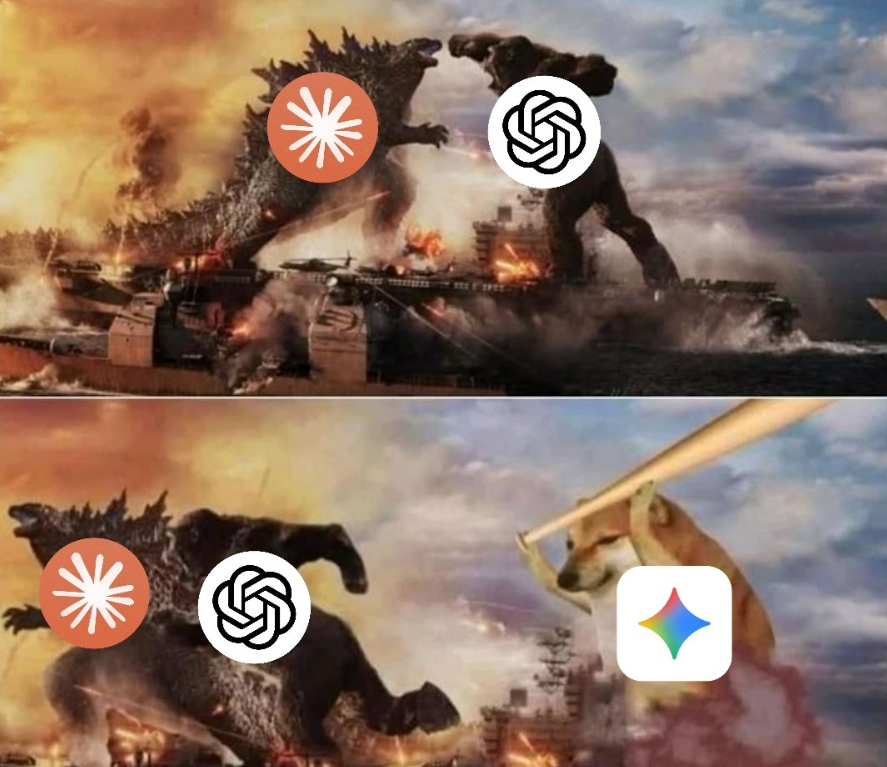
● Shockwaves, Gemini 3, Market Disruption
Google Gemini 3 Shockwave: Will it Disrupt the OpenAI and Anthropic Duopoly? — Key Highlights in the Article: Performance Secrets of Gemini 3 (Pre-training, Data Moat), OpenAI’s Urgent Response (Shallotpeat), Immediate Reactions from Companies and Markets (Salesforce Declaration, MSL Pressure), Security and Guardrail Vulnerabilities (Poetic Prompt Vulnerability), and the Anticipated Frontier Model Competition Timeline and AGI Landscape Change Starting Early Next Year.
News Briefing — Key Points at a Glance
Salesforce CEO Marc Benioff publicly declared that he wouldn’t go back to ChatGPT after using Gemini 3, igniting a public reaction.Gemini 3 has sparked intense competition in frontier models, with the industry recognizing Google’s ascension to the forefront.OpenAI is preparing a counterattack with the code-named ‘Shallotpeat’ project focused on pre-training, with potential performance announcements expected early next year.Concurrent reports of model guardrail vulnerabilities (jailbreaks via poetic prompts) and rapid regional model expansions in China (Ant Group case) are swiftly altering the market environment.
The Superiority of Gemini 3: What’s Changed?
- Innovation in Pre-training
The overwhelming assessment is that Gemini 3’s remarkable performance improvement stems from advancements in pre-training methods.
Observations suggest that it has surpassed the limitations of scaling laws, with a focus on redesigning data, objective functions, and training procedures instead of simply expanding parameters.
- Data Moat
Reddit and industry observations highlight Google’s major strength as its ‘decades of web crawling and curation data linked with search.’
The combination of public data and Google’s internal and proprietary data, along with advanced curation techniques, is presented as a differentiating factor.
- Resulting Significance
Possessing superiority in the combination of data and pre-training results in a significant performance gap even with the same model size.
This marks a transition from a simple model architecture competition to a ‘competition of data, infrastructure, and training pipelines.’
Responses and Strategies of OpenAI, Meta, and Other Competitors
- OpenAI: Direct Response with Shallotpeat
OpenAI has initiated a project to improve pre-training processes, with an internal ‘Code Orange’ level of urgency.
As seen in the retraining case of Orion, which was a candidate for GPT-5, failure in pre-training implies reinvestment and time delays.
- Meta (MSL): ‘Llama 4.5’ and the Essential Conditions for the Next Frontier
While MSL has raised its competitiveness through massive investments in personnel and capital, actual performance needs to verify this investment.
If next year’s target model does not surpass Gemini 3’s level, MSL’s raison d’être may be threatened.
- Anthropic, xAI, and Chinese Players
While Anthropic, xAI, etc., are reacting with specialized capabilities in coding, few models currently approach the level of Gemini 3.
The rapid spread of Ant Group’s app in China illustrates the potential for regional and application-specific models in a speed race.
Security, Ethics, and Guardrail Issues: Weaknesses Revealed by Poetic Prompts
- Research Findings: Report that LLM Jailbreaks are Possible Using Poetic Expressions
The discovery of guardrail circumvention based on format (prompt style) yielded paradoxical results showing that stronger models are more vulnerable to these adversarial techniques.
This suggests that existing structured filter and keyword-based management methods could be rendered ineffective.
- Policy and Regulatory Implications
As model performance improves, methods for safety validation also need fundamental changes.
Strengthening norms such as behavior-based verification and certification, open test sets, and red team results disclosure is likely.
Market and Customer Reactions and Corporate Risks
- Risk of Enterprise Customer Attrition
Salesforce CEO’s public remarks demonstrate that enterprise customers can swiftly switch their model choices.
Once users and business logic migrate to another platform, recovery costs become significant.
- Acceleration of Recruitment and Talent Wars
As frontier competition intensifies, competition to secure key researchers and engineers becomes fiercer.
As demonstrated by Meta’s case of large-scale investment to attract talent, failure raises issues of talent retention and ROI.
Outlook from Next Year to 2026: Timeline and Scenarios
- Short-term (Early Next Year)
The concentrated announcement of OpenAI’s Shallotpeat results and updates from others (Meta, Anthropic) is likely to trigger the appearance of performance-compensating models that surpass Gemini 3.
- Medium-term (2025~2026)
The re-ignition of frontier competition means victory hinges on data accessibility (proprietary data), training process innovation (pre-training, objective changes), and safety regulation compliance.
Companies delivering less than expected results by early 2026 risk being excluded from the AGI candidate pool in the long term.
Key Fact Check Summarized by the News
- Marc Benioff publicly announced ceasing ChatGPT usage after demonstrating Gemini 3.
- OpenAI is urgently responding with the pre-training enhancement project ‘Shallotpeat,’ with potential results visible early next year.
- The community and industry cite Google’s data curation and pre-training innovation as the core factors of Gemini 3.
- Studies on poetic prompts reveal that stronger models are more vulnerable to format-based circumvention attacks.
- Within four days of release, Ant Group’s app recorded one million downloads in China, demonstrating the speed race of regional models.
‘The Most Crucial Factor’ That Should Not Be Overlooked Unlike Other News
Google’s advantage likely stems not from model architecture or parameter count, but from ‘the quality of data that enables pre-training and its curation pipeline.’
Thus, the upcoming frontier competition will transcend mere ‘model spec competition’ and transform into a ‘competition of integrating data, search infrastructure (search-training loop), and training methodology.’
This point, while mentioned in numerous media outlets, is expected to act as a crucial variable practically influencing corporate strategy, M&A, and regulatory response.
Strategic Implications — Checklist for Companies, Investors, and Policymakers
- Companies (Product Managers): Review multi-model and multi-backend strategies, prepare plans to minimize migration costs to prevent customer churn.
- Investors: Verify whether companies possess data and infrastructure assets and pre-training capabilities.
- Policymakers: Demand mechanisms ensuring safety and transparency along with performance improvements (public disclosure of red team results, certification systems).
- Researchers: Focus on developing behavioral/goal-based safety assessment frameworks that complement format-based guardrails.
< Summary >
Gemini 3 has disrupted industry dynamics.
The key secret lies in pre-training methods and Google’s unique data curation capability.
OpenAI is preparing a counterattack with Shallotpeat, and the frontier model competition is expected to re-ignite early next year.
Guardrail vulnerabilities (poetic prompts) and the speed competition of regional models are significant variables in security, policy, and market aspects.
Companies and policymakers must prioritize data, pre-training capabilities, and safety verification as the foremost tasks.
[Related Articles…]Sudden Shift in Opinion to ‘Google No.1’…”OpenAI Faces ‘Innovator’s Dilemma’”GPT-6 and ‘Science 2.0’, and OpenAI
*Source: https://www.aitimes.com/news/articleView.html?idxno=204249
Leave a Reply