

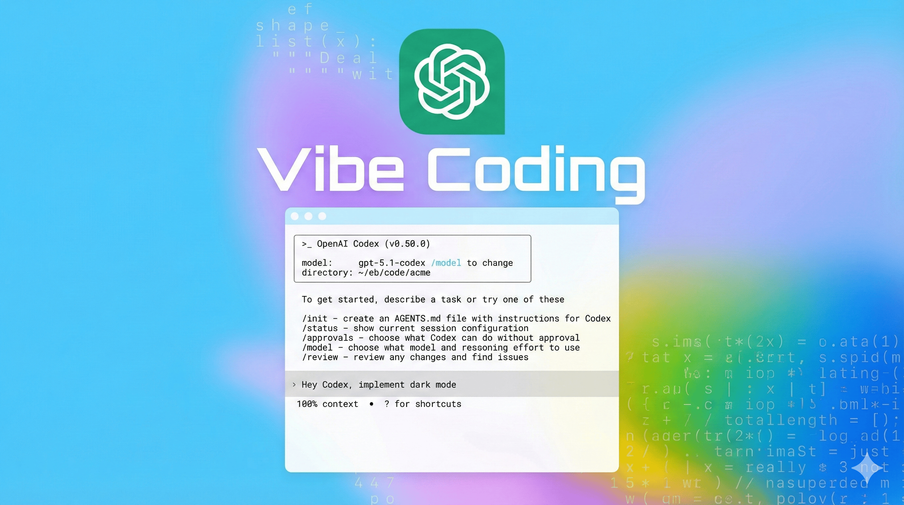
● Explosive Economic Shifts Unleashed
‘Vibe Coding’ 10-Minute Practical Guide — How to Create a Website with ChatGPT, Impact on Business & Economy, and Essential Tips Not Shared in the Field
Key topics covered in this article:
- Definition of Vibe Coding and the 3-step practical process (Role Assignment → Copy & Execute Code → Modify & Tune).
- Specific prompts and a checklist to create a ‘Today’s Fortune Cookie’ website with ChatGPT in 10 minutes.
- Economic impact on enterprise and national levels: Digital transformation, productivity changes, labor market restructuring, innovation opportunities.
- Security, quality, and governance risks, along with actionable strategies ready for enterprise use (including KPIs).
- Crucial points often missed by other news: Operations (ops), ROI measurement, vendor lock-in, real cost of computing, code maintenance solutions.
Vibe Coding: Core Concept Outline
Vibe Coding is a coding approach where code is generated and modified through conversations with AI in natural language.
Introducer/Highlight:
- Concept proposed by Andrej Karpathy, explaining requirements with ‘vibe’ for AI to implement in code.
Technical Shift:
- Programming shifts from memorizing syntax to communicating requirements and emotions (e.g., “80s classic game vibe”) and overseeing results.
Economic Keywords Connection:
- Economic Outlook: Qualitative leap in software productivity.
- Digital Transformation: Shortened service/product development cycles for companies.
- Productivity: Potential increase in output per engineer.
- Labor Market: Transition in roles from coder to validation/design/operation.
- Innovation: Significant drop in product experimentation costs for startups and large companies.
3 Practical Steps: Creating a ‘Today’s Fortune Cookie’ Website with ChatGPT
1) Step 1 — Role Assignment and Idea Pitching
- Example prompt: “You are a beginner web development tutor. Create a simple HTML/CSS/JavaScript website showing today’s fortune cookie, one-page, random phrase upon button click, responsive, no external libraries, comments included.”
- Expected Outcome: Entire file structure (index.html, styles.css, script.js) and code blocks.
2) Step 2 — Copy and Execute Code
- Create index.html locally and paste the code.
- Open it in a browser to verify functionality.
- If errors occur, copy the console log (Developer Tools) and ask AI.
3) Step 3 — Bringing the ‘Vibe’ (Request Modifications)
- Example tuning prompt: “Change the design to feel like an 80s arcade game. Pixel-style font, add animation to buttons, colors in neon blue/pink. Maintain color contrast for accessibility.”
- Apply and verify once AI provides modified CSS/HTML/JS.
Practical Tips (Field Know-how):
- Do not give large requirements at once; break them into smaller goals and revise repeatedly.
- Include test cases (e.g., mobile button functionality, screen reader compatibility) in prompts.
- Always manage code versions with Git (GitHub Desktop recommended for beginners).
Practical Application: Checklist for Immediate Use in Companies/Products
Early Prototype in Feature Development:
- Goal: Prototype within 1 hour, MVP demo within a day.
- Checkpoints: Security, input validation, minimizing external dependencies, license (open-source) verification.
Review Before Operation:
- Conduct code review alongside AI with a senior person.
- Include automated unit and integration tests.
- Verify the integration of build and deployment pipeline (Jenkins/GitHub Actions).
Business KPI (ROI Measurement):
- Reduction rate (%) in development cycles, bug reduction rate, speed of customer feedback integration, prototype-to-production transition costs.
Economic Ripple Effect: What Changes
Short-term (1-2 years):
- Reduction in initial costs for startups, increased frequency of experimentation.
- Accelerated software service launch speeds → Intensified competition.
Mid-term (3-5 years):
- Reallocation of tasks in some software sectors (reduced routine coding, enhanced design/validation/operation).
- Surge in demand for education market (retraining/bootcamps).
Long-term (5-10 years):
- Possible increase in GDP contribution due to productivity improvements (positive economic outlook).
- Labor market restructuring: A shift in focus to high-skilled and domain expertise for compensation adjustment.
Policy/Corporate Response:
- Needs for national retraining/infrastructure investment (accelerated digital transformation).
- Companies should prepare internal governance and AI safety checklists.
Risks and Security: Must-Checks in Practice
Main Risks of AI Coding:
- Security vulnerabilities introduced by hallucinated code.
- License/Copyright issues: Unclear origin of AI-generated code.
- Vendor lock-in: Risk of dependency on specific models/platforms.
- Surge in cloud computing costs: High costs for large-scale automated tests and generation.
Practical Response Strategies:
- Use tools for automatic scanning of source/license when generating code (Copilot/OSS scanner).
- Handle sensitive data with local models or private instances.
- Cost monitoring: Detailed alarm settings for generated API calls and token usage.
- Governance: Mandatory ‘AI-generated’ tagging and review process for generated code.
Crucial Points Often Overlooked by Other Media — This is How You Win
1) Operational Cost Analysis from an Ops Perspective
- Many articles emphasize ‘development time reduction,’ but in reality, costs for AI use, review manpower, testing, and remediation accumulate.
- A “total cost of ownership (TCO) compared to time savings” model is needed in practice (e.g., initial development time reduced by 20% is offset by QA/security remediations).
2) Maintenance and Technical Debt Management
- Quality variation is high in auto-generated code. In the long run, separate refactoring sprints for ‘AI-generated code’ are necessary.
- Recommendation: Apply Lint/static analysis and regular refactoring policies to all AI-generated code.
3) Organizational Culture/Role Redefinition (Manager Perspective)
- Recruitment criteria change: Importance shifts from ‘good coders’ to those who can collaborate with AI for design, validation, and management.
- Include ‘AI tool usage guide’ in onboarding process.
4) Setting Measurable KPIs (Specifically)
- Time to prototype creation, production transition rate, cost per AI call, number of discovered security vulnerabilities, code rejection reasons (review decline rates).
Safe Practice Guide for Beginners (Security & Legal Cautions Included)
- Never include sensitive information (personal data, API keys, etc.) in prompts.
- Verify licenses when using external libraries (commercial use availability).
- Run SCA (Software Composition Analysis) before deployment.
- Consult with legal and security teams before practical application.
Prompt Templates for Immediate Use (Copy and Use)
- Initial Creation: “You are a beginner web development tutor. Create a one-page fortune cookie website with HTML/CSS/JS files, display random phrases on button click, include comments, prohibit external libraries.”
- Design Tuning: “Change the design to an 80s arcade style. Pixel font, neon colors, add hover animation to buttons.”
- Accessibility Requirement: “Meet WCAG AA color contrast standards, add aria-label to buttons, enable keyboard navigation.”
- Security Request: “Add validation routine for input values, include escape functions to prevent XSS vulnerabilities.”
Quick Checklist Before Project Start
- Define Objective (Prototype vs. Production)
- Prepare Prompt Writing Template
- Configure Local Testing Environment (Browser, Console Check)
- Prepare Security/License Scanning Tools
- Establish Git for Version Management and PR Review Process
- Set Up Cost/Model Usage Monitoring
< Summary >Vibe Coding is a new paradigm where code is created through conversation with AI in natural language.Beginners can create a prototype with ChatGPT within 10 minutes, but security, licensing, maintenance, and cost issues must be thoroughly considered for practical application.Companies should leverage digital transformation and productivity improvement opportunities, while preparing retraining and policies considering labor market changes and governance risks.The most important point is to beware the illusion of ‘time savings’ and to establish a total cost of ownership (TCO) and maintenance plan first.
*Source: https://themiilk.com/articles/a56be06aa?utm_source=Viewsletter&utm_campaign=06b7b18d66-EMAIL_CAMPAIGN_2025_08_05_08_52_COPY_01&utm_medium=email&utm_term=0_-f7bc1a2247-385751177
[Related articles…]
Leave a Reply