

● AI job apocalypse, survive with ruthless verification, renaissance polymath mindset
Everyone, today’s story isn’t just simple IT news. It contains the core answer on how we must survive and evolve amidst the upcoming AI trends.I will summarize in great detail the ‘5 Survival Strategies for Developers and Economic Agents in the AI Era’ revealed by the legendary CTO of Amazon (AWS), Dr. Werner Vogels, in his final keynote speech.It goes beyond the level of simply “AI doing the coding”; it is truly important content that allows us to grasp how the landscape of the technology economy is changing, so please stay focused until the end.
AI Era, Will We Be Replaced? Or Will We Evolve?: The Birth of the ‘Renaissance Developer’
1. The Hottest Question: “Will AI Take My Job?”
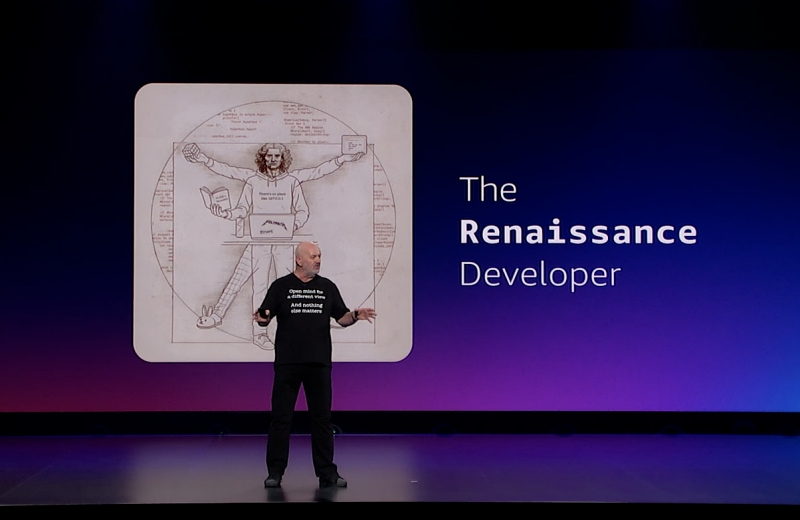
[On-Site Situation]Recently at ‘AWS re:Invent 2025’ held in Las Vegas, Dr. Werner Vogels opened with a question he hears wherever he goes in the world.”Will AI take my job?”His answer was clear. “Probably. But if you evolve? Absolutely not.”
[Key Message]Work belongs to you, not the tool (AI).He clarified that while we are in the middle of a productivity revolution, AI is merely a tool, and important decisions and responsibilities still lie with people.He likened this period to the ‘Renaissance,’ where explosive development occurred after the dark ages of the past, defining us as ‘Renaissance Developers.’
2. 5 Essential Frameworks to Become a Renaissance Talent
Dr. Vogels’ 5 proposed qualities apply not only to developers but to every office worker who needs to survive in the rapidly changing future job market.
① Be Curious
- Detailed Content: Simply observing is not enough. You must learn by colliding with things directly and failing. He cited the ‘Yerkes-Dodson Law,’ which states that the brain wakes up and grows only when there is appropriate stress and pressure.
- Key Point: Don’t just stay at your desk; go outside. ‘Social learning’—talking to people and participating in communities—is real learning.
② Think in Systems
- Detailed Content: You must see the forest, not just the trees. The example of ‘Trophic Cascade,’ where releasing wolves into Yellowstone National Park changed the flow of the rivers, was impressive.
- Key Point: You must design from a macroscopic perspective, considering what ripple effects (Butterfly Effect) a single small code or a small policy will bring to the entire technology economy system.
③ Communicate with Precision
- Detailed Content: The most important thing when assigning tasks to AI is eliminating ‘ambiguity’. Not only in conversations between people but also in communication with AI, the ability to define exact ‘Specs’ is technical skill itself.
- Key Point: An AI that ‘understands perfectly even if spoken to poorly’ is dangerous. The ability to give clear instructions (prompts/specs) so that the machine performs the desired logic exactly is essentially competitiveness.
④ Be an Owner
- Detailed Content: Just because AI writes code doesn’t mean it takes responsibility. The concept of ‘Verification Depth’ emerged, meaning the process of reviewing and understanding code written by AI has become more important than writing it yourself.
- Key Point: Do not rely on AI’s output. Creating a ‘mechanism’ to verify whether it is a hallucination or the correct answer is true ownership.
⑤ Become a Polymath
- Detailed Content: The era of digging only one well is over. While having your own area of expertise (Deep), you must become a ‘T-shaped talent’ who can connect knowledge (Broad) from various fields such as humanities and science.
- Key Point: Whether it’s the cloud industry or finance, the person who fuses diverse knowledge to create new value will be the ultimate winner.
3. The ‘Real’ Key Insights Not Told Elsewhere (Interpretation Behind the News)
The most important point I felt while watching this keynote, which cannot be known simply by looking at the news, is the danger of ‘Verification Debt’.
Many media outlets focus on the convenience that “AI helps with coding,” but Dr. Vogels accurately pointed out the ‘risk’ hidden behind that convenience.AI spits out code in 1 second, but the speed at which humans understand and verify that code cannot keep up.He meant that the gap generated by this difference in speed could later lead to fatal errors or security incidents for companies and systems.
In other words, companies will henceforth be distinguished not by “how fast they develop” but by “how efficient and accurate a system they have equipped to verify AI-generated results.”This will become the true ‘Professional Pride’ we must possess in the AI era and the realm of humans that cannot be replaced.
< Summary >
- AI Threat Rebuttal: AI does not replace developers but is merely a tool for evolution. A transition to a ‘Renaissance Developer’ is necessary.
- 5 Core Qualities:
- Curiosity: Do not fear failure and grow through social learning.
- Systems Thinking: Consider the impact small changes will have on the entire ecosystem.
- Clear Communication: Eliminate ambiguity for both AI and humans and present exact specs.
- Ownership: Do not blindly trust AI results; establish thorough verification mechanisms.
- Polymath (T-shaped Talent): Fuse deep expertise with broad knowledge.
- Key Insight: The real risk in the AI era is the verification gap, which is the difference between ‘generation speed’ and ‘understanding speed’. The ability to control this will be the measure of future competitiveness.
[Related Posts…]
- Survival Strategies in the AI Era: How to Become a Renaissance Talent
- Key Summary and Implications of AWS re:Invent 2025
*Source: https://byline.network/2025/12/16-591/
Leave a Reply