
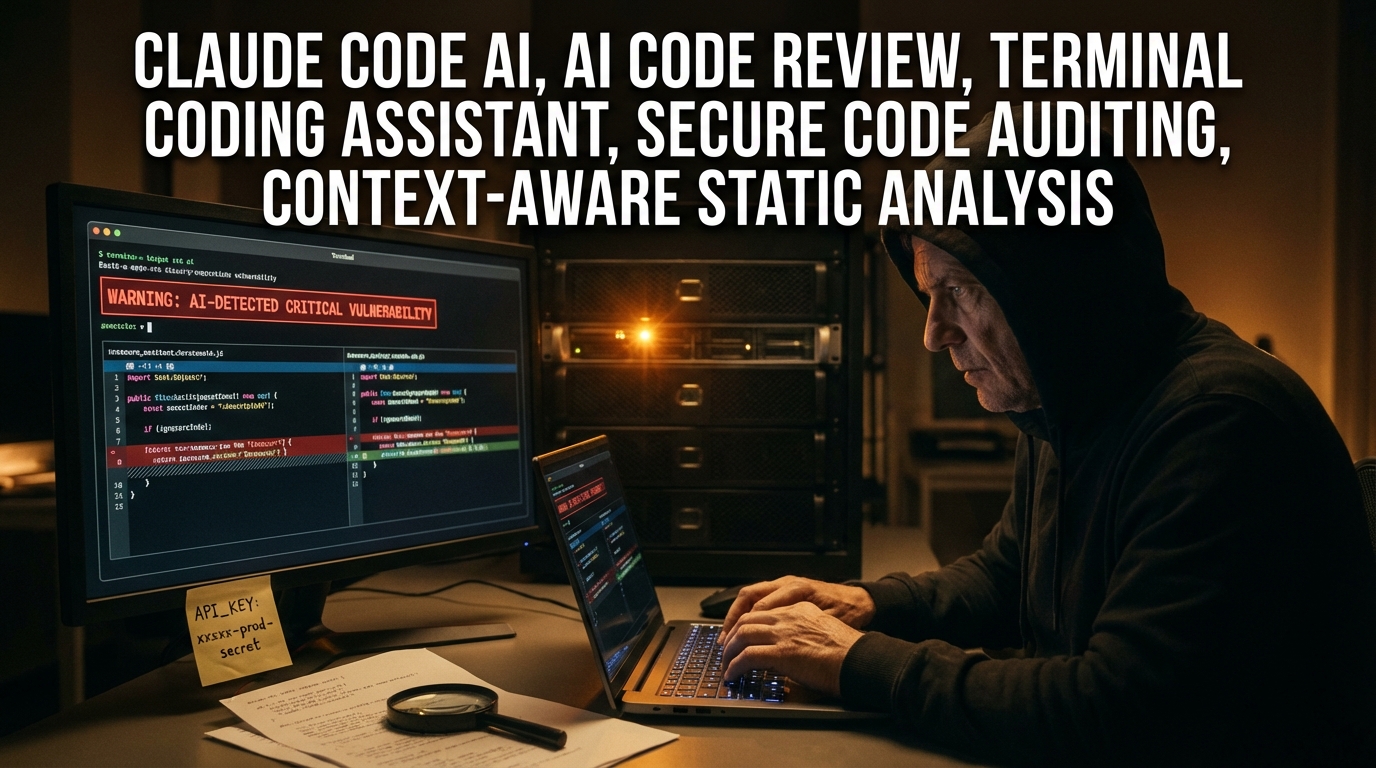
● Claude Code hijacks the terminal, savage AI code roast, security blunders exposed
If you are a developer or highly interested in IT trends, you absolutely cannot miss today’s story. It’s not just an AI that writes code; a “scary AI senior” has appeared to point out your coding habits and overhaul them.
Anthropic’s “Claude Code” is causing a stir among developers. I will neatly summarize why this is a significant event that will change the landscape of the generative AI market and what the core points are that the news hasn’t covered. After reading this, you will definitely get a sense of why “AI automation” has now moved beyond simple labor to the realm of “mentoring.”
[In-depth Analysis] “The Arrival of a Brutally Honest AI Mentor”… Claude Code Precisely Targets Developers’ Bad Habits
1. News Briefing: Escaping the Chat Window to Take Over the Developer’s Home Turf (Terminal)
How did we use ChatGPT or Claude until now? Open the website, copy the code, paste it, bring back the modified version… Honestly, it was annoying. But this newly released ‘Claude Code’ is different.
It operates directly in the Terminal (CLI) environment that developers stare at all day.
Recently, Tech Writer ‘Joe Njenga’ from Medium became a hot topic for his experiment entrusting his project to Claude. He asked Claude not for simple coding, but to “analyze my code, explain the architecture, and harshly criticize (Roast) my coding habits.”
The result? AI has transformed from a simple tool into a ‘code auditor’ that maximizes software engineering efficiency.
2. Fact Bomb: 3 Fatal Mistakes AI Found in You
Claude wasn’t just catching syntax errors. Like a senior developer with 10 years of experience crossing their arms and sighing behind your monitor, it pointed out problems very explicitly. There were largely three things.
① A Strong Warning on Security Insensitivity (Hardcoded Secrets)“You didn’t use an environment variable (.env) file and embedded the API key directly in the code? This is the worst for security.”
This is a mistake commonly made by beginners and even seniors when creating prototypes. Claude recognized this not as a simple warning but as a ‘priority task to fix immediately’.
② ‘Spaghetti Code’ and Modularization Failure“You shoved all the logic into a single main.py file. This is a violation of the Single Responsibility Principle (SRP). How do you intend to maintain this later?”
It started asking not if the code works, but ‘is it structurally healthy’. In the era of digital transformation, unmaintainable code is no different from bad debt.
③ Disappearance of Documentation“You wrote the code, but there are no comments or explanations? Will others or your future self know what this is?”
Many developers make the excuse that “code is documentation,” but Claude doesn’t let that slide. It forces the necessary requirements for collaboration.
3. [Core Insight] The ‘Real’ Core Point They Don’t Tell You Elsewhere
Okay, up to here is content you can know just by looking at the news. But in my view, the really important point is separate.
First, the combination of ‘Static Analysis’ and ‘Context Understanding’.Existing code analysis tools (Linters) only shouted “Rule violation!”. But Claude Code reads the entire project’s file structure and advises while understanding (Context Awareness) “why this module is connected to that module in this way.” This is not simple autocomplete, but the pinnacle of technology productivity trends that grasps the project’s ‘intent’.
Second, the trade-off between ‘Cost’ and ‘Depth’.Doing this analysis reads the whole project, so token consumption (cost) is significant. But compared to the labor cost of a human senior developer doing code review for 2 hours? It is overwhelmingly cheaper. In other words, for startups or junior developers without a mentor, a ‘highly skilled mentor for $20 a month’ has appeared.
Third, the immediacy of Actionable Insights.It doesn’t end with just pointing things out. If you say “Then you fix it” right in the terminal, it applies the refactored code immediately. It is the moment when the context switching cost between the web and IDE converges to ‘0’.
4. Conclusion: AI is No Longer a ‘Tool’ but a ‘Partner’
What this case implies is clear. AI has started to play the role of ‘eyes’ and ‘brain’ that evaluate human output and suggest improvement directions, rather than just ‘hands’ that do as humans order.
The expression “My coding habits got roasted” is funny, but it is also a painful reality. However, through this bitter advice, we can build more robust and secure software. The future development culture will likely make receiving a ‘spicy’ review from AI and going through a first round of corrections before getting reviewed by a colleague the New Normal.
< Summary >
- Background: Anthropic’s ‘Claude Code’ has moved beyond the web to directly infiltrate the developer terminal (CLI) environment.
- Function: Beyond simple code generation, it understands the entire project architecture and sharply criticizes and fixes the developer’s bad habits (security, structure, documentation).
- Differentiation: Unlike existing tools, it provides logical code reviews at the level of a human senior developer by grasping the ‘Context’.
- Outlook: The cost-efficiency is overwhelming, and receiving a primary review from AI will become the new standard way of working for developers.
[Related Posts…]
Claude 3.5 Sonnet and the Future of AI Coding
Anthropic’s Counterattack, Intensifying Competition in the Generative AI Market
*Source: https://medium.com/@joe.njenga/i-tested-claude-code-insights-it-roasted-my-coding-habits-e38c642e1642
Leave a Reply