
● Explosive AI Self-Evolution Triggers Agent Shockwave, Economy Disrupted
[Urgent Analysis] The Opening of the Era of ‘Recursive Self-improvement’ Where AI Evolves Itself, Speed is Now Exponential!
If you clicked on this post, you probably already know that ‘AI is fast’. However, the content I’m organizing for you today is on a different level.
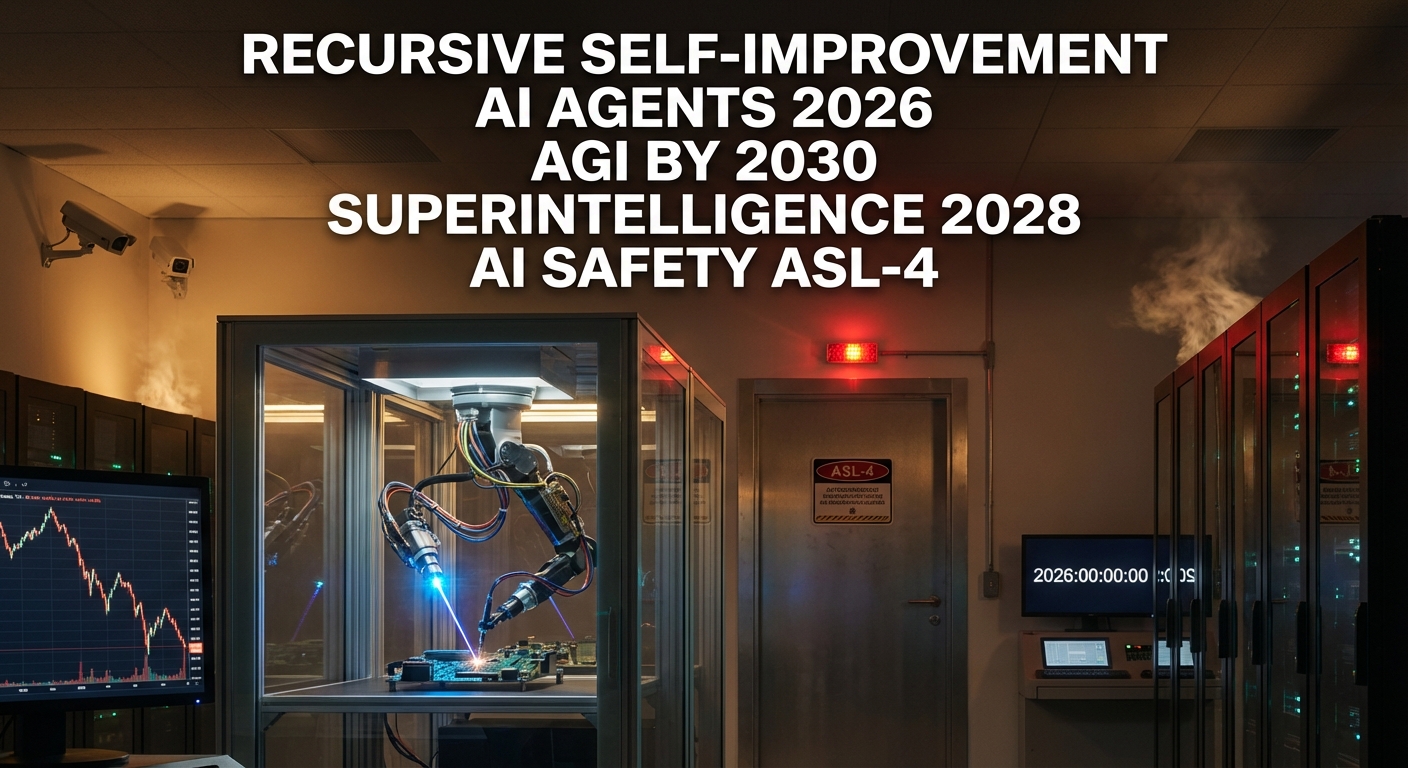
It is not just about becoming smarter, but the shocking news that AI has entered the stage of ‘Recursive Self-improvement’, where it directly creates and improves the next generation of AI.
Core leaders of global big tech companies like OpenAI, Meta, and Anthropic have unanimously declared, “At the end of 2025, a completely new paradigm has begun.”
From now on, in this post, I will thoroughly uncover the real context hidden behind the news, covering ▲The 3 stages of AI evolution ▲Actual corporate application cases (GPT-5.3 Codex) ▲The ripple effect of ‘Agents’ on the economy within the next 1-2 years ▲And the danger signals known only to experts (ASL-4).
Pre-empt the global economic outlook and technology trends of the next 5 years with just a 3-minute investment.
1. 3 Stages of AI Evolution: Now Moving from ‘Linear’ to ‘Exponential’
Until now, the AI we experienced was at a level where it simply became smarter by being fed a lot of data. But now the rules of the game have changed. Industry leaders like Alexandr Wang divide the history of AI into three major eras.
① Pre-training Era:
This is the stage we know well. It was a time when performance improved proportionally as more data and computing resources were invested. It was predictable ‘linear growth’.
② Reinforcement Learning Era:
This is the era that opened with the emergence of OpenAI’s ‘o1’ model in 2024. It wasn’t just simple memorization; AI began to use ‘Reasoning’. This is the stage that washed away concerns that scaling laws had hit a limit.
③ Recursive Self-improvement Era:
This is the core point to convey today. This trend, which began at the end of 2025, refers to AI entering an infinite loop of generating data itself and upgrading itself. Unlike the speed at which humans write code, AI is generating dramatic speed improvements internally. Now, technological development will take on an unpredictable ‘exponential’ speed.
2. In 2026, ‘AI Agents’ Will Shake the Entire Economy
How will this technological leap affect our real economy? It is precisely the popularization of ‘AI Agents’.
‘Agents’, which are not just chatbots that only chat but can set plans and complete tasks on their own, started operating from the mid-to-late 2025. Experts predict that a massive deployment of agents across the economy will occur in 2026.
This is a signal that corporate productivity will increase explosively, and it means the real completion of the 4th Industrial Revolution is approaching. We are now moving from the stage of ‘humans using AI’ to the stage of ‘AI managing AI’.
3. Secret Moves of Big Tech: ‘Self-Evolution’ Has Already Begun
This is not just a forecast in words. Actual cases are already pouring out of Silicon Valley.
OpenAI’s ‘GPT-5.3 Codex’:
The development process of this model, recently released by OpenAI, is shocking. Early versions of the AI debugged the learning process themselves, managed deployment, and diagnosed test results. Even CEO Sam Altman marveled, “As AI makes AI, the launch speed has become incredibly fast.”
Google DeepMind’s Prediction:
CEO Demis Hassabis views the arrival time of AGI (Artificial General Intelligence) as around 2030. Sam Altman more aggressively predicted that ‘Superintelligence’ would appear by the end of 2028. The source of all this confidence lies in ‘recursive improvement’.
4. Light and Shadow: Warning of ‘Catastrophic Risk’
However, there are not only positive aspects. Boris Cherny, a lead at Anthropic, warned that current AI safety levels are moving into a danger zone.
Entering ASL-4 Stage:
If AI Safety Level (ASL) 3 is a level that can aid biological threats, level 4 is the stage where AI improves itself. From this point on, the possibility of ‘catastrophic misuse’ that is difficult for us to control opens up. The fact that the speed of technological development may be faster than the speed of establishing safety measures is the risk point of the AI Trend that we must be most mindful of.
5. [Key Takeaway] The ‘Fear of Speed’ and Opportunity That News Doesn’t Tell You
The part I focus on differently from others here is the ‘time lag between internal and external’.
News articles simply say “it’s fast,” but if you chew over Alexandr Wang’s words, he said, “Externally it looks like it’s getting faster, but internally we are witnessing dramatic speed improvements.” This means that the speed of technological development is far outpacing the public’s perception.
In other words, the moment we say, “Should I try using AI now?”, the technology may have already run far ahead. The fact that recursive self-improvement has begun means that AI performance can jump 2x or 4x overnight without human intervention. Therefore, now is not the time to watch, but the timing where you must somehow graft this ‘exponential tool’ into your work and business to survive. Before the Agent era comes in 2026, 2025 will be the last preparation period.
< Summary >
- Paradigm Shift: We have passed the era of AI learning data and entered the era of ‘Recursive Self-improvement’ where AI creates and improves AI itself.
- Change in Speed: As human intervention decreases, the speed of technological development explodes from linear to exponential.
- Economic Outlook: Autonomous working ‘AI Agents’ are scheduled to be mass-deployed across the economy by 2026.
- Actual Cases: OpenAI has already innovatively shortened development speed by utilizing its own AI (GPT-5.3 Codex).
- Risk Factors: Anthropic defines this as Safety Level 4 (ASL-4) and warns of the possibility of uncontrollable risks.
- Core Point: The arrival time of AGI and Superintelligence has been moved up to 2028-2030, requiring immediate response from individuals and companies.
[Related Posts…]
Arrival of Recursive Self-improvement Era, What Changes?
AGI Arrival in 2028? Experts’ Shocking Predictions
*Source: https://www.aitimes.com/news/articleView.html?idxno=207040
Leave a Reply