
● AI-Fueled Market Shock
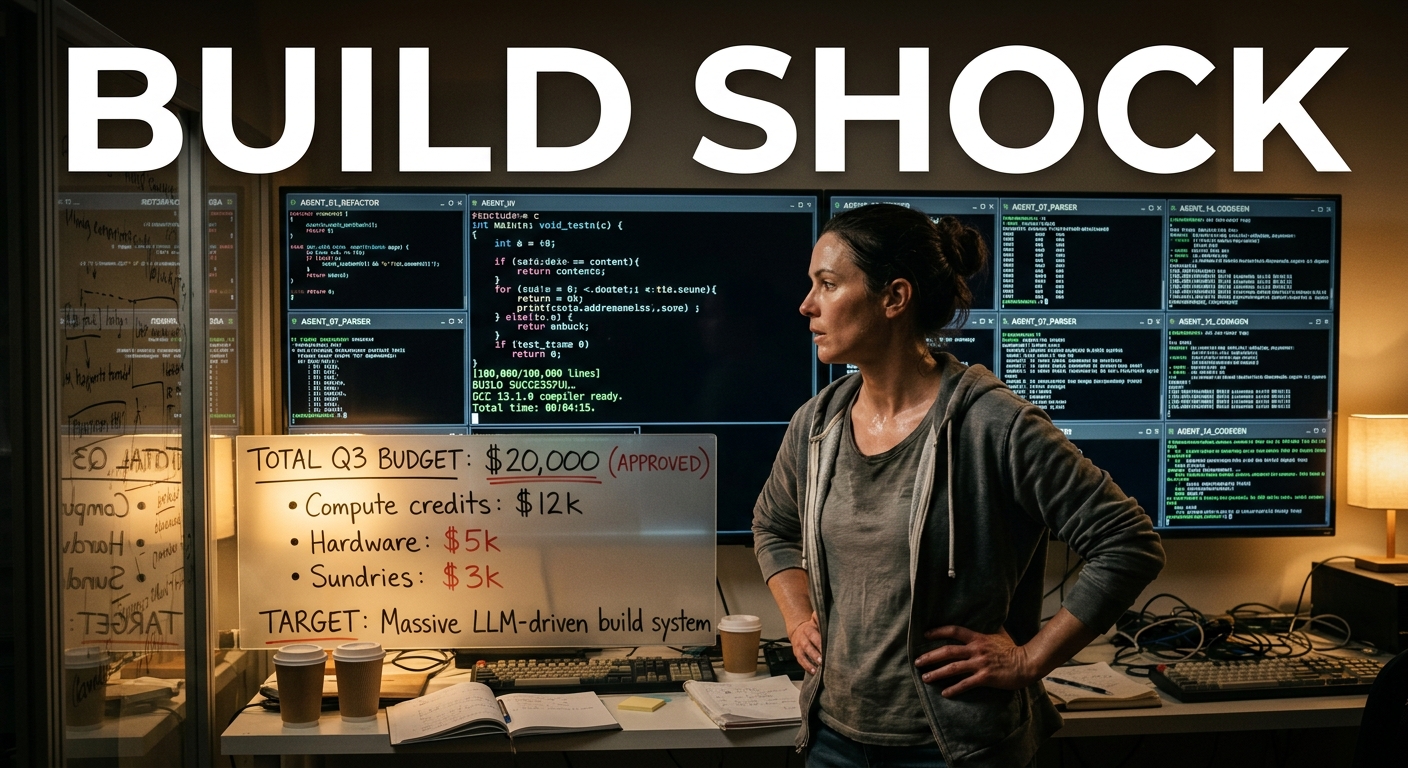
What we are covering today is not simple AI update news.It is a shocking event where a whopping 16 AIs formed a team and created a 100,000-line C compiler capable of compiling the Linux kernel for merely 20,000 dollars.By reading this single article to the end, you can take away all the true principles and limitations of the ‘Claude Agent Team’ that others do not know, as well as premium know-how you can use immediately in your field.In particular, I will exclusively reveal a perfect dissection from my perspective of ‘realistic practical tips to avoid cost bombs’ and ‘precautions for practical implementation,’ which other YouTube channels or news outlets only skim over.
The Era of AI Working Alone is Over: The Emergence of the Claude Code Agent Team
Evolution from Simple Assistants to a Perfect ‘AI Team’
Think about the way a team leader breaks down tasks and distributes them to team members, and the team members communicate with each other while working on a major project at a company.The ‘Agent Team’ feature unveiled by Anthropic alongside Opus 4.6 takes exactly this structure.It is an amazing method where a single Claude Code acts as the team lead, creates multiple independent Claude Code instances as teammates, and makes them work simultaneously.This is proof that the direction of digital transformation pursued by companies is now evolving beyond the introduction of a single tool into an organic collaboration system among AIs.
The Decisive Difference from Existing Sub-agents
The reason this is revolutionary is that it is on a completely different level from the sub-agents we previously knew.Past sub-agents were merely simple laborers where we could not intervene in the middle once the task started, and they only mechanically reported the results to the main AI.However, in the agent team, each teammate thinks and acts completely independently.Team members send and receive messages directly with each other and autonomously coordinate tasks while looking at a shared task list.Since we can also talk directly to the team member AIs to give additional instructions, a true ‘team’ that literally debates and collaborates with one another has been created.
Why Should We Be Enthusiastic About the Agent Team Now?
The Overwhelming Three Core Point Synergies
First, parallel code review becomes possible.You create separate AIs in charge of security, performance, and testing, and have them simultaneously review a single Pull Request.In fact, as a result of Anthropic testing with this structure, they found a whopping 84 percent of issues in over 1,000 lines of code and caught an average of 7.5 critical problems.
Second, a tremendous weapon called competitive hypothesis debugging is obtained.When a bug with an unknown cause occurs, you throw different hypotheses to five detectives (AIs) and make them disprove each other’s hypotheses.Through this process, you can prevent bias toward a single hypothesis and quickly find the most accurate cause.
Third, it is a productivity innovation through cross-layer development.Different AIs simultaneously work on the frontend, backend, and test code.When each task is finished, the team lead AI synchronizes the results into one and directs the next steps, so the development speed inevitably accelerates exponentially.
Unbelievable Practical Achievement: The Miracle of 20,000 Dollars
Nicholas Carlini’s C Compiler Project
It is not just plausible in theory.Nicholas Carlini, a researcher on the Anthropic security team, personally ran 16 Claude instances in parallel to create a Rust-based C compiler.It went through 2,000 sessions over about two weeks, and the cost involved was merely 20,000 dollars.Surprisingly, this compiler, written in 100,000 lines of code, succeeded in compiling the Linux 6.9 kernel on three completely different architectures: X86, ARM, and RISC-V.Passing the GCC torture test with a 99 percent rate is basic, and it perfectly runs the classic game Doom as well as compiling QEMU, FFMPEG, SQLite, and PostgreSQL.
Perfect Harmony Created by Role Distribution
The secret to the success of this project is that roles were strictly divided just like at a construction site.Just as a plumber, electrician, and carpenter each do their jobs, some AIs were dedicated to removing code duplication, some to performance optimization, and others to code review and document management.It showed the ultimate form of advanced AI automation, such as Claude resolving conflicts on its own during the synchronization process with Git.
🚨 [Core Point Analysis] Fatal Flaws and Realistic Limitations That Others Do Not Talk About
Blindly Introducing It Will Lead to Token Bankruptcy
Well, hearing up to this point, it feels like you should introduce it right away, but the reality is different.The most important fact overlooked by other media is precisely the issue of ‘cost’ and ‘overhead’.Since each teammate is an independent Claude instance, creating a team of four members basically quadruples the token consumption.On top of this, additional tokens are generated every time team members exchange messages, and broadcasting a general announcement can lead to a massive failure in cost optimization proportional to the team size.Even the official documentation warns that it uses significantly more tokens than a single session.
The Pitfall of Coordination and the Risk of File Conflicts
As the number of team members increases, the volume of communication grows, generating a coordination overhead where the costs outweigh the benefits.The officially recommended optimal team size is three to five members, and it is best to distribute five to six tasks per person.This means that three focused individuals are better than five distracted ones.Also, a catastrophe where code is overwritten can occur if two AIs modify the same file at the same time, so you must physically separate the assigned files.The fact that session restoration is not yet possible because it is still an experimental feature, and that replacing the team lead or forming nested teams is impossible, are also limitations that practitioners must be aware of.
A Field-Oriented Guide to Smartly Utilizing It at 200%
The Five Principles of AI Team Setup Without Failure
Then, how should we utilize this double-edged sword for work process optimization?First, rather than writing code, start with ‘reading-centric’ research and review tasks like Pull Request reviews, library investigations, and bug hunting.Second, when writing a prompt, simply saying “Do it as a team” might make it fall into a sub-agent structure, so specifically instruct, “Plan which tasks to do in parallel and how to configure the teammates,” and attach the link to the official documentation.Third, since team settings are stored locally, be sure to clearly specify a ‘team name’ and set it up so that it can be reused later.Fourth, require a ‘plan approval’ step without fail to prevent the AI from immediately jumping into the task, thereby blocking the waste of precious tokens in the wrong direction.Fifth, automate a ‘Hook quality gate’ so that a verification script automatically runs every time a teammate finishes a task, relieving humans of the effort to manually check each one.
< Summary >
- Core Point Concept: The Claude Code agent team is not merely laborers (sub-agents) receiving simple instructions, but a true AI team where independent instances communicate and collaborate with each other.
- Practical Achievement: Sixteen AIs developed a high-performance 100,000-line C compiler (at the level of compiling the Linux kernel) with just 20,000 dollars in cost and two weeks of time through role distribution.
- Major Advantages: It guarantees overwhelming task speed and quality through parallel code review, competitive hypothesis debugging, and cross-layer development.
- Precautions (Important): Token costs increase exponentially in proportion to the number of team members, and there is a risk of file conflicts and coordination overhead.
- Practical Tips: Start with reading-centric tasks (review/research) with a small team of three to five members, and you must go through clear prompt writing and a ‘plan approval’ step to prevent token waste.
[Recommended Related Articles]A Perfect Guide to the Practical Construction Process of an Agent TeamThe Impact of the Claude 4.6 Update on Corporate Work
*Source: Claudical
Leave a Reply