

● AI-Driven Productivity Boom
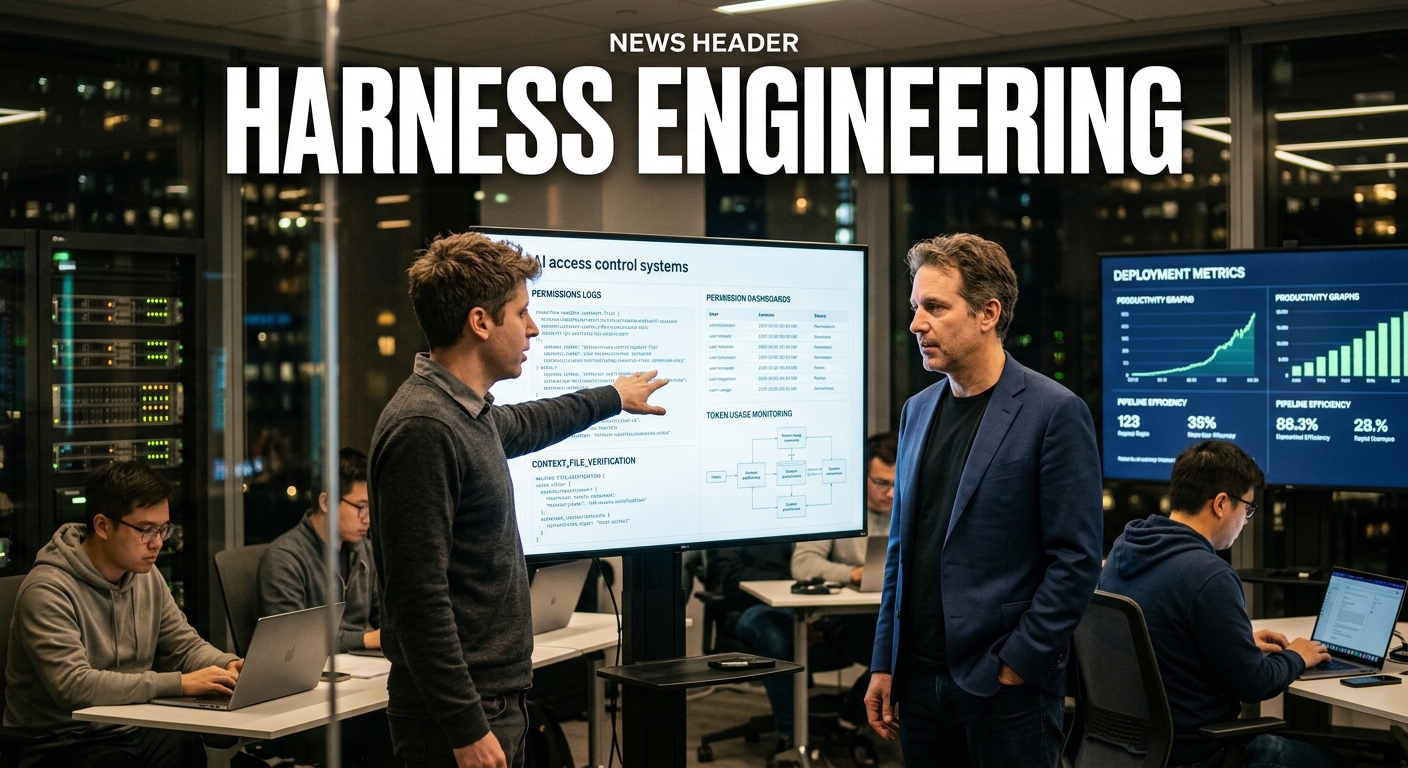
Did you know that just three OpenAI engineers deployed a large-scale product in five months without writing a single line of code themselves?
In this article, we uncover the true secrets of Harness Engineering, which other news and YouTube channels only cover superficially.It contains everything from why AI keeps repeating bizarre mistakes no matter how carefully you write prompts, to powerful system design methods that fundamentally block those mistakes themselves.Going beyond simple knowledge delivery, check out the most important insights right now to survive as an architect who sets the stage rather than a replaced worker in the coming era.
Why Existing Methods, Prompt and Context Engineering, Hit a Limit
Looking at recent global AI trends, the speed of technological advancement is truly terrifying.Until now, we have focused on prompt engineering, which is communicating well with AI by saying things like, “Make me a scientific calculator.”However, there is a clear ceiling to prompts.This is because if the AI does not know our company’s project tech stack or database structure, good results can never be produced.That is exactly why context engineering emerged.It is a technology that selects and provides the AI with exactly the necessary information right now, such as project structure, existing code, and API documentation.However, there is a fatal problem that cannot be solved no matter how well the information is provided.This is because problems of rules and control, rather than information, arise, such as the AI suddenly changing the database schema at will or exposing credit card numbers in the logs while building a payment system.
[Exclusive Core Point Summary] The True Philosophy of Harness Engineering Not Spoken Elsewhere
YouTube and the news usually only talk about what tools to give the AI, but the most important essence lies elsewhere.Imagine an AI agent as a massive horse with tremendous power.This horse can plow fields and carry heavy loads, but without a harness, it will run away into the forest and destroy all the fences.Here, if the technology to train the horse is Agentic Engineering, then the technology to make the reins and carts so the horse does not go to the wrong places is exactly Harness Engineering.The most important philosophy we must never forget is this.”When the AI breaks a rule, do not fix the prompt; instead, fix the harness so that the failure is structurally impossible to repeat.”Shouting “Do not cross!” when the horse tries to jump the fence is merely a request.Instead, making the fence higher and stronger so that it is physically impossible to cross at all, this is the true core point of business automation and the essence of Harness Engineering.
The 4 Core Point Pillars Supporting Harness Engineering
The harness is concretely completed with the following four systemic components.
1. Machine-Readable Context FilesThis refers not to Notion documents read by humans, but to runtime configuration files like clude.md or agents.md that the AI reads and executes first when starting a task.If you embed rules like “Do not introduce new libraries” into the file, they are automatically applied as behavioral constraints for the AI without needing to write them repeatedly in the prompt every time.
2. Automated Enforcement of Rules by the SystemWriting them in a document does not mean the AI will listen one hundred percent.Therefore, through linters that check code syntax, structural tests, and pre-commit hooks, the system automatically runs checks before saving the code.Just like a sterilizer turning on automatically when a chef draws a knife, rules are embedded into the system itself, which is the core point of the Fourth Industrial Revolution.If the AI makes an error, an automated correction loop operates where the system spits out an error message and the AI fixes the code itself without our need to intervene.
3. Boundary Setting for Tool AccessIt sets up physical barriers so that the AI cannot touch dangerous tools in the first place.It restricts permissions, such as saying “This folder is read-only” or “Database deletion commands are absolutely impossible.”Unlike making requests through prompts, systemic constraints become physical boundaries that the AI can never break.
4. AI Code Garbage CollectionOver time, code quality can degrade as the AI learns and replicates existing bad code patterns.Therefore, a cleaning system is needed to periodically inspect the code created by the AI and automatically remove duplicate or unused dead code.Every time the AI makes a mistake, that mistake is added as a new test rule, making the system increasingly robust over time.
How Does the Actual System Interlock and Operate? (Operating Mechanism)
These four pillars operate in the following flow in a real software development environment.First, a router analyzes the user’s request and filters out tasks going in the wrong direction in advance.Second, a context manager smartly provides information only for the area that needs to be plowed right now, rather than the entire field.Third, an execution loop operates where tests are automatically run when the AI writes code, and upon failure, it goes through a feedback loop to correct it itself.Fourth, worker isolation, which completely separates the AI writing the code from the AI reviewing it, maximizes the quality of the output.It is a perfect structure where the AI corrects errors itself even before the user checks the results.
How Will Our Roles Change?
The reason the three OpenAI engineers mentioned earlier built a product without writing code is precisely because they designed this entire harness system.Just because AI is replacing coding does not mean our roles disappear.Rather, we are evolving into higher-level beings who take on judgment and responsibility, leading the productivity innovation of enterprises.If in the past we were players kicking the ball directly, we are now moving upwards to become managers who strategize and run the team.As the saying goes, “Humans steer, and agents execute,” only those who control and design the system will survive in the coming era.
< Summary >
- Existing prompt and context engineering has the limitation of being unable to control AI mistakes.
- Harness Engineering is the technology of designing reins and fences to prevent the AI from doing the wrong things.
- The core point is not to change instructions when mistakes are made, but to fix the system to prevent mistakes from structurally repeating.
- It operates on the four pillars of machine configuration files, automated system enforcement, access permission restriction, and automatic garbage collection.
- Human roles evolve upwards from simple coders or executors to system supervisors who design safe environments for the AI to play in.
[Related Articles…]Perfect System Control Methods for the AI Era Completed by Harness EngineeringCore Point Workflow Design Know-How to Make Agent AI Work on Its Own
*Source: 실밸개발자
Leave a Reply