
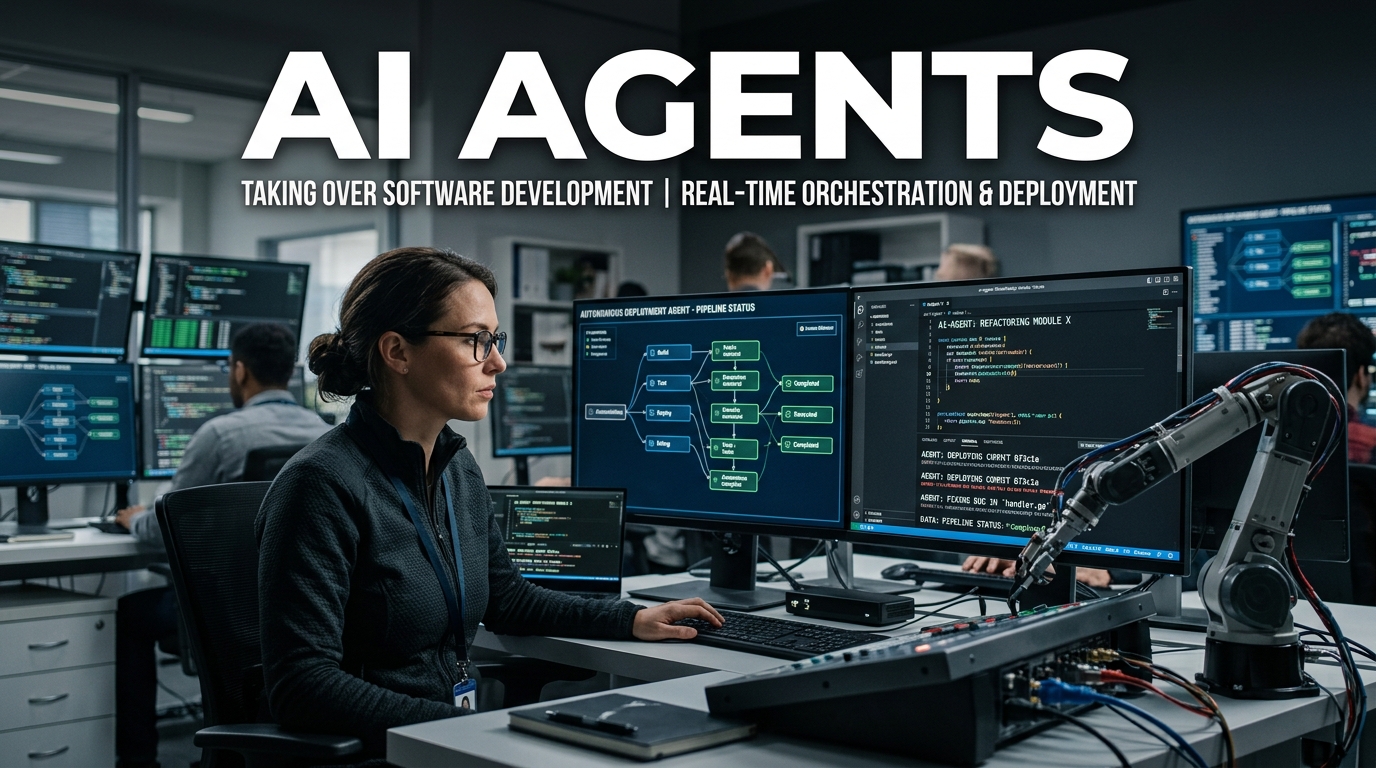
● Agent-Driven Software Revolution
If you still think of AI as merely an ‘autocomplete tool’, today’s article will completely overturn your perspective on business and your career.
The latest artificial intelligence trend we are facing right now has moved far beyond the level of simply writing code quickly.
The content I am summarizing for you today includes ‘the shocking scene of AI agents holding meetings and fixing code on their own (Gas Town)’, ‘an innovative tool that prevents AI memory loss (Beads)’, and ‘the only formula for software companies to survive in the AI era’.
In particular, ‘the real survival rules of the AI era that others will never tell you’, summarized in the latter half of the article, is a key takeaway you must know no matter what business you plan in the future, so absolutely do not miss it.
Now, let’s easily and thoroughly dig into the chilling changes that Steve Yegge, a legendary software engineer with 40 years of experience, is directly experiencing in the field, in the format of a news briefing.
1. The Evolution of AI Coding: A World Where We Went from Walking to Riding Hoverbikes
Steve Yegge instinctively knew that the future of coding had already changed the moment ChatGPT 3.5 was released.
While others complained, saying “Code written by AI still has too many errors to be used,” he compared it to the ‘hoverbike’ in the Zelda game.
He realized that even if the battery runs out quickly and you crash at first, it is overwhelmingly faster than walking.
And with the emergence of GPT-4.0 and Claude Opus 4.5, it has reached a level where flawless modifications are possible while maintaining the original text even in code exceeding 1,000 lines.
This means that beyond the simple advancement of tools, a massive productivity innovation has occurred in the very act of coding itself.
Now is the time to face the uncomfortable truth that a developer writing code manually by hand has become the epitome of inefficiency.
2. Beads: Implanting ‘Perfect Memory’ in AI Agents
Those who have assigned tasks to AI will know that once a new chat window opens, it completely forgets the previous context.
The very thing born to solve this problem is a dedicated AI to-do management tool called ‘Beads’.
Beads is on a completely different level from the standard to-do lists we use.
It connects the priority and causality of tasks (you must do A to do B) as a graph, and it is built on an SQL foundation, which AI handles best.
Above all, it sits on top of Git (a version control system), so the work history never disappears.
When the AI discovers a problem during work, it does not ignore it but creates a Bead (a task) on its own to leave a record.
This becomes the most powerful framework for building a perfect business automation system.
3. Gas Town: A Self-Running Factory Where AI Agents Live Together
As trust in AI builds, we naturally come to think, “Then how about running multiple AIs at the same time?”
Originating from this idea, ‘Gas Town’ is a tool that operates and manages multiple AI agents as if they were a single team.
What is interesting is that when AI was given an inbox and titles like ‘Mayor’ and ‘Subordinate Agent’, they actually started exchanging emails with each other and distributing work.
There was even an incident where, upon waking up, the agents had flawlessly fixed 30 bugs on their own.
Gas Town even demonstrated a shocking evolution of ‘building itself’ as the AI wrote the very system code that runs it.
The emergence of a system where AIs collaborate with each other without human intervention is a massive paradigm shift that will completely upend future global economic prospects.
4. A World That Ends If You Fall 2 Hours Behind: The Demise of Traditional Planning
The speed at which 20 AI agents write code simultaneously is beyond human imagination.
A war of speed is unfolding where, even if you do not communicate with team members for just 2 hours, the system architecture changes 6 times in the meantime.
In other words, this means that the traditional method of writing pretty proposal documents and getting approvals like in the past is completely over.
The era of real-time development has arrived, where the software itself is both the planning document and the prototype.
Ultimately, in the flow of this massive Fourth Industrial Revolution, only those who collaborate with AI to make rapid attempts and produce results, rather than relying on perfect plans, will survive.
🚨 The Most Important Key Takeaway Insight That YouTube and News Never Tell You
Based on everything so far, I will reinterpret the ‘true meaning’ of this phenomenon for you, the readers.
Other media outlets focus solely on “AI does all the coding, developers are in big trouble.”
However, the most chilling business survival formula hidden in Steve Yegge’s interview is the fact that “the main subject of consumption has shifted from humans to AI.”
The software or services that survive in the future will not be products with pretty UI/UX.
Only ‘AI-friendly infrastructure’ that is easy for AI to access and saves the costs (tokens and energy) incurred when AI computes will survive.
Just like how Notion secretly optimized itself so that AI could easily read its data.
If you are planning a new business or app, you must move beyond “Is it easy for a person to use?” and consider “Is it easy for an AI agent to take and use this service?” as your top priority.
In an extreme scenario, two years from now, only one AI app might remain on a person’s smartphone, and all other services could be reduced to subcontractors that the AI secretly accesses behind the scenes to extract data.
Preemptively securing this ‘energy efficiency’ and ‘AI-friendly B2B (Business to Bot) model’ is the key takeaway to future wealth.
< Summary >
- The Tipping Point of AI Coding: Moving beyond simple autocomplete, we have entered a stage where agents understand code on their own and flawlessly modify thousands of lines of code.
- The Emergence of Beads: A ‘perfect memory system for AI’ has been commercialized, allowing AI to retain past memories, break down and connect tasks, and solve problems on its own.
- The Shock of Gas Town: When multiple AIs were given roles and inboxes, a ‘self-evolving factory’ was born that distributes work on its own and even codes itself.
- The Demise of Planning: Development speed has become so fast that document planning has become meaningless, and only organizations that create code in real-time while adjusting direction will survive.
- Core Point Survival Formula: The consumer of the future is not human but AI, and only services that save AI’s computation costs (energy efficiency) and help AI easily extract data will be able to survive.
[Related Articles…]
The Business Automation Secret to Running AI Agents with Notion Without a Single Line of Code
The Story of a Planner Who Succeeded in 100% Automating Daily Work with Claude Code
*Source: https://maily.so/josh/posts/w6ovpjwpok5?from=email#comments
Leave a Reply