
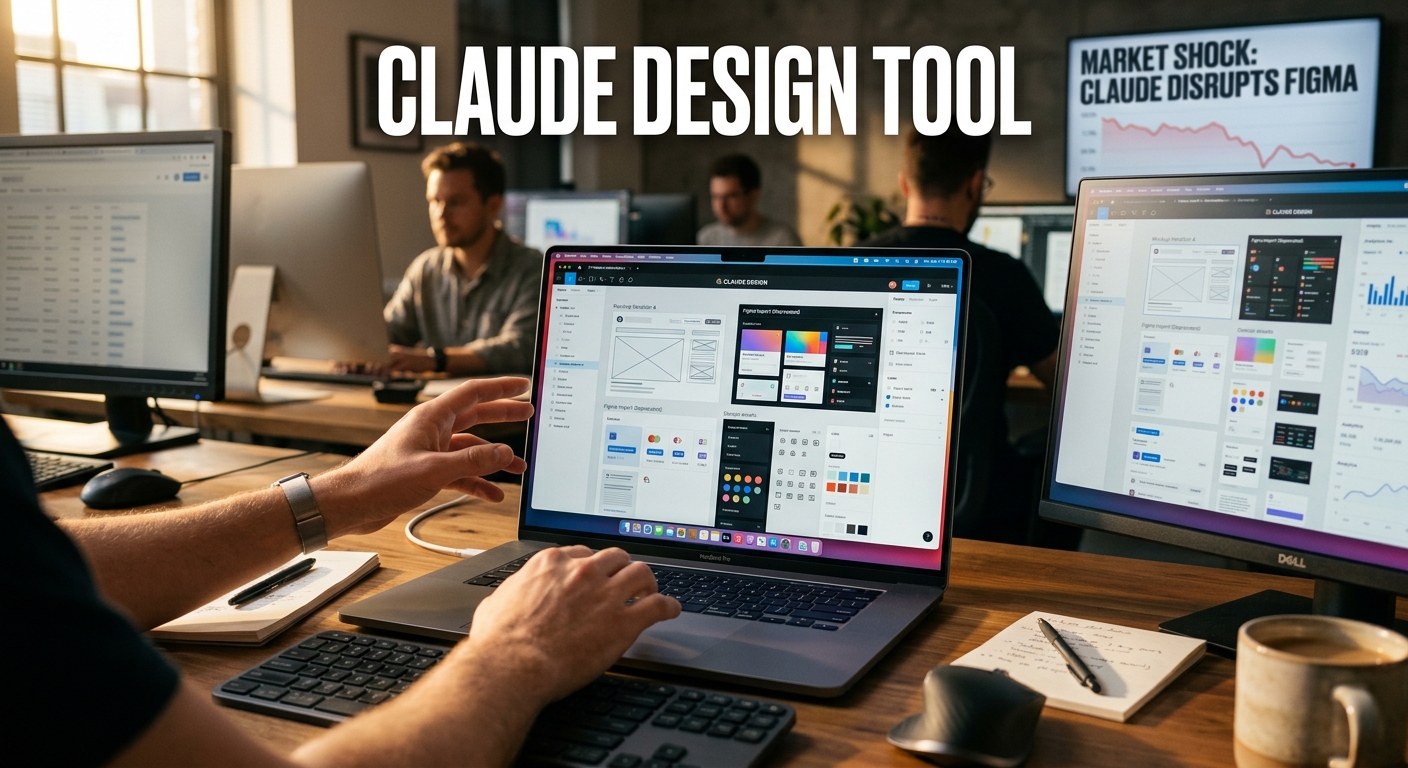
● Figma Crash
I will get straight to the point.
The reason you absolutely must not miss this article today is that it contains a massive shift that will completely transform the way we work, rather than just news of a simple new design tool launch.
From the real reason Figma’s stock plummeted right after the announcement, to the secret of how even non-designers can seamlessly churn out perfect prototypes using only text, and Anthropic’s ‘hidden big picture’ that other news absolutely ignores, I will systematically break everything down for you.
By reading this single article to the end, you will surely gain the definitive insight to stay ahead of global trends.
1. News Briefing: Anthropic’s Masterpiece, ‘Claude Design’ Unveiled
The Beginning of Magic Where Text Becomes Design
On April 17, 2026, Anthropic unveiled ‘Claude Design’, a collaborative design tool specialized in creating visual assets, to the world.
Powered by the latest vision model, Claude Opus 4.7, this tool whips up everything from design drafts to prototypes and slides when a user simply describes it in text.
Going beyond simple image generation, it provides a flawless workflow that connects ideas to actual, implementable results through advanced artificial intelligence technology.
Currently, it is being gradually rolled out in the form of a research preview to Claude Pro, Max, Team, and Enterprise subscribers.
2. Core Point Feature Analysis: What Changes and How?
Automatic Construction of Team-Customized Brand Systems
The most surprising aspect is that during the onboarding process, Claude autonomously reads the team’s existing codebase and design files.
Through this, it grasps the organization’s unique colors, typography, and components to automatically build a consistent design system.
In essence, it instantly resolves the issue of design inconsistency across departments, which has always been a headache during the digital transformation process of large enterprises.
Free Input and Granular Control
You don’t just input simple text prompts.
Not only can you upload documents like images, DOCX, PPTX, and XLSX, but you can also bring in actual website elements exactly as they are through a web capture tool to work on them.
When modifications are needed, you can leave inline comments on specific elements or move custom sliders to meticulously adjust spacing and colors.
Powerful Exporting and the Evolution of Collaboration
Once the design is finished, it can be instantly exported to an internal organizational URL, Canva, PDF, PPTX, or even a standalone HTML file.
In particular, the completed result can be packaged as a ‘Claude Code handoff bundle’ and passed directly to developers, realizing groundbreaking workflow automation.
The fact that a draft created in Claude can be handed over to Canva for perfect subsequent editing through a partnership with Canva is also a tremendous appeal for practitioners.
3. 💡 Exclusive Insight: The Real Key Takeaway No One Else Mentions
Figma Stock Price Plummet and the Massive Turf War
You shouldn’t just view this news and brush it off as “A good tool came out,” but you must pay attention to the fact that the landscape of the IT market is shifting.
The reason Figma’s stock price dropped right after the announcement is that Claude Design directly targeted the market share of non-designers, such as founders, PMs, and marketers, rather than designers.
Considering that a significant portion of Figma’s or Adobe’s paid accounts previously belonged to general job roles for simple viewing or light modifications, the blow is bound to be severe.
You must not overlook the fact that Mike Krieger, the former CPO of Anthropic, suddenly stepping down from Figma’s board of directors was also precisely because he foresaw this massive platform ecosystem collision.
Agent Orchestration That Shares ‘Context’ Rather Than Results
Anthropic is not just selling a design tool right now simply to make money.
Claude Code, business Chat, and now this Design all share one large brain, the Claude model.
This is a terrifying blueprint to build ‘agent orchestration,’ the ultimate finalized form of productivity enhancement where AI autonomously coordinates the entire process of software creation from planning to design and development in the future.
Ultimately, in the future, it will not be humans connecting tools to tools, but a single AI model that will dominate the entire workflow.
4. Field Reactions: Mixed Perspectives of Practitioners (Global Developer Community Summary)
Cheering Non-Designers and Enterprises
There is an overwhelming response that it is literally a gift from God for creating internal enterprise tools that require a predictable and consistent UI rather than complex artistic designs.
This is because the feedback loop, which previously took weeks from writing a brief to mock-up reviews, is now completed in just a few minutes within a single chat window.
Its practical value is already being proven, with complex animation pages that required dozens of prompts in other tools being reproduced with just 2 prompts.
Bitter Remarks from Concerned Experts
On the other hand, there is also sharp criticism that relying solely on generative tools will lead to a failure in understanding the essence of the problem (UX) and merely being trapped within the pretty templates provided by the tool.
Practical complaints are also emerging that token consumption is excessively high and detailed logo work is still terrible.
Above all, there is a bitter critique that websites will devolve into standardized designs all utilizing similar glass effects and drop shadows.
< Summary >
• Claude Design Launch: A collaborative tool based on Claude 4.7 vision that creates designs, prototypes, and slides with just text.
• Main Features: Automatically learns the organization’s existing design system, supports various inputs including web captures, and instantly connects to Canva and development code (Claude Code).
• Market Impact: Increases design accessibility for non-designers (PMs, marketers, etc.), shaking up the stock prices of existing design tools like Figma.
• Hidden Meaning: Anthropic is building a massive AI workflow ecosystem that ties planning, design, and development together, moving beyond a simple tool.
[Recommended Related Articles]
▶ The Crisis of Figma and Future Strategies for Design Platforms in the AI Era
▶ Claude Code and Agent-Based Development Workflow Innovation
*Source: https://news.hada.io/topic?id=28640
Leave a Reply