
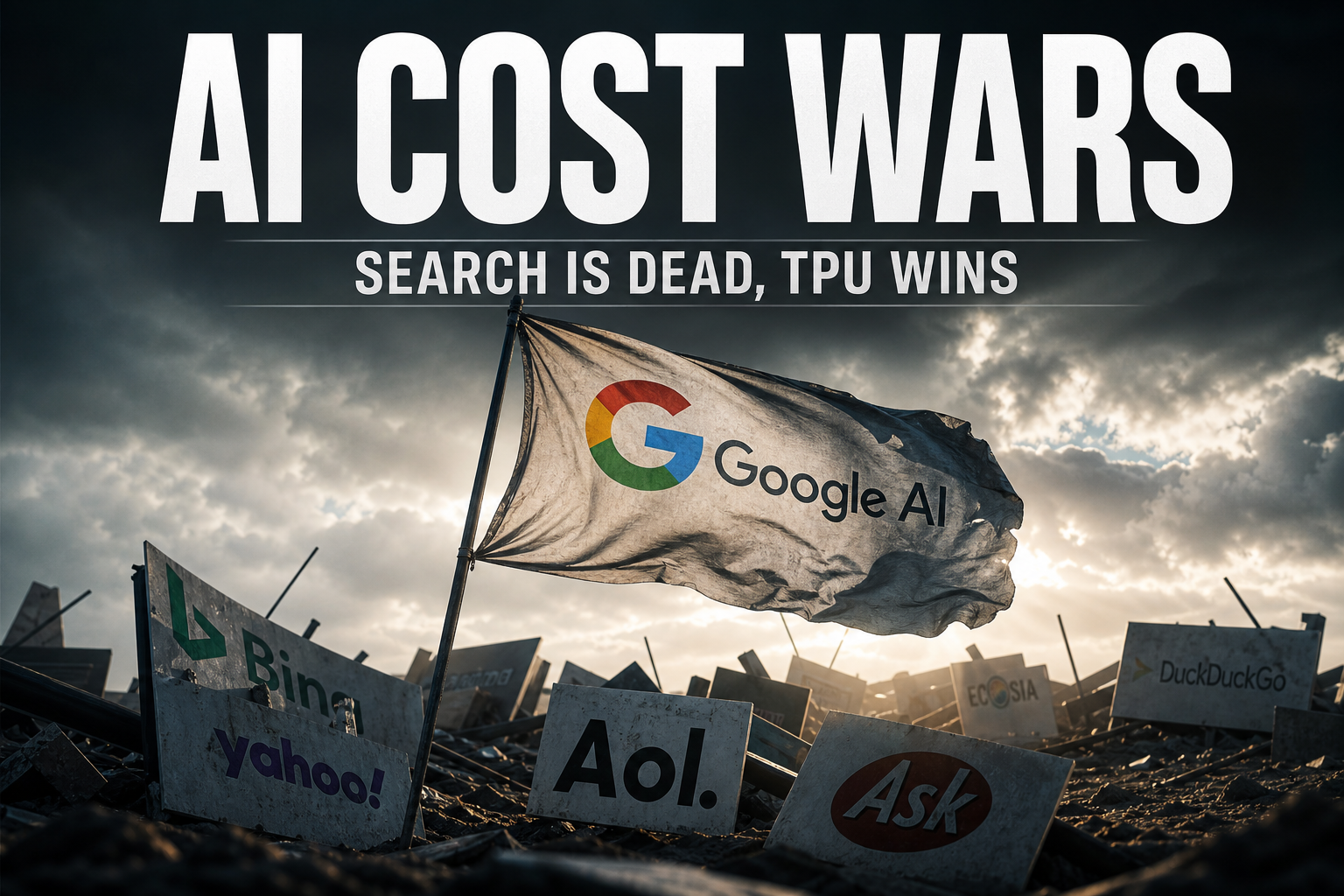
● Googles AI Cost Wars
Google I/O 2026 Key Takeaways: From TPU to AI Services, Platform Dominance, and a Global Read on Economic and AI Trends
This year’s Google I/O 2026 keynote was not just a product launch.
The core point was that the winner in the AI agent era is not “model performance,” but “inference costs and infrastructure control,” and Google made that extremely clear.
In particular, the vertical integration strategy that bundles TPU, cloud, search, YouTube, and Workspace together is now in full swing,
and the message that enterprise AI demand surging could translate into real revenue opportunities also came through strongly.
Below, I’ll organize this in a news-style format covering AI agents, generative AI, semiconductor investment, global tech stocks, and cloud competition.
1. News in One Line: Google Is No Longer a “Search Company” but an “AI Operating System Company”
The biggest change in this keynote was Google redefining itself not as a simple search engine, but as a platform that supplies the entire environment where AI works, makes decisions, and acts.
In the past, the competition centered on “who has the smarter AI model,”
but now the key is “who can make inference cheaper, longer, and at scale.”
Google is very advantaged in this area.
That’s because it has its own chip, TPU,
can directly optimize the models and services running on it,
and already has dense user touchpoints across Search, YouTube, Chrome, Workspace, and Cloud.
In other words, Google is moving from being a company that “sells” AI models,
to a company that controls the very “platform” on which AI actually runs.
2. The Most Important Number: AI Demand Has Already Exploded, and Now It’s a Cost War
What stood out most in this announcement was that AI usage has already exploded beyond imagination.
Annual token usage has surged,
and the message that more than 375 customers used over 1 trillion tokens in the past 12 months means that AI has now become a large-scale infrastructure industry.
This means companies are no longer at the stage of asking, “Should we try AI?”
They are now asking, “How do we operate AI at scale in a cost-efficient way?”
That connects directly to SEO keywords often mentioned such as cloud computing, semiconductor investment, AI infrastructure, generative AI, and tech stock outlook.
What Google emphasized was not just performance,
but how to change the structure where running AI continually costs money.
3. TPU 8th Generation and KPEX: Google’s Real Weapon Is Its Own Semiconductors
The hidden star of this announcement was actually TPU.
As AI demand rises, Google is reducing dependence on external chips
and continuing to advance its in-house TPU design.
In particular, TPU 8th Generation separates training and inference for optimization,
showing a structure that efficiently handles learning and inference separately.
Why does this matter?
Because the essence of the AI era is not “building it well once,” but “running it cheaply over and over.”
Google showed that capital expenditures, which were around $31 billion in 2022, are expected to reach as much as $190 billion this year.
This figure should not be seen as just an increase in investment,
but as the combined total of data center investment, semiconductor competition, and cloud expansion needed to secure AI infrastructure.
In short, Google is completing vertical integration from chips to services
and proving it has the strength to support AI agents at massive scale.
4. Gemini 3.5 Flash: The Era of “Most Efficient Model,” Not “Most Expensive Model”
One very important message in the keynote was Gemini 3.5 Flash.
This model is not just a fast model,
but is designed to handle repetitive tasks and long-horizon reasoning needed in the agent era at much lower cost.
In search, coding, testing, monitoring, and repeated execution,
cost efficiency is key because these tasks continuously consume tokens.
Google suggested that for some companies, shifting 80% of total workloads to 3.5 Flash could create annual savings of $1 billion.
That is a huge implication.
Going forward, companies are likely to stop applying top-performance models universally to every task.
Most work will probably be handled by cost-efficient models,
while only truly important tasks will be routed to high-performance models in a hybrid AI operations approach.
5. Antigravity and Developer Workflows: In AI Coding Too, “Operating Cost” Matters More Than Speed
Google also optimized Gemini 3.5 Flash for Antigravity, its developer workflow.
This was not just about API calls,
but about reducing token usage,
improving task success rates,
and lowering latency across the actual workflow developers use.
In particular, Google emphasized that the optimized version in Antigravity is up to 12 times faster than other frontier models.
This matters for developer productivity, of course,
but for enterprises, it more importantly means reducing the total cost of AI coding and automation.
Ultimately, Google did not just build a “developer tool,”
it built a “development environment for operating AI agents at scale.”
6. Google Search’s Major Shift: Search Is Now About “Delegation,” Not Just “Finding”
The most symbolic change in this announcement was Google Search.
Google defined AI Mode as the biggest change in search.
The search box is no longer a place where you enter keywords and choose links.
Now, it is a space where you describe your goal,
and AI organizes, compares, recommends, and in some cases even executes in the background.
In particular, the concept of information agents is powerful.
For real estate listings, product drops, price changes, or updates on specific topics,
AI can monitor things 24/7 in the background and notify you,
without the user having to keep searching directly.
This is not just a convenience feature,
but a change that redefines the search industry itself.
We are moving from an era where search results end as a list of links,
to an era where search connects to UI and actions tailored to the user’s goal.
7. The Growth of AI Overviews and AI Mode: Google Search Has Actually Become Stronger
At one point, there were major concerns that AI would cannibalize search.
But Google’s actual data points in the opposite direction.
AI Overviews surpassed 2.5 billion monthly active users,
and AI Mode surpassed 1.5 billion monthly active users within a year of launch.
This is a very important point.
It means AI is not replacing search,
but increasing search usage overall.
In other words, Google is not building a structure where AI weakens search advertising,
but one where AI expands the search ecosystem even further.
This is likely to have a major impact on the global advertising market, digital marketing, search traffic, and SEO strategy.
8. Gemini App and Spark: Evolving from Personal Assistant to Action Agent
The Gemini app is also undergoing a major transformation.
It is no longer just a chatbot that answers questions,
but becoming a personal agent that synthesizes email, calendar, documents, and conversational context to suggest next actions.
Google’s emphasis on personal intelligence is quite important.
If the same question is answered based on my calendar, my email, my schedule, and my habits,
then it is no longer a general chatbot, but something much closer to a real work assistant.
In particular, the Daily Brief goes beyond simple summaries
and evolves into something that organizes what you need to do today and what should be prioritized first.
And Gemini Spark takes on the character of a personal agent running in the background 24/7.
In the future, it could expand into MCP, email, and chat integrations,
making the competitive landscape in the agent market even hotter.
9. Chrome Becomes the Execution Space for Agents: The Browser’s Role Is Changing
The fact that Gemini Spark is integrated with Chrome is also very important.
The browser is no longer just a tool for viewing the web,
but is becoming the execution environment where AI agents actually do work.
This will have a major impact on the web ecosystem going forward.
That’s because browser share, search share, web automation, personal productivity tools, and enterprise SaaS competition could all change.
For Google, Chrome is the strongest entry point in the AI era.
It can capture the user touchpoint through search and the browser,
then layer Gemini on top to naturally expand the agent experience.
10. Gemini 2.0 Visual and Omniverse: Generative AI Moves Into a Multimodal Editing Engine
Google also showed a clear direction in the creative field.
The workflow is one that bundles image, video, music, editing, and remixing into a single flow of generative AI.
It is no longer just about “creating once.”
The workflow is shifting toward a structure where you converse, edit, recreate, and stitch content together repeatedly.
Gemini Omniverse is less a tool that ends with a single prompt,
and more like a multimodal editing engine that accepts voice, text, and control inputs to produce video.
This trend could broadly affect content creation, advertising, education, media, short-form content, and commerce video production.
In particular, if AI lowers the cost of video production and editing, which used to be expensive,
the barrier to content production could fall dramatically.
11. AI Glasses and XR: The Next Battleground for Hardware Is “Eyes and Ears”
Google also showcased AI glasses and XR.
The products launching later this year are likely to begin with audio-first experiences,
and the highlights included collaboration with Samsung, Google Android XR, and partnerships with brands like Gentle Monster and Warby Parker.
The key point is not the hardware itself,
but how naturally AI can operate in everyday life.
If you combine camera, voice, notifications, and watch integration,
AI can understand and respond to the user’s surroundings without needing to pull out a phone.
This could reshape competition in the wearable market and smart device market going forward.
12. AI Ultra and Pricing Strategy: Google Is Now Betting on Mass Adoption Too
The move to lower the AI Ultra plan into the $100 range is also notable.
This can be interpreted as a strategy to attract more users by lowering the barrier to entry
from what was originally a high-priced premium-only structure.
This is not just a discount policy.
It signals that the AI market is shifting from “who can sell the most expensive product”
to “who can secure the broadest user base.”
Google appears to be trying to grow its subscription-based AI ecosystem further
by maintaining premium features while lowering the barrier to entry.
13. Demis Hassabis and Scientific AI: What Really Matters Is “Industrial Application”
The appearance of Demis Hassabis at the end was also meaningful.
Google aims to expand Gemini not just as a productivity tool,
but as a platform connected to scientific research, biosciences, and life sciences.
Through connections to more than 30 biomedical databases and tools,
Google says it wants to improve real research productivity and contribute to scientific progress.
This is a very important implication in AI trends.
Many people think of AI only as a chatbot, image generator, or coding tool,
but the real market may open much more in industry-specific AI, research AI, healthcare AI, and scientific AI.
In other words, the next wave of AI may not be consumer apps, but tools that transform industry and research.
14. A Key Point Often Overlooked in Other Coverage: Google’s Real Goal Is the “Payment Infrastructure of the Agent Economy”
In my view, one of the most important points in this announcement,
and one that other news outlets and YouTube channels cover less often, is that Google is not trying to sell AI models,
but rather to control the economic infrastructure that keeps agents working continuously.
An agent is not a chatbot that answers once and ends.
It runs 24/7, retries when it fails, calls tools, reads data, and repeats actions.
Then the key is not the model’s intelligence, but cost per token, cost per execution, and cost per infrastructure unit.
Here, Google is trying to control the “basic operating system” where agents run,
by connecting TPU, Search, Chrome, YouTube, Workspace, and Cloud.
That means the money in the AI era comes not from a single model, but from the intersection of semiconductors, cloud, subscriptions, advertising, and workflow automation.
Once you understand this point, it becomes immediately clear why Google’s announcement feels so formidable.
15. Significance from a Global Economic Perspective: Signals Have Now Arrived for Big Tech, Semiconductors, Cloud, and Advertising Markets
Google I/O 2026 sent signals not just about technology, but also about the global economic outlook.
First, the AI investment race among Big Tech companies is likely to continue growing.
Second, AI servers and data center demand could keep pulling up the semiconductor industry and power infrastructure.
Third, search and advertising may not weaken because of AI, but instead be restructured and potentially grow even larger.
Fourth, companies adopting AI are likely to care more about total cost of ownership, or TCO, than model performance.
Fifth, competition in AI agents may ultimately become competition for platform share.
In other words, this announcement was not just a product showcase,
but an event that shows the direction of future AI trends, tech stock outlook, semiconductor investment, cloud competition, and generative AI.
Summary
The core point of Google I/O 2026 was not model competition, but control over inference costs and AI infrastructure.
Google is evolving into an agent operating system by connecting TPU, cloud, search, Chrome, Workspace, and YouTube.
Key highlights include Gemini 3.5 Flash, AI Mode in Search, Gemini Spark, Omniverse, AI glasses, and scientific AI across the board.
Ultimately, Google is moving from a search company to an AI platform company.
[Related Posts…]
How TPU 8th Generation Is Changing the AI Semiconductor Competition and Cloud Landscape
How Gemini 3.5 Flash Is Powering the Agent Era and Search Innovation
*Source: 안될공학 – IT 테크 신기술
Leave a Reply