
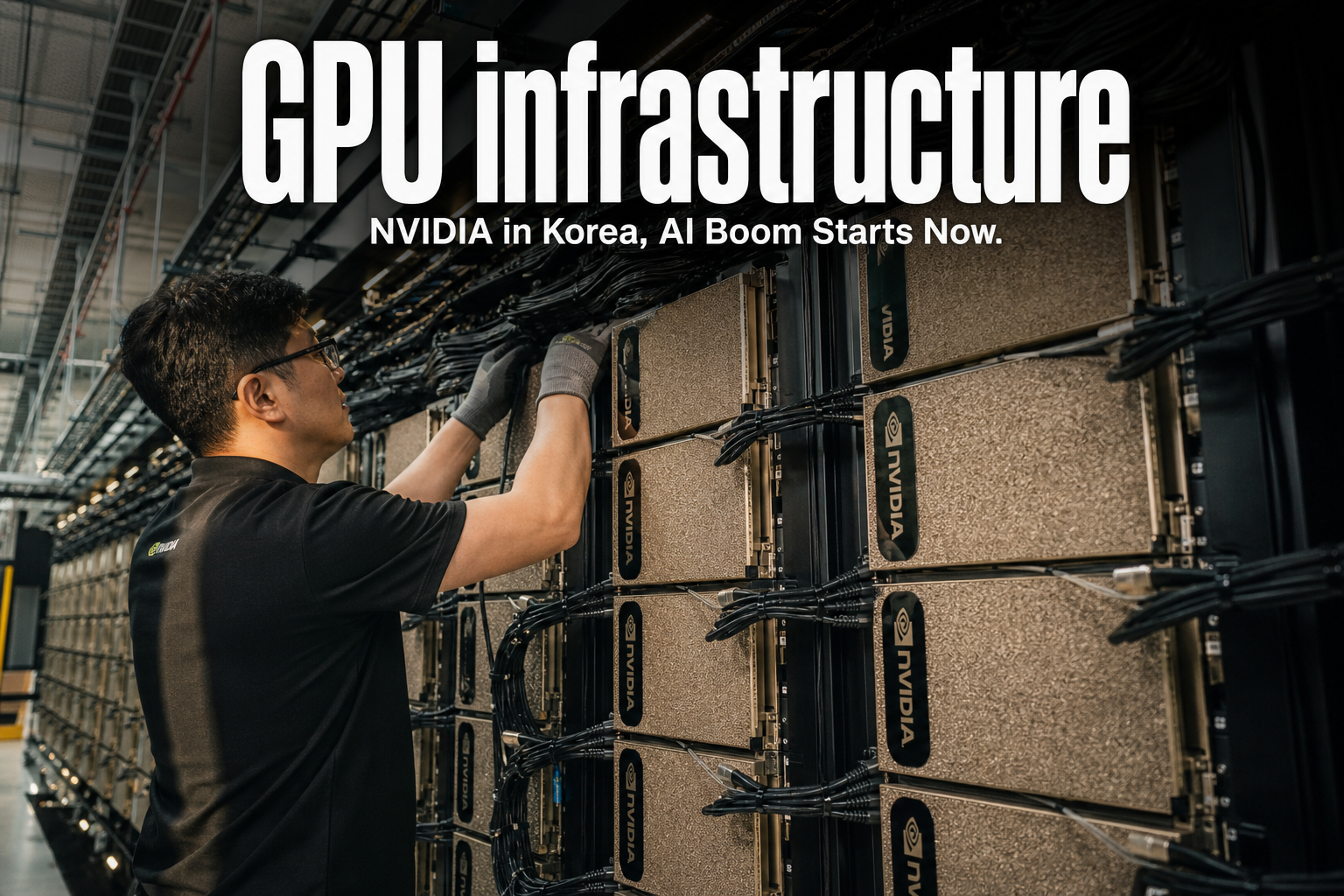
● Nvidia Builds Physical AI Lab in Korea
NVIDIA Begins Establishing a Korea AI Technology Center… A Signal that Korea Is Rising as a Global AI and Robotics Hub
The three points to look at first are these.
First, NVIDIA has started hiring to actually build an AI technology center in Korea.
Second, this hiring is not for simple research staff, but for advanced R&D centered on physical AI, digital twins, and robotics.
Third, Korea is no longer just an important country in the semiconductor supply chain; it is becoming a global testbed where AI infrastructure and manufacturing are combined.
In this article, I will summarize why NVIDIA’s move to Korea is not just another investment news item, what ripple effects it could have on the Korean economy and AI industry, and the key points that other articles often miss, in a news-style format.
1. Core News Summary
NVIDIA has begun full-scale hiring to establish its Korea AI Technology Center.
The job posting is for a Physical AI Solutions Architect position based in Seoul.
The scope of work includes digital twins, robotics, OpenUSD-based simulation, synthetic data generation, and fine-tuning humanoid foundation models.
In other words, NVIDIA is not building a simple sales or support organization in Korea, but rather an R&D base for developing core technologies together.
CEO Jensen Huang also described Korea at Gimpo Airport as “the ideal place for AI and robotics R&D investment.”
2. Why This News Matters
This case is different from the usual foreign company investment in Korea.
Typically, global big tech’s Korea presence falls into three categories.
First, sales and marketing focused.
Second, service operations and customer support focused.
Third, limited collaborative research focused.
But NVIDIA’s AI Technology Center is a much higher level than this.
That is because it will jointly develop core technologies with local universities, companies, and the government, and even submit papers to international academic conferences.
This means Korea could be promoted from being a “demand market” to a “development market” within the global AI ecosystem.
3. Why NVIDIA Chose Korea
3-1. High Density of AI and Robotics Talent
NVIDIA values Korea’s expertise in AI and robotics highly.
In particular, Korea’s strength lies in a tightly connected pool of PhD-level talent, university labs, and corporate R&D organizations.
Physical AI is not a field that can succeed with software alone; it requires computer engineering, electrical engineering, physics, mathematics, and control engineering all at once.
Korea has a fairly strong pool of talent in these combined technologies.
3-2. A World-Class Manufacturing Hub
Physical AI ultimately moves into factories, logistics, automobiles, robots, and production lines.
Korea is a country densely populated with the automotive, electronics, battery, semiconductor, and precision manufacturing industries.
In other words, it is a place where AI can be directly demonstrated in real industrial settings.
From NVIDIA’s perspective, Korea is not just a place for research, but a testing ground where technology can be commercialized immediately.
3-3. Strong Potential for Collaboration with Government and Companies
Last October, NVIDIA signed an MOU with Hyundai Motor Group and the Korean government, promising the supply of 50,000 GPUs and the establishment of an AI technology center.
50,000 GPUs are not just a simple hardware number.
This is a computing resource investment that can elevate Korea’s AI infrastructure to the next level.
That is because large-scale training, digital twins, autonomous driving, humanoids, and industrial AI all depend on computational power.
4. The Real Meaning Behind This Hiring Announcement
4-1. Physical AI Is the Core Axis
The keyword in this hiring is physical AI.
Physical AI is not a chatbot on a screen, but AI that controls robots, manufacturing equipment, vehicles, and logistics systems in the real world.
Simply put, it is the stage where AI does not stop at talking, but actually moves and makes decisions.
In the future, the competitiveness of the AI industry will shift from mere LLM performance to how accurately it operates in the real world.
4-2. Digital Twins Move Together with It
A digital twin is a technology that replicates a real factory, city, or robotic environment in a virtual space for testing.
It is highly compatible with manufacturing because it allows optimization and failure simulation without stopping actual equipment.
In a country like Korea, where manufacturing accounts for a large share of the economy, digital twins become a productivity innovation tool.
In other words, this center is likely to become not only an AI research lab, but also an upgrade platform for Korea’s manufacturing industry.
4-3. Synthetic Data and Simulation Are Key
NVIDIA has presented a structure in which Cosmos models are used to create synthetic data, Omniverse is used to build virtual worlds, and Isaac Sim is used to test robots.
This is very important.
That is because the era of training only on real-world data is reaching its limits.
Especially for robots and autonomous systems, where failure costs are high, synthetic data and simulation determine the speed of AI development.
5. Impact on the Korean Economy
5-1. Expanded AI Infrastructure Investment
If the supply of 50,000 GPUs becomes a reality, demand for AI infrastructure in Korea could rise sharply.
Data centers, power grids, cooling systems, networks, and cloud services will all see ripple demand.
This is not just an IT story, but a macroeconomic issue that extends into power, real estate, telecommunications, and industrial equipment.
5-2. Rising Demand for High-Level Talent
This hiring requires PhD-level qualifications, at least five years of practical experience, publication records, and experience in industry-academia-government collaboration.
In other words, the high-end talent market is bound to heat up further.
It is natural for AI professionals’ salaries in Korea to rise, and movement among universities, research institutes, and companies is likely to become more active.
5-3. Accelerating AI Transformation in Manufacturing
Companies in Hyundai Motor, electronics, batteries, shipbuilding, and logistics should watch this trend closely.
That is because physical AI ultimately connects to process automation, inspection automation, logistics optimization, and robot collaboration.
The next growth driver for Korean manufacturing will not simply be producing more, but how precisely it can be produced and operated with AI.
6. Important Points the Market May Easily Miss
6-1. “Fixing the Ecosystem” Matters More Than “Establishing a Center”
Many articles focus only on whether the AI technology center is established, but the real issue is whether the ecosystem becomes anchored in Korea.
Once a research base is built, people, projects, supply chains, and partnerships all follow.
If that happens, Korea is not a one-time beneficiary but could become a lasting AI hub.
6-2. Paper and Patent Competition May Intensify
An AI technology center’s core role includes submitting papers to international conferences.
This means Korean university and corporate researchers will enter global top-tier research competition more deeply.
Going forward, not only service revenue, but also patents, papers, standards, and open-source influence will become more important competitive strengths.
6-3. Korea Will Shift from an AI “Consumer Country” to a “Demonstration Country”
Until now, Korea has been viewed as a market that quickly adopts global AI technology.
But if a company like NVIDIA sets up a research base here, the story changes.
Korea could become a demonstration country that directly verifies, tests, and fine-tunes technology.
In the long term, this is a change that alters the quality of industrial competitiveness.
7. Reading This News from a Global Economic Outlook Perspective
7-1. AI Investment Is Still Alive
Even amid global economic volatility, the AI investment cycle is continuing.
In particular, NVIDIA is evolving beyond AI hardware into an AI platform company.
This trend can be interpreted as a signal that AI-related CAPEX may remain resilient even during a global economic slowdown.
7-2. Supply Chains Are Becoming Regionalized and Strategic
AI chips, data centers, robots, and manufacturing demonstrations are difficult to concentrate in a single country.
That is why companies are diversifying strategic hubs such as the United States, Singapore, Taiwan, the United Kingdom, and Korea.
NVIDIA’s Korea AI Technology Center is an extension of this strategy.
7-3. The Convergence of Manufacturing Power and AI Power
In the future, the winners will likely not be countries that are simply good at AI, but countries that combine manufacturing and AI.
In that sense, Korea is in a favorable position.
That is because it already has a strong base in semiconductors, automobiles, batteries, shipbuilding, and smart factories.
8. Trends You Must Watch from an AI Trend Perspective
8-1. Physical AI Is the Next Mega Trend
If generative AI was centered on text and images, the next stage is expansion into robots and industrial equipment.
Physical AI is likely to spread widely into manufacturing, logistics, healthcare, defense, and smart cities.
8-2. Rising Value of Digital Twin and Simulation Platforms
Simulation is essential if AI is to operate safely in the real world.
That is why the value of platforms such as Omniverse, OpenUSD, and synthetic data platforms is bound to rise further.
8-3. Intensifying Competition in Humanoids and Industrial Robots
NVIDIA’s support for fine-tuning and deploying an open humanoid foundation model is also worth noting.
This signals that the humanoid market is entering a full-scale industrial competition phase.
Korea has strong potential to benefit because it has capabilities in robot components, manufacturing processes, and systems integration.
9. One-Line Summary Readers Should Not Miss
This news is not about NVIDIA opening a single office in Korea, but about its attempt to develop Korea into a global physical AI laboratory and a manufacturing-oriented AI hub.
10. Checklist from a Blog Operator’s Perspective
Korea AI industry, AI semiconductors, GPU investment, physical AI, digital twins, robotics, smart factories, and manufacturing transformation are all likely to see rising search volume together in the future.
In other words, this issue is not something to end with a single article; it is a topic that can be continuously expanded into industry analysis and investment-focused content.
< Summary >
NVIDIA has begun hiring to establish its Korea AI Technology Center.
The core points are physical AI, digital twins, robotics, and synthetic data.
Korea is attracting attention as the ideal testbed with both AI talent and a manufacturing base.
This issue can be seen as a signal that Korea is moving from an AI consumer country to an AI development and validation country.
The supply of 50,000 GPUs, industry-academia-government collaboration, and humanoid competition are all likely to follow.
[Related Articles…]
- The Manufacturing Transformation Driven by Physical AI: Why Korean Companies Should Pay Attention
- Expanding NVIDIA Investment in Korea: A Breakdown of the 50,000 GPU Supply and AI Infrastructure Beneficiaries
*Source: https://www.yna.co.kr/view/AKR20260605141000017
Leave a Reply