
● AI Productivity Myth Exposes Workslop Risk
The Illusion of AI Productivity: Why Workslop Is the Most Important Issue Right Now
These days, many companies describe AI adoption as a “productivity revolution,” but the exact opposite problem is growing in actual workplaces.
Although things appear to have become faster on the surface, workslop, which increases review time and rework, is spreading as a hidden cost across organizations.
The core point of this issue is not simply that “AI does not create documents well.”
What matters more is that it signals what must change for AI productivity, business automation, enterprise AI, digital transformation, and AI governance to lead to real business performance.
1. The Core Point from the News: What Is Workslop?
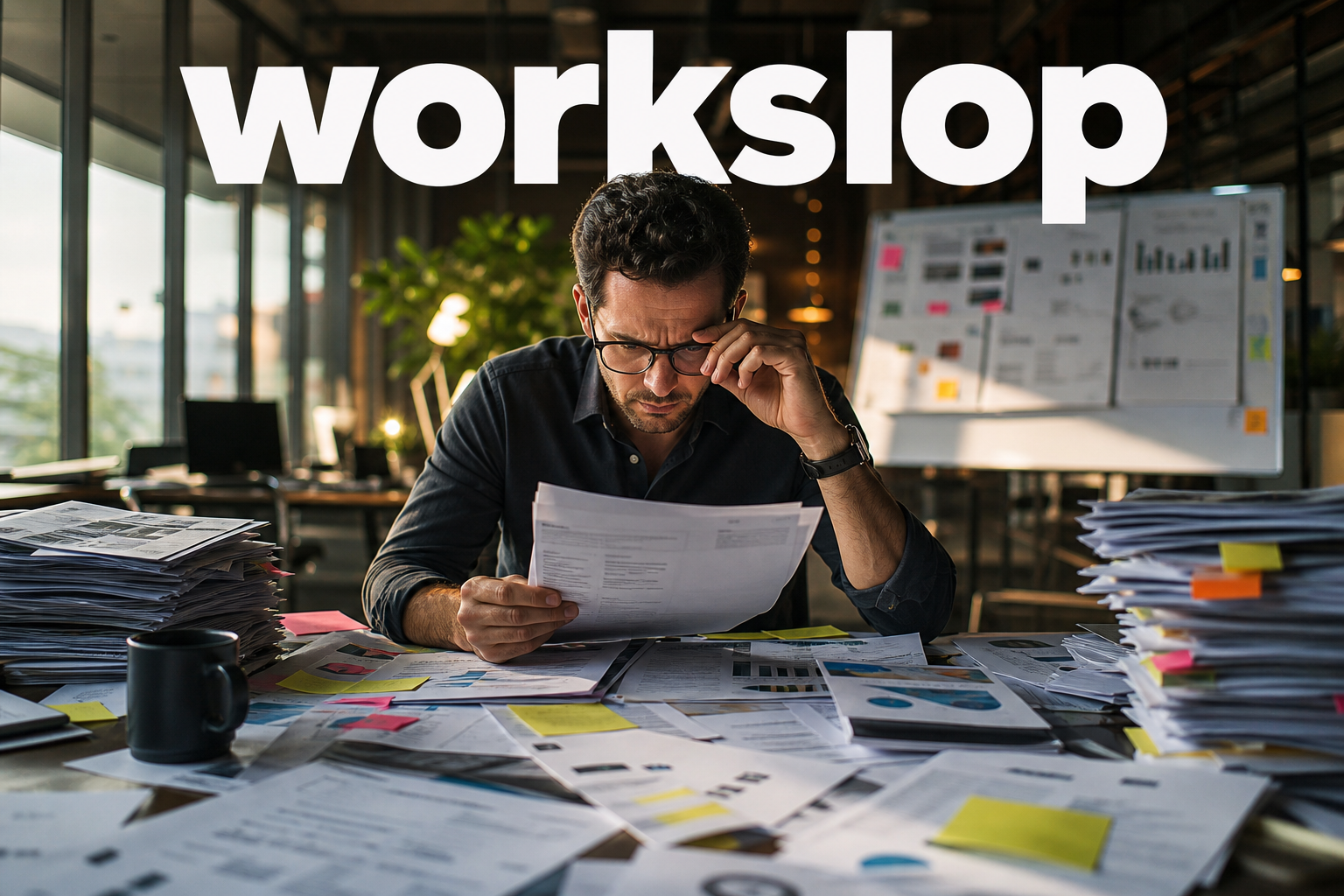
Workslop refers to AI-generated output that looks plausible on the surface but lacks context and is difficult to use immediately in real work.
Typical examples include a document that looks like a report but cannot be used directly for decision-making, or slides that appear organized but lack the core logic.
In other words, AI-generated output becomes not “the end of the work,” but something that only increases “the beginning of the work.”
2. Why Rework Is Increasing Instead of Productivity
The biggest problem is that the cost does not remain only with the person who created the output.
The creator may feel that AI helped them finish quickly, but the recipient has to reread the content, interpret it, find missing context, and correct the wrong parts.
In the end, the time saved by AI has not disappeared across the organization; it has simply been transferred to someone else’s work.
In this structure, individual perceived productivity may rise, but the company’s overall productivity can stagnate or even decline.
3. What Is Actually Happening in Companies
In many companies, AI is first introduced for meeting minutes, email drafts, report drafts, and summary documents.
The problem is that many organizations have decided “what to create,” but have not defined “what level of quality it must meet.”
As a result, fast drafts pile up in the workplace, while verification and revision remain human responsibilities.
When this process repeats, employees begin to see AI not as a convenient tool, but as a tool that increases their workload.
4. The Real Risk Companies Are Missing Right Now
The most important point in this issue is not simply a decline in document quality.
The bigger problem is that the internal trust cost within an organization increases.
If AI-generated output must be verified every time, people will begin to distrust automatically generated results by default.
At that moment, AI becomes not a productivity tool, but an additional step that forces review.
This trust cost does not immediately appear on accounting books, but in actual workplaces, it becomes one of the most expensive costs.
5. Why Telling Employees to “Use AI More” Does Not Solve the Problem
It is the right direction for CEOs to encourage AI use.
However, using AI more and using AI better are completely different things.
If work design, approval standards, accountability, and quality verification procedures do not change together, workslop will inevitably increase.
In other words, the core point of AI adoption is not tool adoption, but work redesign.
6. What Companies Must Do
First, companies must clearly define usage standards for AI-generated output.
The acceptable quality level should differ by document type, such as drafts, reference materials, externally published documents, and management reports.
Second, companies must clearly define “who is responsible for review.”
AI-generated documents should be treated not as automatic completion, but as part of a process that includes human verification.
Third, companies should not stop at prompt training; they must also design how work context is provided.
Good output comes not only from good questions, but from good work context.
Fourth, quality metrics must be reviewed together with productivity metrics.
If only speed is measured, workslop may continue to grow without becoming visible.
7. Why AI Governance Has Become Important Again
This trend shows that AI governance is not merely a response to regulation, but a core part of organizational operations.
Without AI governance, fast generation, low quality, and high rework will repeat.
By contrast, companies with well-established governance can use AI not as simple automation, but as a decision-support system.
In the end, the competition will be decided not by model performance, but by the operating system around AI.
8. Implications for the Global Economy and the AI Industry
This problem is not limited to individual companies.
If inflated expectations around AI productivity weaken, the investment logic behind corporate digital transformation will also be reexamined.
Especially during an economic slowdown, the question “Why are costs not falling even after introducing AI?” may become stronger.
In other words, AI adoption has now entered a stage where companies must look not only at the growth story, but also at cost structure, operational efficiency, and workforce redeployment.
This is also an important shift for the global economic outlook.
If technology investment does not translate into real productivity, the pace of corporate profit improvement may be slower than expected.
9. The Most Important Point Other Articles Often Miss
Many people view workslop merely as “poorly made documents created by AI.”
However, the real core point is that if the way an organization adopts AI is wrong, it accumulates work debt instead of creating a productivity revolution.
The key point is that AI does not simply replace work; it breaks work into smaller pieces, disperses review responsibility, and creates new bottlenecks.
This is not just a document problem, but a problem with the corporate operating model.
In the future, companies that perform well with AI are likely to be those that have clear standards for filtering AI-generated results, not those that simply use AI more.
10. Key Points to Watch Going Forward
The first point is how companies measure the results of AI adoption.
They must look not only at adoption rates, but also at rework time, review costs, and approval lead time.
The second point is whether AI work standards will be created.
Quality standards will differ by task, including documents, meetings, analysis, customer service, and code generation.
The third point is whether internal AI training moves from a prompt-centered approach to a work-design-centered approach.
This shift is necessary for real productivity improvement.
The fourth point is whether AI evolves in a direction that complements human judgment.
In areas that require final judgment, AI should be a verifiable intermediate tool, not a finished product.
Summary
Workslop refers to AI-generated output that looks plausible on the surface but increases rework and trust costs instead of improving corporate productivity.
The core point is not AI adoption itself, but work redesign and AI governance.
Going forward, companies with strong quality standards and verification systems for AI results are more likely to become stronger than companies that simply use AI more.
[Related Articles…]
How AI Is Changing the Future of Work
Digital Transformation Strategy in the Age of Automation
*Source: https://themiilk.com/articles/a553cb43a?utm_source=Viewsletter&utm_campaign=4aee6bca9c-ceofucus45_COPY_01&utm_medium=email&utm_term=0_-aba9c4e0ad-385751177
Leave a Reply