
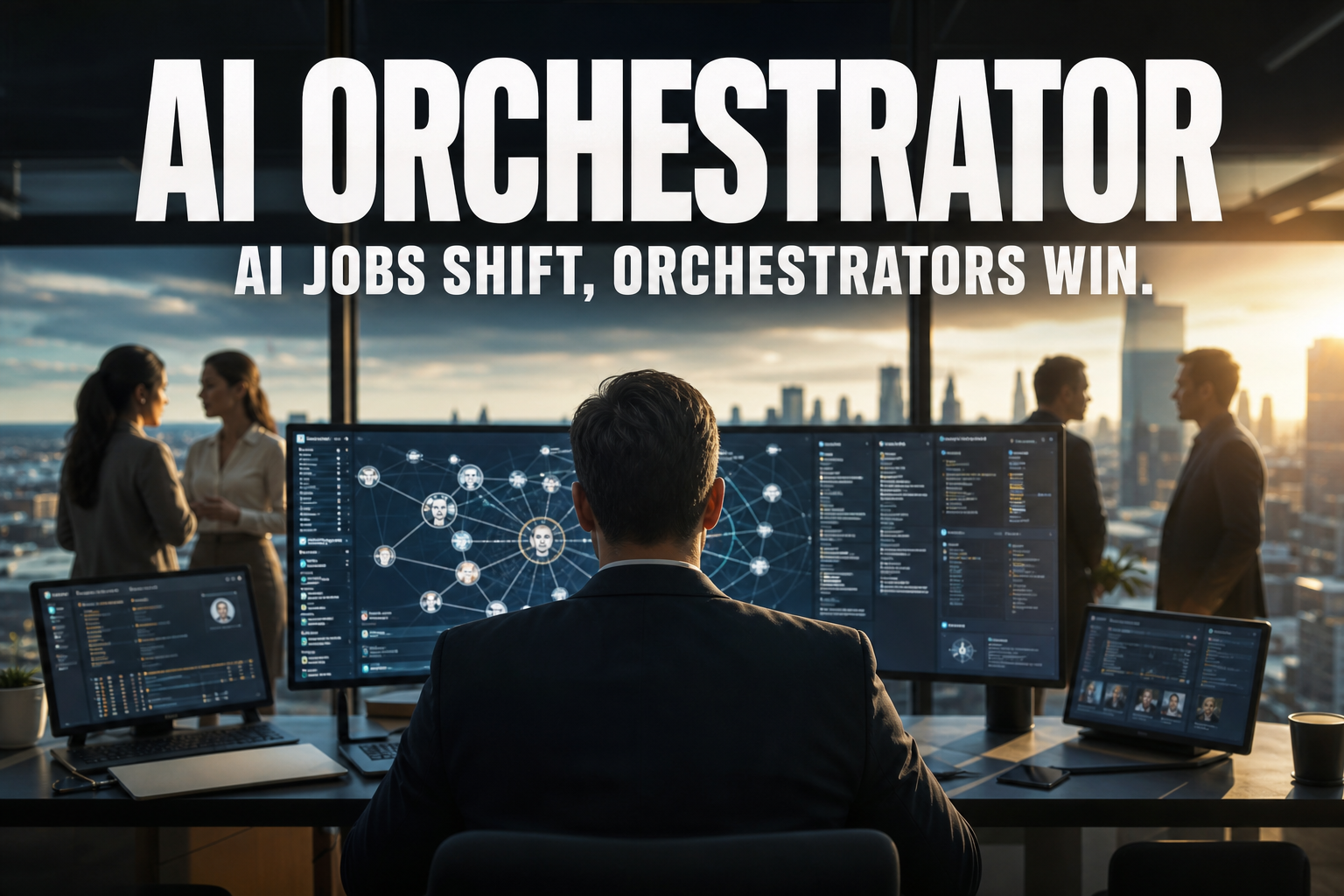
● AI Jobs Shift To Orchestrators
High Performers in the AI Era Do Not Just Work Hard… They Orchestrate Work
AI is not simply eliminating jobs; it is breaking work down into smaller parts and redistributing it.
As in the case of radiologists, what AI takes over first is not an entire “job,” but a “task.”
That is why what matters now is not being someone who works quickly, but someone who designs, verifies, and orchestrates work.
In this article, we will summarize in a news-style format the atomization of work, orchestrator-type talent, how AI is changing hiring and salary structures, the collapse of seniority-based systems, and the capabilities needed to survive in the AI era.
In particular, we will separately examine points that are rarely covered in other articles or YouTube videos: “why AI can actually increase hiring,” “why outcomes are becoming more important than resumes,” and “the structural shift in which juniors are expected to demonstrate senior-level capabilities.”
Is AI Eliminating Jobs? The Core Point Is Not That Simple
In this lecture, Son Jae-kwon, CEO of The Miilk, argued that predictions such as “AI will eliminate this job first” are half right and half wrong.
A representative example is radiology.
As AI became better at image interpretation, it seemed as though doctors might disappear, but the actual trend moved in the opposite direction.
As interpretation speed increased, the number of examinations grew, hospital revenue expanded, and hiring ultimately increased.
In other words, rather than eliminating jobs, AI can operate in a way that increases the total volume of work and productivity.
This trend is likely to continue not only in healthcare but also across manufacturing, finance, retail, and startup operations.
The AI Paradox That Leads to More Hiring
One of the most important points of the lecture is this.
When AI improves productivity, it does not necessarily reduce the workforce; in some industries, it can actually lead to more hiring.
This is not just simple efficiency improvement, but the result of better economics.
When production costs fall, customers increase, throughput expands, and new demand emerges.
Ultimately, people do not disappear; instead, they take on higher-level judgment and responsibility.
This is the true essence of what is often called digital transformation, AI innovation, productivity improvement, labor market change, and industrial restructuring.
Work in the AI Era Is Being Reorganized Through the “Atomization of Work”
In the past, one person was responsible for a large body of work from beginning to end.
They planned, researched, wrote drafts, reviewed, and even checked risks.
But in the AI era, this flow is changing completely.
Work is being broken down into smaller units.
For example, it can look like this.
- Researching materials
- Summarizing core points
- Writing drafts
- Organizing tables and documents
- Generating counterarguments
- Checking risks
- Comparing alternatives
- Supporting decision-making
Son described these broken-down units as Atoms of Work.
What matters now is not “I do everything myself,” but “what should be assigned to AI and what should humans judge?”
In other words, the definition of work is changing.
The Core Talent in the AI Era Is the “Orchestrator”
The new high performer emphasized by Son is the orchestrator.
An orchestrator is not simply someone who works quickly.
It is someone who connects various AI tools and human roles to create greater outcomes.
Put simply, this person is closer to a conductor than to someone who plays every instrument alone.
This role requires five capabilities.
- Decomposition: The ability to break work down into units that AI can handle
- Instruction: The ability to create prompts that include context and conditions
- Verification: The ability to critically review AI-generated outputs
- Automation: The ability to connect repetitive work into workflows
- Scaling: The ability to turn individual productivity into team performance
Only people equipped with these five capabilities can raise the productivity of an entire organization in the AI era.
The Boundary Between Juniors and Seniors Is Collapsing
One particularly striking part of the lecture was the change in organizational structure.
As AI becomes more widespread, the old distinction of “juniors handle simple tasks, seniors handle strategic work” is becoming blurred.
In fact, junior roles are increasingly being required to demonstrate capabilities that used to be expected of seniors.
Leadership, problem definition, strategic thinking, and decision-making ability are now needed from the entry level.
This means the compression of seniority-based structures.
The old growth formula of employee, assistant manager, manager, and senior manager no longer works as well as it once did.
Now, “what results have you produced?” matters more than “how many years of experience do you have?”
The Era of the Resume Is Ending, and the Era of Outcomes Is Coming
Son also argued that the usefulness of job titles is weakening.
In the past, which company you worked for and what title you held explained your career.
But today, that alone is not enough to judge actual capability.
Going forward, the core point will be what you did, what you created, and how you solved problems.
In other words, portfolios matter more than resumes, and outcomes matter more than titles.
This trend will affect the job market, career-change market, and hiring market as a whole.
In particular, talent hiring, job design, organizational operations, and performance evaluation methods are likely to change together.
AI Creates Democratization, but It Also Strengthens Specialization
As AI becomes easy for everyone to use, it lowers the barriers to entry for work.
This is clearly a positive change.
At the same time, however, roles that require higher-level judgment are growing faster.
According to Upwork data cited in the lecture, specialized jobs are growing faster and seeing higher wage growth than democratized jobs.
The key takeaway is this.
The more AI levels simple tasks, the more human value remains in high-level judgment, problem definition, responsibility, empathy, and leadership.
In other words, AI is not a tool that makes people average; it can actually widen the gap between those who perform well and those who do not.
This is the essence of competitiveness in the artificial intelligence era.
In the AI Era, “Design” Matters More Than “Speed”
In the past, a high performer was someone who was fast, diligent, and good at reporting.
But that standard has now changed.
What matters is not who did it faster, but who designed it better.
People who use AI well do not merely increase speed.
They change the structure of work, eliminate repetition, and improve the quality of judgment.
Then they connect those results to the performance of the entire team.
In other words, the high performer of the AI era is not an executor but a work designer.
Organizations Are Now Shifting to an Orbital Collaboration Model
Son described the work structure of the industrial era as a pyramid-shaped structure of “Task-Process-Output.”
But in the AI era, the structure changes.
It becomes an orbital collaboration model, where humans are at the center and multiple AI agents are positioned around them.
In this structure, humans set the direction, while AI searches, summarizes, drafts, and reviews.
In other words, humans are the central axis, and AI is the high-speed execution layer.
As this model spreads, organizational decision-making will become faster, and individual productivity will increase significantly.
What matters here is not merely using tools well, but developing the ability to operate AI agents.
What the AI Era Requires Is the Ability to Give Instructions
The most important capability for an orchestrator is instruction.
But instruction here does not mean simply saying, “Do this.”
Good instruction must include context, constraints, goals, and evaluation criteria.
For example, you should be able to ask questions like these.
- Can this work be broken down into units that can be assigned to AI?
- Can I create criteria to verify whether the output is correct?
- Can I reflect the company’s situation and the customer’s context?
- Can humans supplement what AI misses?
- Can individual productivity be connected to organizational performance?
A person who can answer these questions is the core talent of the AI era.
A Core Point Rarely Covered Elsewhere: AI Does Not Reduce the Human Role; It Increases the Weight of Responsibility
This part is truly important.
When many people look at AI, they think, “Human work will decrease now.”
But the reality may be the opposite.
The more AI takes over execution, the more humans must take on greater judgment and responsibility.
That is because the person who gives final approval for the outcome is ultimately human.
In other words, humans in the AI era are not becoming more comfortable; they are becoming more advanced.
This is both good news and a burdensome reality.
People who cannot use AI well may fall behind, but those who can handle AI effectively will gain much greater influence.
That is why what matters going forward is not simple usage skills, but responsible judgment.
Practical Strategies to Apply Immediately in the AI Era
At the individual level, it is good to prepare in the following ways.
- First identify repetitive tasks and break them down
- Define units of work that can be assigned to AI
- Create criteria for verifying outputs
- Document workflows in the areas where you are strong
- Accumulate outputs as a portfolio
At the organizational level, the following changes are needed.
- Provide strategic thinking training even for juniors
- Recognize AI utilization experiments as performance
- Redesign jobs around outcomes rather than roles
- Create structures that allow AI to learn internal knowledge and context
- Shift team collaboration methods toward an orchestration structure
Ultimately, the core point is one thing.
Do not view AI merely as a “tool,” but as an opportunity to redesign the structure of work.
Implications for the Economy and Industry
This lecture is not just about workplace survival strategies; it also shows a larger economic trend.
When AI improves productivity, companies do not stop at cutting costs; they look for new revenue opportunities.
In this process, the U.S. economy, the global economic outlook, AI industry investment, semiconductor demand, and corporate AX transformation move together.
In other words, AI is not only changing the labor market.
It is changing industrial structures, hiring methods, wage systems, organizational design, and investment direction all at once.
That is why AI should now be read not as technology news, but as economic news.
One Key Takeaway You Must Not Miss
The winners of the AI era will not be those who do the most work, but those who break work down, delegate it to AI, and recombine it through judgment that only humans can provide.
< Summary >
AI is atomizing work rather than eliminating jobs.
Core talent is no longer the executor, but the orchestrator.
Seniority-based systems and resume-centered evaluations are weakening, while outcomes and judgment are becoming more important.
AI can increase productivity and even lead to more hiring.
Going forward, design will matter more than speed, responsibility more than technology, and verification capability more than simple usage.
[Related Articles…]
How AI Agents Are Reshaping Workflow Innovation
Why Corporate AX Transformation Is Accelerating
*Source: https://www.themiilk.com/articles/a7e5faa5e?utm_source=Viewsletter&utm_campaign=16b0b4dae8-viewsletter744_COPY_01&utm_medium=email&utm_term=0_-66ea647efa-385751177
Leave a Reply