
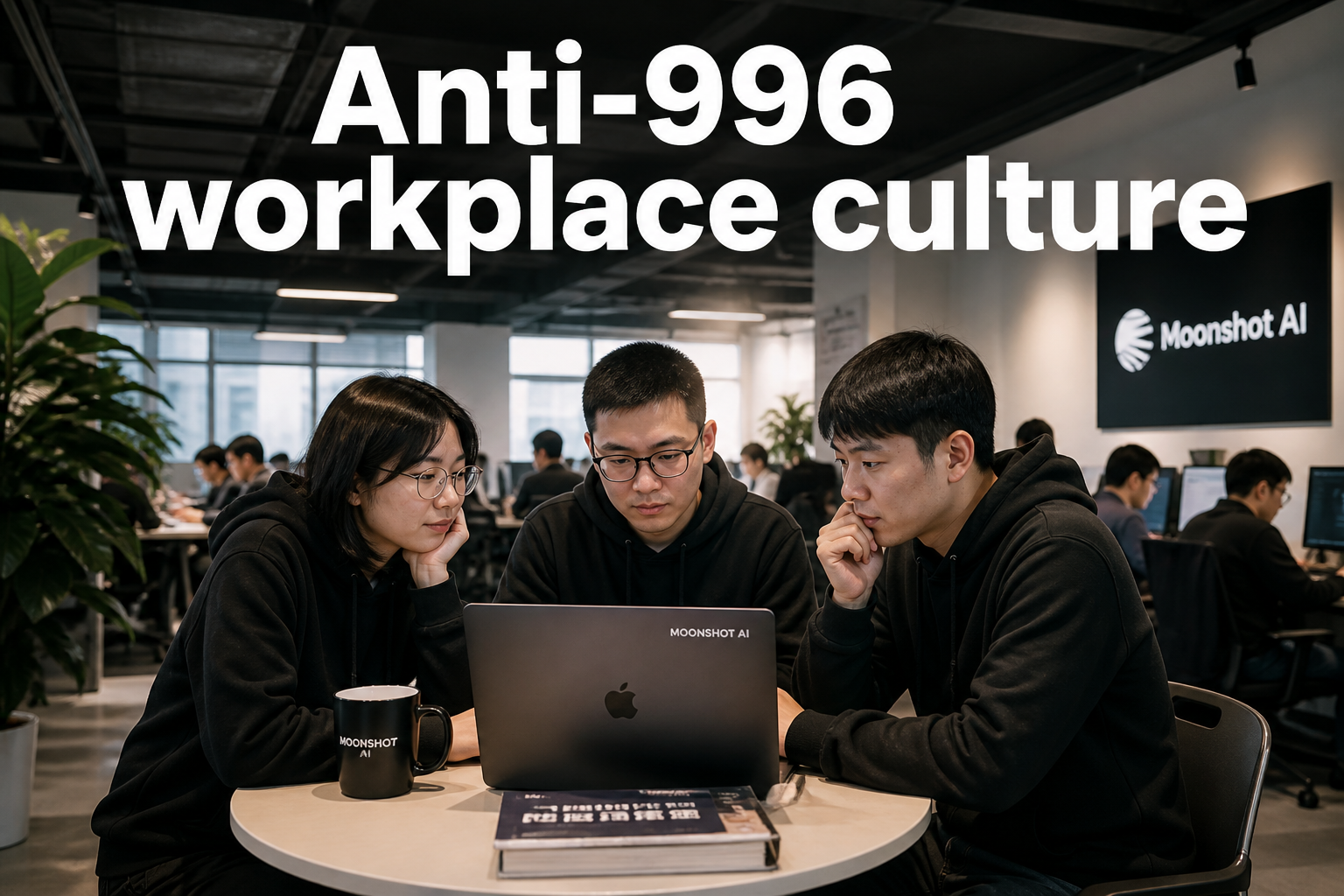

● AI Organization Reset Drives Breakneck Growth
Moonshot AI, the Chinese AI Startup That Eliminated Commuting, Meetings, and Reports: Why It Is Breaking the 996 Culture and Growing at the World’s Fastest Pace
There are exactly five core points to look at first in this article.
First, why the Chinese AI startup Moonshot AI grew to a valuation of around 50 trillion won in just three years.
Second, why it is conducting the opposite experiment by reducing commuting, meetings, and reporting in China’s IT industry, where the 996 work culture was once taken for granted.
Third, AI talent recruitment is shifting from academic background and career history to judgment, persistence, and AI-native capability.
Fourth, model competition that achieves performance comparable to OpenAI and Anthropic is no longer just a battle of technology, but is becoming a battle of organizational design.
Fifth, what kind of AI organizations, talent, and industrial structures Korean companies and investors should watch going forward.
On-the-Ground Report from Beijing, China: A Quiet Office, a Piano at the Entrance, and Employees in Their 20s
Moonshot AI’s headquarters looks different from a typical startup from the outside.
Before the company’s name sign catches the eye, a white piano stands out, while each meeting room has recliners and a rock-band atmosphere.
Even after 10 a.m., the office was quiet, and employees moved around freely in T-shirts, shorts, and slippers.
It was a scene completely opposite to the 996 culture often associated with Chinese IT companies: arriving at 9 a.m., leaving at 9 p.m., and working six days a week.
The core point was not working hours, but results.
The explanation is that there are no separate commuting hours and no fixed workplace.
This scene alone shows that Moonshot AI is not simply a company that builds good AI models, but a company experimenting with an AI-era organization.
The Real Reason Moonshot AI Is Drawing Attention: The “Performance Parity” Shown by Kimi K3
The direct reason Moonshot AI gained global attention was its AI model, Kimi K3.
As the model was evaluated as being nearly comparable to leading global models from OpenAI and Anthropic in core performance, market attention quickly converged on the company.
This is a fairly important signal for China’s AI industry.
In the past, the question was, “How quickly can China catch up with American technology?” Now, the question has become, “Who can build and operate models more efficiently?”
In other words, the focus of AI competition is shifting from a simple catch-up race to organizational operations, research productivity, talent density, and data utilization efficiency.
Moonshot AI’s valuation rising to 35 billion dollars, or about 50 trillion won, in just three years is also tied to this trend.
The market is no longer looking only at AI model performance, but also at how quickly and with how few people that performance can be achieved.
Why It Abandoned 996: In the AI Era, “Fast-Learning Organizations” Beat “Long-Hours Organizations”
Moonshot AI’s biggest differentiator is its work culture.
In China, long working hours are still often treated as a source of competitiveness, but Moonshot AI has directly overturned that formula.
Inside the company, people say there is no atmosphere of obsessing over bosses or emphasizing rank.
Employees are used to communicating through messaging apps, and even colleagues sitting right next to each other often exchange opinions by text rather than speaking.
This is not simply about creating a comfortable atmosphere.
Because AI development depends on rapid experimentation, fast modification, and quick verification rather than repetitive work, the judgment is that unnecessary meetings and hierarchy actually slow things down.
Ultimately, Moonshot AI should be understood not as a company that increases working hours, but as a company that reduces decision-making friction.
A Completely Different Organizational Structure: Departments, Titles, OKRs, and KPIs Are Minimized
Moonshot AI has chosen an operating method different from that of ordinary companies.
It has no departments, ranks, or titles, and it does not use OKRs or KPIs.
Instead, it only maintains team categories such as algorithms, product development, growth, and strategy.
This means it operates around projects, problems, and speed rather than traditional organizational management.
If help from another team is needed, employees ask the relevant person directly without a separate reporting procedure or coordination meeting.
CEO Yang Zhilin even displays the phrase “direct communication” on his mobile messenger profile, showing that communication is oriented toward horizontality.
Employees describe this as the absence of old-guard seniority culture, which simply means there is no authoritarian or condescending workplace culture.
This kind of structure is especially important for AI startups.
That is because AI is not an industry with fixed answers, but one in which models, data, products, and market reactions constantly change.
The Standard for Hiring Talent Has Changed: Judgment Over Academic Background, Persistence Over Career History
Moonshot AI is also highly distinctive in its hiring standards.
Rather than valuing prestigious universities and impressive career histories, it places greater importance on the judgment to recognize which problems matter and the persistence to dig into problems others have given up on.
Of course, many of its actual employees come from prestigious Chinese universities such as Peking University and Tsinghua University.
However, the company makes it clear that it does not simply want model students.
It says it prefers people with abstraction ability, people who are almost obsessive in their persistence, and people who can work with intense dedication.
This means the AI industry wants talent that can reconstruct complex problems more than talent that memorizes correct answers.
Especially in the AI era, even the same career experience can quickly become outdated, so the ability to adapt quickly to new environments is becoming more important than past success.
Moonshot AI’s Real HR Strategy: Friend-Referral Hiring and Preference for AI Natives
Moonshot AI hired a significant share of its employees over the past year through internal referrals.
This is a method in which people join through employees’ friends and friends of friends, and inside the company it is referred to as person-to-person referral.
The core point of this method is not simple networking-based hiring.
It first brings in people who fit the organization’s culture and working style, and then gives them as much autonomy as possible after they join.
Moonshot AI does not treat career history as absolute in this process.
In fact, many employees say their responsibilities changed several times after joining.
This is because the AI industry changes so quickly that AI natives are judged to have an advantage over people who only insist on methods that worked well in the past.
An AI native, in simple terms, is not merely someone who uses AI tools, but someone who accepts AI as a basic language and naturally integrates it into the problem-solving process.
The Core Point Often Missed in Other News: Moonshot AI Is Not Just a “Model Company,” but an “Organizational Innovation Company”
Many articles and videos usually conclude with a message such as “China has caught up with American AI.”
But the more important point lies elsewhere.
The core point of Moonshot AI is not merely that it has narrowed the technology gap, but that it has redesigned the way organizations operate for the AI era.
In other words, AI model competition is ultimately becoming not just a matter of code, but a matter of how people are gathered, how they communicate, how much autonomy they are given, and how unnecessary friction is reduced.
This is an extremely important hint for Korean companies going forward.
Organizations with many meetings, lengthy reports, and numerous approval stages may struggle to keep pace with AI speed.
On the other hand, organizations with small elite teams, horizontal communication, rapid experimentation, internal-referral-based hiring, and systems for developing AI natives are more likely to move ahead faster.
From a Global Economic Outlook Perspective: AI Is Now a Matter of Productivity Restructuring, Not Labor Cost
The Moonshot AI case is not simply a startup story.
From a global economic outlook perspective, AI is no longer merely a tool for reducing labor costs, but a core variable that restructures productivity.
Companies must build products faster with fewer people and conduct more frequent experiments in shorter periods of time.
In that process, actual problem-solving ability becomes more important than unnecessary ranks, formal meetings, and performance-indicator-centered management.
This will also affect the labor market.
Going forward, AI utilization ability, the ability to define complex problems, and the ability to learn quickly are likely to become more valuable than years of experience.
These changes could spread across almost every industry, including manufacturing, platforms, finance, content, and healthcare.
Key Points for Investors: AI Company Value Is Being Reassessed Through “Talent Density” and “Operating Efficiency”
What Moonshot AI has shown is that the criteria for valuing AI companies are changing.
In the past, revenue growth or user numbers were the core points, but now talent density and organizational efficiency are rising as important evaluation factors.
The structure in which around 300 employees support a valuation of roughly 50 trillion won is highly symbolic.
From the market’s perspective, it is asking, “How much high-performance AI can this company create with minimal friction?”
Therefore, going forward, the structure of the team building the model, its hiring philosophy, and its decision-making speed may influence valuation more than the AI model itself.
This is also important for investors.
When looking at AI-related stocks, investors should look beyond the simple claim that a company is “doing generative AI” and examine whether the organization is truly AI-native, whether its research and productization speed is fast, and how efficient its internal communication is.
Implications for Korean Readers: What Must a Korean-Style AI Organization Change?
What Korean companies should learn from Moonshot AI is not China-style long working hours.
It is the opposite.
In the AI era, short but intense focus, rapid experimentation, low hierarchy, and strong autonomy may become more important than a culture of sitting at a desk for long hours.
In addition, hiring based on problem-solving ability rather than career history, and hiring based on potential rather than academic background, are needed.
It is especially important to consider that young talent is used to working through messengers, defining problems on their own, and finding answers by combining tools.
Ultimately, AI competition is not only a competition of technology, but also a competition of organizational culture.
Moonshot AI shows that fact very clearly.
< Summary >
Moonshot AI has officially entered the global AI competition with Kimi K3.
The core point is not only its technology, but also its horizontal organizational culture and fast decision-making that reject 996.
Its hiring approach, which values judgment, persistence, and AI-native capability over academic background and career history, also stands out.
In the AI era, the outcome will depend not only on model performance, but also on organizational innovation and the restructuring of productivity.
[Related Articles…]
How DeepSeek Is Reshaping China’s AI Competition
The AI Productivity Revolution and the Future of Corporate Organizations
*Source: https://www.hankyung.com/article/2026081642061
Leave a Reply