
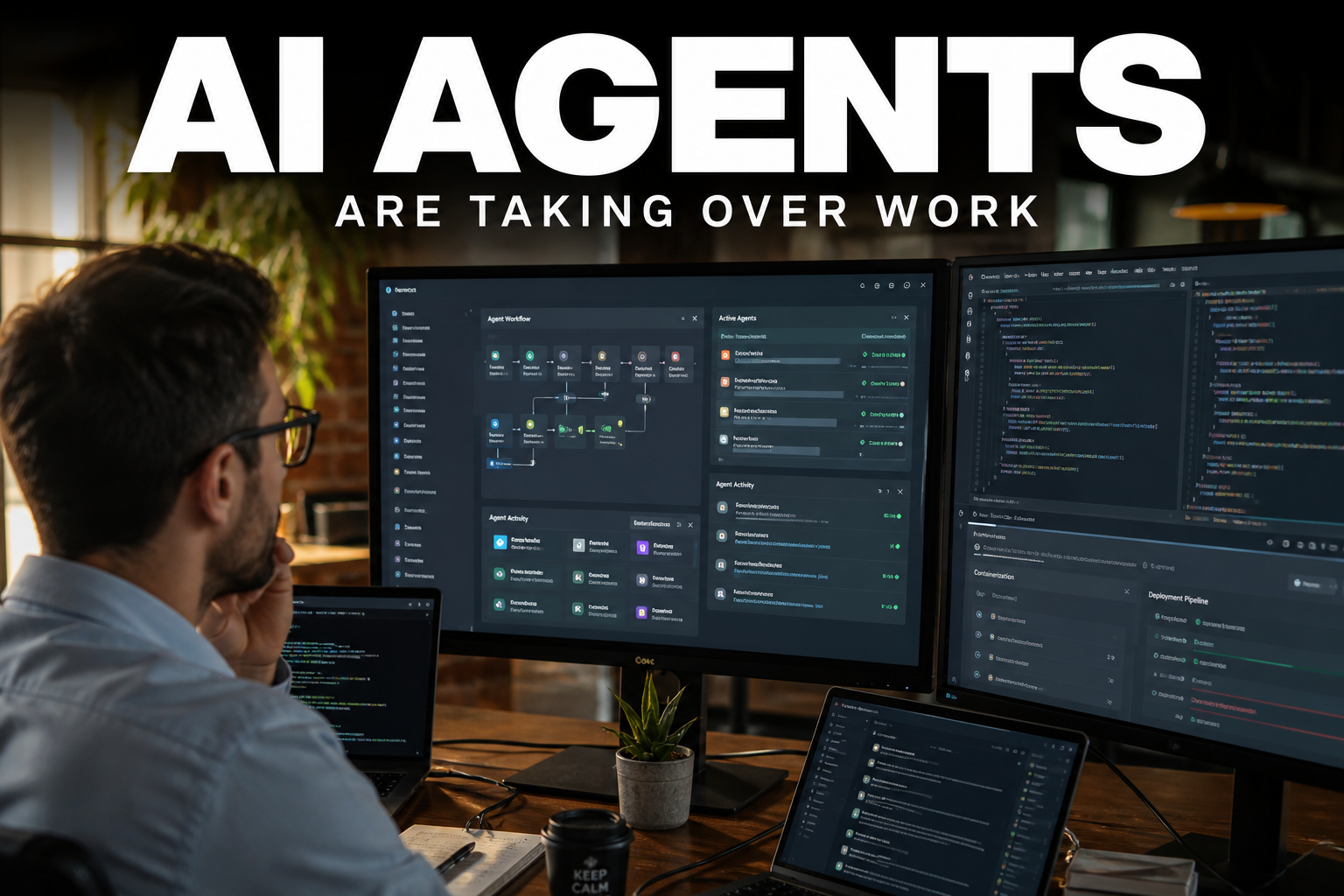
● Agentic AI Shifts
The Core Point to Watch Now: AI Agents Are Moving Beyond “Conversational Tools” and Into “Work Operating Systems”
The next stage of the AI industry is no longer simply a chatbot competition, but a shift toward agentic AI competition that integrates actual development, collaboration, deployment, and verification into a single workflow.The most important point in this discussion is that Claude Code Desktop has evolved beyond a simple coding assistant into an “AI work infrastructure” that includes session separation, parallel work, cloud execution, remote control, browser verification, and enterprise security controls.This is not just a technology trend. It is a shift that could affect the productivity software market, cloud demand, enterprise AI adoption, developer productivity, and AI security and governance all at once.
News-Style Core Point Summary: What Has Changed in Claude Code Desktop?
Claude Code Desktop is not merely an AI for coding. It is a desktop app focused on actually “getting work done” in development environments.It allows users to handle chat, code work, long-running tasks, browser verification, file editing, terminals, and remote sessions within a single screen.In other words, it is closer to a development workflow automation platform than a simple generative AI tool.
The especially notable points are as follows.Each session has an independent context and workspace.It supports parallel sessions that allow multiple tasks to run at the same time.It automatically provides separated work environments based on Git worktrees to reduce conflicts.Cloud sessions continue running even after the app is closed, making them useful for long-running tasks.It can directly verify apps in the browser, capture screens, inspect the DOM, and continue making fixes.In enterprise environments, permissions, external sites, SSH, MCP, and plugins can be controlled in detail.
1) The Essence of AI Agent Competition: It Is About “Execution,” Not “Generation”
The direction shown by Claude Code Desktop is very clear.AI is now evolving beyond the level of giving good answers and moving toward actually performing work.
In the past, AI was strong at summarizing documents, generating code samples, and organizing ideas.Now it is moving to the next stage.It reads files,modifies code,runs commands,executes tests,checks results in the browser,and fixes problems again when something goes wrong.
This flow is extremely important from a corporate perspective.That is because what consumes the most human time is not “thinking,” but “repetitive execution.”Therefore, future AI investment is likely to expand beyond simply purchasing LLM APIs intodevelopment environment automation,collaboration tool integration,cloud execution infrastructure,and security controls.
2) Why Session-Centered Design Matters: Multitasking Productivity Changes
The most powerful structure of Claude Code Desktop is session independence.Each conversation is a session, and each session manages its own history, project folder, and code changes separately.
Why does this matter?Because in real work, people do not handle only one task at a time.Backend fixes, frontend verification, PR reviews, bug investigations, and deployment checks often run simultaneously.Existing tools tend to force all of this into one mixed workspace, but session separation reduces that confusion.
The core advantages are as follows.Contexts do not get mixed across tasks.Parallel work becomes possible.Responsibility and tracking become easier by task unit.Later PRs, change history, and reviews also become clearer.
This is not only a matter of developer productivity.In future enterprise AI adoption, the most important standard will not be whether AI “does one thing well,” butwhether it can reliably handle multiple tasks at the same time.
3) Parallel Sessions + Git Worktree: A Structure That Raises Collaboration Productivity to the Next Level
Claude Code Desktop separates each session in a Git repository using a Git worktree.In other words, changes in one session do not immediately affect another session.
This structure is quite powerful in real work.For example,one session can fix a login bug,another session can organize a payment API,and another session can only plan a refactoring.
The advantages of this approach are clear.Experimentation becomes easier.The burden of rollback decreases.Conflicts are reduced.PR-level organization becomes cleaner.It is useful for large-scale refactoring.
In other words, this should not be seen as a simple convenience feature.It should be viewed as a way for AI to standardize the parallel work structure of development teams.
4) What Permission Modes Tell Us: The Core of Enterprise AI Is “Controllable Autonomy”
One of the most realistic points in this document is the permission mode structure.The design that carefully separates how far AI can execute actions on its own is extremely important.
The modes can be understood broadly as follows.Manual requires human approval every time.Accept edits allows file modifications more quickly, but still requires confirmation for terminal commands.Plan first reads and proposes only an execution plan.Auto moves more autonomously while including background safety checks.Bypass permissions runs with almost no restrictions, but is limited from a security perspective.
This structure matters because companies want AI, but fear it at the same time.No matter how smart AI is, incorrect command execution, file contamination, permission abuse, and actions on external sites can all become major risks.
Therefore, future AI competition is likely to be determined not only by “stronger models,” but also bymore sophisticated permission design,organization-specific policy control,and auditability.
5) Browser Verification and External Site Control: AI Is Entering the Stage of Handling Real Services
Claude Code Desktop can preview and test apps in a browser panel and also handle external sites.This is a very important turning point.
That is because one of the most costly parts of development is“checking whether the actual screen works properly after the code has been changed.”
Here, Claude can perform the following tasks.Run the development server,check the screen in the browser,capture screenshots,inspect the DOM,click buttons,enter form data,detect errors,and revise the code again.
In other words, AI is expanding beyond a simple code generator into aQA + debugging + verification automation tool.
In particular, access to external sites requires approval, and organizations can control it through allowlists and blocklists.This is extremely important in the B2B market.Companies want controllable automation more than convenience.
6) Computer Use: The Era in Which AI Directly Handles the Desktop
This feature is quite symbolic.Claude can open the user’s actual computer screen, operate apps, and perform screen-based work.
The meaning of this feature is simple.AI can also handle legacy tools that do not have APIs.In other words, AI can enter GUI-centered work such as ERP systems, internal admin tools, and specific desktop programs.
However, the important point is that this feature is powerful, but also risky.That is why access permissions, screen access, app-specific controls, masking, and exception app settings are included.
From an industrial perspective, this isthe final segment of knowledge work automation,or the core technology for automating work that does not have APIs.
7) The Meaning of Cloud Sessions: Long-Running Work Becomes a Default AI Use Case
Cloud sessions continue running even after the app is closed.This is not just a convenience feature. It changes the AI usage pattern itself.
In the past, AI was centered around short responses while staying next to the user.In the future, AI work that runs overnight will become natural.Representative examples include large-scale refactoring,test suite execution,migration,multi-repository work,and long-running debugging.
This is also connected to demand for cloud computing.As AI actually runs work for longer periods,the markets for computing resources,session management,workflow orchestration,and remote monitoring will grow together.
Simply put,AI competition is now moving beyond model performance competition and towardexecution infrastructure competition.
8) Plugins, Connectors, and MCP: The Real Value of AI Comes From “Connectivity”
Claude Code Desktop can connect with external tools such as GitHub, Slack, Linear, Notion, and Google Calendar.This part is extremely important.
The future value of AI will be determined less by how smart the model is and more byhow many work systems it can connect to.
That is because company work is ultimately distributed.Schedules are in calendars,issues are in Linear,conversations are in Slack,documents are in Notion,and code is in GitHub.
If AI connects all of this,it becomes not just a question-and-answer tool, but the central hub that links the entire workflow.
The MCP server and plugin structure are very strategic in this regard.As standardized connection methods increase,the barrier to enterprise adoption becomes lower,and the complexity of AI operations decreases.
9) The More Important Point From an Enterprise Perspective: Security and Governance Are Product Competitiveness
News articles and YouTube videos often end by simply saying “new features have been added.”But the truly important question is whether companies can actually use them.
The points to watch in this document are as follows.External site access control,SSH host allowlists,local session blocking,Auto mode disabling,Bypass permissions blocking,device management policies,SSO requirements,MCP tool control,and network allowlists.
This is a very clear signal.The competitive battleground for AI products is no longer model performance, butan operating system that companies can safely allow.
In other words, in the B2B AI market,“how safely, controllably, and auditably it can be used” is becoming more important than“how smart it is.”
10) From a Global Economic Perspective: AI Software Is Now Changing the Cost Structure of Productivity
This change is not simply a story about development tools.From a global economic perspective, AI has the potential to change corporate cost structures and workforce allocation.
The areas likely to be most affected are as follows.Software development productivity,IT operations automation,increased cloud usage,enterprise subscription transitions,rising security and compliance costs,and expansion of the collaboration tool integration market.
This means that companies that adopt AI quickly will be able to process more work with fewer people.On the other hand, companies that are late to adopt AI may face greater pressure from labor costs and operating costs.
Therefore, AI is no longer just a technology trend.It is an economic variable that creates gaps in corporate competitiveness and productivity.
Core Points Often Missed by Other YouTube Channels or News Outlets
There are several very important points here that are often overlooked.
First, the essence of this change is not “chatbot enhancement.”It is AI changing the structure of actual workspaces.
Second, session separation and worktrees may look like minor features,but in large organizations, they can determine whether AI adoption succeeds or fails.The reason is that context conflicts and task branch management are core to real productivity.
Third, permission modes and organizational policies are not additional features.They are essential conditions for enterprise AI.AI without security controls will ultimately struggle to expand in usage.
Fourth, cloud sessions and remote execution are key mechanisms that expand the market,because AI usage directly leads to cloud costs and infrastructure demand.
Fifth, browser verification and computer use are signals that we are movingfrom an era in which “AI only writes code” to an era in which “AI operates systems.”
Final Perspective: The AI Trend Is Now a Productivity Platform War
The current market is not simply a fight over who can build a better model.It is a fight over how deeply AI can enter work tools, cloud systems, development environments, collaboration platforms, and security policies.
Claude Code Desktop clearly shows the direction of this change.Developers work faster,teams process more tasks in parallel,companies maintain stricter control,and AI takes on deeper execution responsibilities.
Ultimately, the core point of the next AI trend is this.The market will be won not by AI that answers, but by AI that works.
< Summary >
AI is now evolving from an answer tool into a work execution platform.Claude Code Desktop demonstrates this shift through session separation, parallel work, cloud execution, browser verification, computer use, and enterprise security controls.The core points are improved development productivity, enterprise AI adoption, expanded cloud demand, and stronger security and governance.Ultimately, the next battleground of the AI trend will not be “how smart it is,” but “how safely it can handle real work.”
[Related Articles…]
- Anthropic AI Strategy and Enterprise Automation Trends
- AI Agents and the Future of Work Execution Platforms
*Source: https://code.claude.com/docs/en/desktop?utm_source=it&utm_medium=email&utm_campaign=Week2_2026_Q3_DEVREL_MKTG_Claude_Code_Newsletter_Aug28&utm_term=claude_code&utm_campaignId=19603515#work-in-parallel-with-sessions
Leave a Reply