
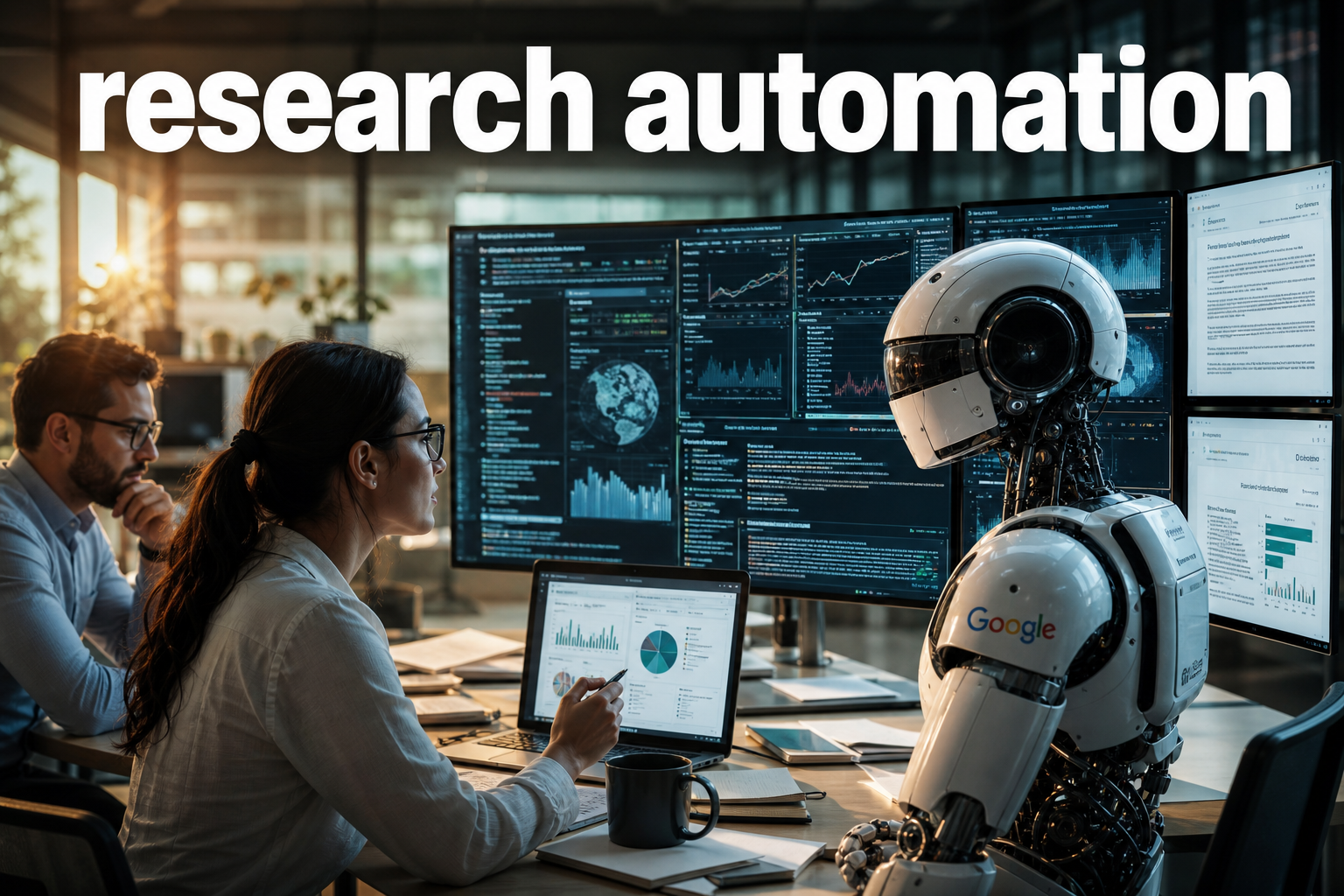
● Multiaagent Breakthrough
The Moment AI Becomes a Research Partner: How Google Antigravity’s “Teamwork” Changes the AI Collaboration Landscape
The core point right now is not a simple AI chatbot.
Multi-agent orchestration, where multiple AI agents propose, critique, and revise one another’s work while solving problems together over long periods, is entering the mainstream.
This Google Antigravity Teamwork update is an important signal that allows us to read the broader trends in AI agents, generative AI, AI semiconductors, cloud computing, and digital transformation all at once.
The key takeaway is that it has produced real results, including solving difficult mathematical problems, simulating a RISC-V CPU, and optimizing open-source projects.
In other words, AI is moving beyond “a tool that gives good answers” and becoming “a partner that conducts research together.”
The Core Announcement in the News: What Is Teamwork?
Google Antigravity has announced an update to Teamwork, a multi-agent framework.
This feature is structured so that multiple agents operate simultaneously while reviewing and improving one another’s work.
Simply put, instead of one AI completing everything alone, it creates a team that collaborates over an extended period.
This structure is stronger for problems with many variables, such as long-horizon research, complex software engineering, and large-scale data analysis, rather than simple tasks.
The user manages only the goal and final approval, while the AI team repeatedly handles the intermediate exploration and verification.
This approach is likely to increase the importance of agent operations, a higher-level concept than prompt engineering.
Why It Matters: A Structure That Goes Beyond the Limits of a Single AI
The essence of this announcement is not a single high-performing model, but orchestration.
Even with a good model, long-term tasks can easily become unstable if there is no system for breaking down problems, comparing candidates, and catching errors.
Teamwork addresses exactly this weakness.
By having agents critique one another, it creates a structure that does not amplify early mistakes but instead filters out errors quickly.
This is a very important shift in the AI industry.
In the future, competitiveness is likely to move from “model size” alone to “how reliably an AI team can be operated.”
Pattern-Based Design: AI Team Composition Changes Depending on the Problem Type
Teamwork is not one fixed AI team.
It automatically selects different patterns depending on the nature of the problem.
Here, a pattern is a blueprint that defines which agents participate, what roles they take, and what criteria must be passed before moving to the next stage.
In other words, it is a structure that changes the team composition after looking at the problem.
Five Major Patterns
1) Iterative Coding
This method is optimized for a loop of writing code, testing it, and fixing it again.
It is strong for non-decomposable problems that are difficult to solve correctly in one attempt.
2) Distributed Coding
Engineering tasks that can be divided are handled in parallel by multiple workers, while critique agents review the results.
It is suitable for large-scale development collaboration.
3) Long Proof
This is a pattern for exploring open problems over the long term, such as mathematics and theoretical computer science.
It creates many candidate strategies, refutes them, and synthesizes them again.
4) Self-Verification
This is a pattern for proving and verifying its own reasoning.
It focuses on reducing errors in deep mathematical reasoning.
5) Document Review
This pattern structurally reviews and critiques papers, technical documents, and research materials.
It is highly useful for automating research work.
The Part to Watch Most Closely: Long Proof Changes the Level of Research AI
The most powerful part of this update is the Long Proof pattern.
This pattern does not simply generate an answer; it selects strategies, refutes them, decomposes problems, and recombines ideas.
In other words, it is closer to how researchers actually solve problems.
The Core Structure of Long Proof
Strategy Competition
It generates multiple strategies at the same time and assigns a falsifier role to each strategy to try to break it.
In this process, even incorrect ideas are not completely discarded, and useful pieces are preserved.
Problem Decomposition
It divides a large proof into subproblems so that they can be handled independently.
This structure makes it possible to parallelize even long-running research.
Reverification of Each Subproblem
At each stage, it reads both the candidate solution and the critique, then creates a better solution again.
If it is wrong, it goes back and reflects the accumulated refutations.
Failures Are Also Stored as Assets
Previous failures and verification results are used in the next attempt.
This is not simple memory, but a research asset through which AI improves its work.
What It Actually Achieved: Results in Mathematics and Theoretical Computer Science
Google said it solved multiple open problems using a combination of Teamwork and Gemini models.
This is highly symbolic even within the AI industry.
That is because it provides evidence that generative AI is moving beyond simple coding assistance and directly improving research productivity.
Summary of Major Results
Seven Open Problems Solved
It produced results in areas such as sparse convex optimization, subspace approximation, verifiable LLM quantization, vector embeddings, Prefix-Matrix decomposition, and Knuth’s Cycles conjecture.
71% on TCSBench
It recorded the best internal score on a theoretical computer science benchmark.
What matters especially is that this level of performance was achieved by using a Flash-class model together with Teamwork.
Expert Verification
Most results were reviewed by human experts, and some were even formally verified with Lean.
In other words, the goal was not “plausible answers,” but “verified results.”
Implications for Mathematical AI: Models Now Need Quality Control for Thinking
In fields such as mathematics, physics, semiconductors, and algorithms, systems that reduce the possibility of incorrect answers to the end will become more important than models that simply produce an answer once.
This announcement showed that AI can run exploration, verification, and revision like a single production line.
This is a change that can transform research practice.
It also presents a new challenge for large enterprises, research institutes, and startups: how to design AI agent automation.
System Engineering Results: A RISC-V CPU Simulator That Boots an Operating System
Teamwork did not only perform well in mathematics.
This time, it built a sophisticated cycle-level RISC-V CPU simulator from scratch and succeeded in booting an operating system.
This is not simple coding automation, but a highly difficult task at the boundary between hardware and software.
What Does This Mean?
The fact that the simulator booted an operating system such as xv6 all the way to the shell means that it achieved a fairly high level of functional consistency.
Furthermore, it successfully ran more than 100 RISC-V benchmarks.
Finally, it also presented an average cycle alignment error of 0.71% compared with actual BOOM hardware standards.
This figure means that AI can show considerable reliability even in system-level engineering.
Why This Matters Even More: It Connects to AI Semiconductors and System Design
This achievement can connect directly to AI semiconductors, computer architecture, edge devices, and server optimization.
Even beyond GPUs, an era is approaching in which AI helps with design and verification on open architectures such as RISC-V.
In the long run, AI agents are highly likely to enter the entire stack of chip design, firmware, operating systems, and compiler optimization.
Open-Source Code Optimization: Real Contributions to Eigen and ParlayHash
This announcement did not end as a research demo.
Teamwork also contributed to actual performance improvements in open-source libraries.
Representative Cases
Eigen Optimization
It identified inefficiencies in GeMV operations where there is only one row or one column, and applied direct access, SIMD, and accumulator unrolling.
This change was actually reflected upstream.
ParlayHash Improvement
Using optimization ideas from the Swiss Table family, it improved the performance of a concurrent hash table.
It achieved results such as a 2x increase in initial insertion throughput with 64 threads and a 1.5x increase in overall single-thread throughput.
Memory efficiency also improved, and this too led to upstream adoption.
What to Watch in the Open-Source Ecosystem
What matters is not the benchmark numbers themselves, but the fact that these were real contributions accepted by external maintainers.
This means AI has reached the stage where it does not merely make suggestions, but passes the code review process and is actually deployed.
This is a signal that the definition of development productivity is changing.
The Most Important Point That Other News Often Misses
The truly important point here is not that “AI has become smarter.”
The core point is how well AI intelligence is organized and operated.
Rather than a model becoming slightly better, a structure that combines multiple models and agents to reduce failure and push long-term tasks to completion can create a far greater difference.
In other words, the next competition will be closer to an agent operating system than to single-model performance.
This shift will affect search, coding, research, semiconductors, financial research, and manufacturing optimization.
Interpretation from a Global Economic and Industrial Perspective
This announcement once again shows where investment focus in the AI industry is heading.
Capital is likely to move not only toward models themselves, but also toward multi-agent platforms, developer tools, verification infrastructure, and high-performance computing.
In particular, companies will aim for productivity innovation by embedding AI teams into work processes rather than simply adopting generative AI.
In this process, demand for cloud computing, semiconductors, and data center investment may grow even further.
Ultimately, AI is not only changing the software market, but also moving toward reorganizing IT infrastructure and industrial productivity itself.
Changes to Watch Going Forward
As frameworks like Teamwork become more established, the following changes may accelerate in enterprise settings.
First, research and development speed will increase.
Second, code review and verification automation will become stronger.
Third, AI will be constantly deployed in complex system design.
Fourth, the exploration cost of the entire team, not just the time of one expert, will decrease.
Fifth, the productivity gap between companies that use AI well and those that do not may widen further.
Conclusion: The One-Line Message This Announcement Leaves Behind
The next stage of AI is not a bigger model, but a model that collaborates better.
The core of that collaboration is a multi-agent structure that automates proposal, critique, verification, and reconstruction.
This change has the potential to reshape research, development, system engineering, open source, and future industrial competitiveness as a whole.
< Summary >
Google Antigravity’s Teamwork is a multi-agent framework in which multiple AI agents conduct research and verification together.
It demonstrated real results, including solving difficult mathematical problems, building a RISC-V simulator, and optimizing open-source projects.
The core point is not model performance, but how AI is operated, and future AI competition is likely to shift toward agent orchestration.
[Related Articles…]
How AI Agents Are Changing Workflow Automation and Productivity Innovation
AI Semiconductors and Data Center Investment: Where the Next Growth Wave Is Heading
*Source: https://antigravity.google/blog/teamwork-when-ai-becomes-a-research-partner
Leave a Reply