
● OpenClaw 2.0 Overhauls AI Onboarding for Faster Growth
OpenClaw 2.0: What a Massive Update, Completed Almost Like an Accident, Really Means
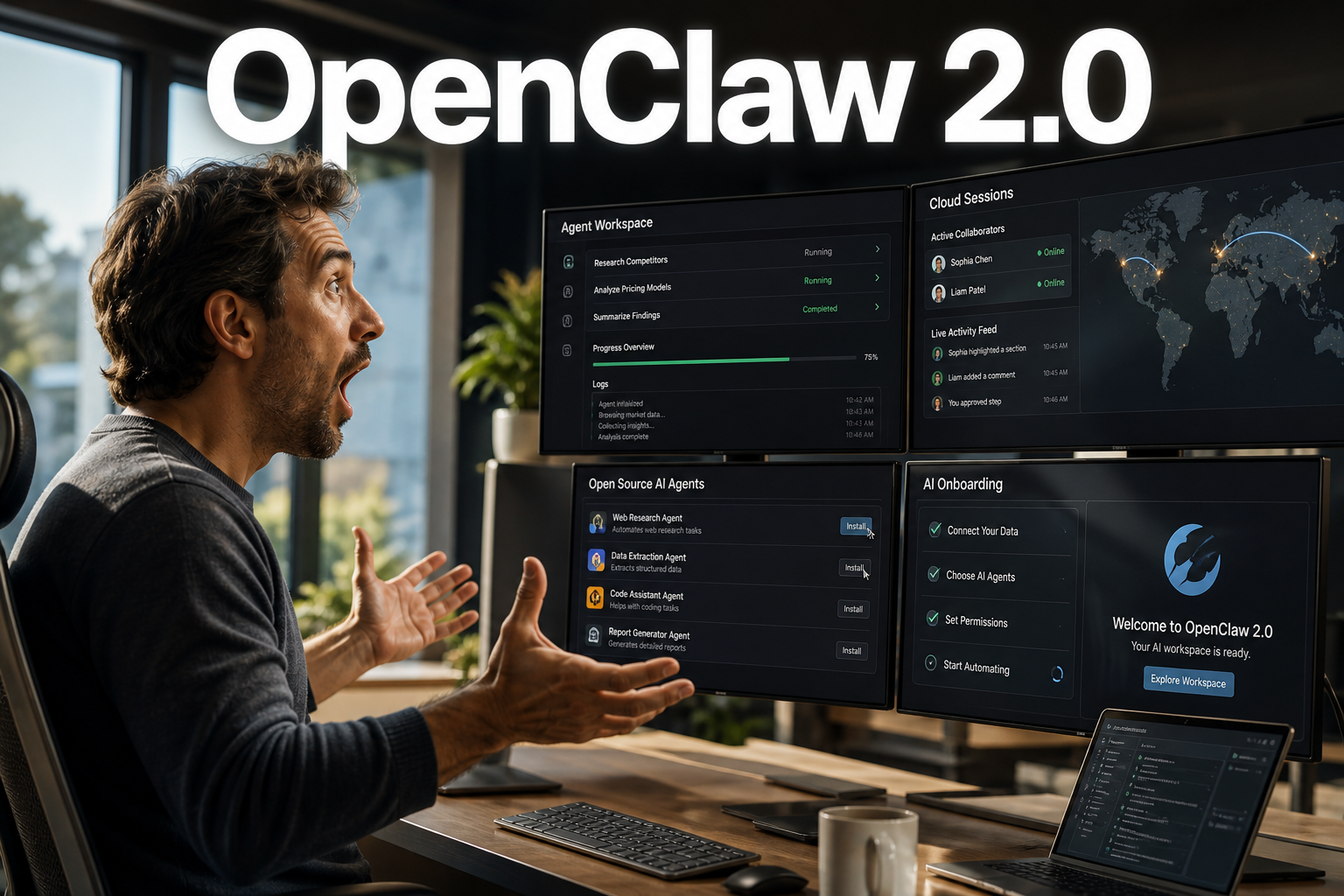
OpenClaw 2.0, released today, is not just a simple feature addition.
It is effectively a complete overhaul that reorganizes everything from the installation experience, browser app, collaboration model, security, plugins, automation, memory, and model connections.
This update involved 933 contributors, including 569 first-time contributors, and more than 16,000 cumulative Pull Requests.
On the surface, it may look like “a version that is easier to install,” but in reality, it is a symbolic event that shows how far AI agents, open-source ecosystems, cloud collaboration, and browser-based work environments are evolving.
This case, in particular, only reveals its true meaning when viewed together with the global economic outlook, AI trends, the productivity software market, and the competitive structure of open source.
Key Takeaways First, in News Form
- OpenClaw released 106 versions almost nonstop over 230 days, but this time it paused releases for nearly seven weeks to rework its structure.
- The goal was to “make it faster to install and faster to use.”
- However, installation simplification was not the end of it. As the browser app was rebuilt as the primary main experience, the entire product was reorganized to a 2.0 level.
- This update showed that OpenClaw can expand beyond a personal AI assistant into a multiplayer agent environment used together by families and teams.
- The fact that it is open source is the core point.
Its direction has become even stronger in avoiding dependence on a specific company, specific model, or specific AI provider.
Why This Update Matters
The core point of OpenClaw 2.0 is not that it has more features.
Rather, its importance lies in the fact that it “reduced complexity and raised real-world usability.”
In the AI market, model performance alone is not the most important factor.
The real competition lies in how much friction can be removed from the moment users first install a product to the point where they actually apply it to their work.
This applies directly to the entire AI agent market as well.
No matter how good a generative AI tool, workflow automation system, or browser-based AI may be, adoption slows down if installation is difficult and connections are cumbersome.
Conversely, if users can quickly get started by using their existing ChatGPT, Claude, API keys, or local models, the adoption speed rises sharply.
In other words, this update is a case that shows “usability competition” has become more important than “model competition.”
1. Why the Installation Experience Was Completely Rebuilt
A Method That First Uses the User’s Existing Environment
OpenClaw 2.0 first makes use of the resources that new users already have.
For example, it allows users to connect their existing ChatGPT or Claude subscription, API keys, or local models first.
This approach reduces the burden of initial setup and greatly shortens the time it takes to reach the first conversation.
The main message is clear.
AI tools are now stronger when they “naturally sit on top of an environment users already use” rather than requiring users to “set up everything from scratch.”
This is likely to become a very important design standard for AI SaaS, workflow automation, and cloud-based productivity tools going forward.
Configure Later, Let Users Try It First
This version was designed to reduce initial settings and complete the remaining configuration through conversation.
In other words, users first meet the agent, and then fill in the necessary features afterward.
This is not merely a UX improvement, but a shift in onboarding philosophy.
The most common failure in AI products is “showing too many good features too early.”
OpenClaw, by contrast, radically simplified the first-use experience.
This approach has a strong chance of becoming a standard in the markets for AI collaboration tools, AI browsers, and business agents.
2. Why the Browser App Was Elevated to the Main Stage
The Trend in Which the Browser Becomes the Workspace
OpenClaw rebuilt the browser app not as a supplementary screen, but as the core experience.
Now users can start directly from the chat window, follow tasks in progress, and continue setup when needed.
The reason this change matters is clear.
The browser is already the workspace where most people spend all day.
This means AI can naturally enter the workflow without requiring users to open a separate program.
One of the keywords to watch in today’s global economy and IT market is browser-based AI.
Because search, document writing, schedule management, messaging, CRM, and email all continue inside the browser, productivity feels much more tangible the moment AI attaches itself to that environment.
The Browser App Is Not Just a UI, but an Entry Point
OpenClaw changed the browser from a “settings page” into “the place where the first conversation begins.”
This is very important.
Many AI tools have impressive settings screens, but weak entry points into actual work.
By contrast, this OpenClaw update emphasizes a structure that users can use immediately.
The main message is this:
In the AI era, product competitiveness depends more on “the first successful experience” than on the model itself.
Users continue using a product only when they experience the first conversation, the first automation, and the first completed task.
3. The Real Growth Model OpenClaw Is Pointing Toward
A Structure That Starts with Small Workflows and Gradually Expands
OpenClaw does not force massive automation from the beginning.
Instead, it presents very small examples.
For instance, it might be a simple task such as checking a child’s school emails and sending a Telegram alert when something important appears.
This method works well because it is practical.
Even one inbox, a few important conditions, and delivery of alerts to one destination can already be useful enough.
As these small successes accumulate, they can later expand into larger workflows connecting email, messages, calendars, documents, and notes.
This shows an important direction for the AI agent market.
Rather than “making AI do everything like a general-purpose intelligence from the beginning,” it is more realistic to “solve exactly one problem well and expand gradually.”
AI That Connects Real Life and Work
The examples are also highly realistic.
If a sibling sends a message saying, “What was the iPad we bought for Dad?” there is no need to manually search through email receipts.
You can simply forward the message to Claw and ask it to find the answer and send it back to your sibling.
This scene matters because it shows that AI is changing from a simple search tool into an execution engine that understands user context and moves across multiple channels.
This shift clearly shows where the core competitiveness of generative AI, digital workflow automation, and personal assistant AI will be found in the future.
The answer is not “smarter speaking,” but “more natural execution.”
4. A Collaboration Model That Has Evolved into Multiplayer AI
The Change Brought by Shared Cloud Sessions
One especially notable feature in this update is Shared Cloud Sessions.
This feature allows users to invite other team members into real-time work or hand off tasks without losing context.
Existing AI tools have often been used like personal assistants.
But real work is not done alone.
Planning, development, operations, review, and approval processes continue one after another, and productivity drops sharply when context is lost along the way.
OpenClaw directly addresses this problem.
In other words, the AI agent has become part of the collaboration space rather than a solo performer.
Market Potential Expanding from Family Use to Team Use
This structure is not just a business feature.
Family members can also share the same context.
For example, one family member can take over a schedule that another was managing, or several people can handle shared shopping, school schedules, or travel preparation together.
This is a fairly significant point in the AI market.
It can expand beyond the personal productivity market into family-level collaboration, small-team collaboration, and community-level knowledge sharing.
The main message is this:
The next generation of AI products is more likely to evolve into “collaboration platforms that connect work between people” than into “assistants used alone.”
5. What This Update Suggests for the Global Economy and AI Trends
Strengthening the Competitiveness of the Open-Source AI Ecosystem
OpenClaw is open source.
This is extremely important.
It means users are not dependent on the policies, pricing, or model strategies of a specific company.
From the perspective of the global economic outlook,
the AI market can no longer be explained only through competition among closed platforms.
As the open-source ecosystem rapidly matures, both companies and individuals gain more flexible choices.
This trend will affect future AI infrastructure investment, cloud demand, model optionality, security policies, and control over internal data.
In other words, open-source AI is not merely a technical issue, but a strategic issue.
The Reshaping of AI Browsers, Automation, and Productivity Tools
OpenClaw 2.0 dealt with the browser app, automation, messaging, memory, plugins, and security all at once.
This means the competitive arena for AI products has expanded.
What will matter going forward is the following.
- Who has the better model
- Who helps users get started faster
- Who enables more natural collaboration
- Who handles data more safely
These four factors are likely to become the core axes of AI trends.
Browser-based AI and workflow automation, in particular, have strong potential to raise real enterprise adoption rates, which means related industries may also have high growth potential.
The Real Barrier to AI Adoption Is Complexity, Not Features
Many people think AI tools are better when they have more features.
But in the actual market, the opposite is true.
If a product is too complicated, people cannot even start using it, and if they cannot start, it cannot spread.
OpenClaw 2.0 identified this point accurately.
It simplified the installation process, created a faster first-use experience, and changed the structure to enable shared work.
This is the realistic direction AI products should move toward in the future.
6. The Core Point Often Missed by Other News or YouTube Coverage
The Most Important Question Is Not “Who Owns the AI,” but “Who Owns the Context”
The real point of this update is not simple feature improvement.
It is a structure that preserves the context people create, the flow of conversations, work history, and the state of ongoing collaboration.
Many AI services answer well, but they do not return ownership of context to the user.
By contrast, OpenClaw allows users to own the system through its open-source foundation and modify it together when needed.
This will create a very big difference in the AI era.
No matter how good a model is, it cannot be used effectively in real work if context is broken.
Conversely, a system that preserves context can have much stronger practical value even with a smaller model.
The Battle Is Less About “Making AI Smarter” and More About “Bringing AI Closer to Work”
Most people talk only about AI performance metrics.
But real users care more about flow than raw performance.
Email, messaging, browsers, documents, calendars, and notifications must connect naturally for a tool to become something that truly helps people work.
OpenClaw 2.0 improved exactly that flow.
The reason this matters is that the future winner in the AI market may not be the smartest model, but the product that feels the least annoying to use.
7. Points to Watch Going Forward
- AI agents are highly likely to evolve from personal assistants into collaborative work tools.
- The browser is becoming not just a window for accessing the web, but an AI work hub.
- Open-source AI may become increasingly influential in both enterprise adoption and personal diffusion.
- Simplified installation and onboarding are core factors that determine the speed of AI product adoption.
- Shared sessions and context-preserving features are likely to become standards in future productivity tools.
Summary
OpenClaw 2.0 is a major update that pushes installation simplification, browser app restructuring, shared sessions, collaborative AI, and an open-source philosophy all at once.
The core point is not “more features,” but the evolution toward “AI that is easier to start using and more natural to use together.”
This change is an important signal for both AI trends and the global productivity market.
[Related Articles…]
- How the Open-Source AI Ecosystem Is Changing the Flow of Technology Competition
- Why Browser-Based AI Is Reshaping Workplace Productivity
*Source: https://openclaw.ai/blog/openclaw-2-accidentally
Leave a Reply