
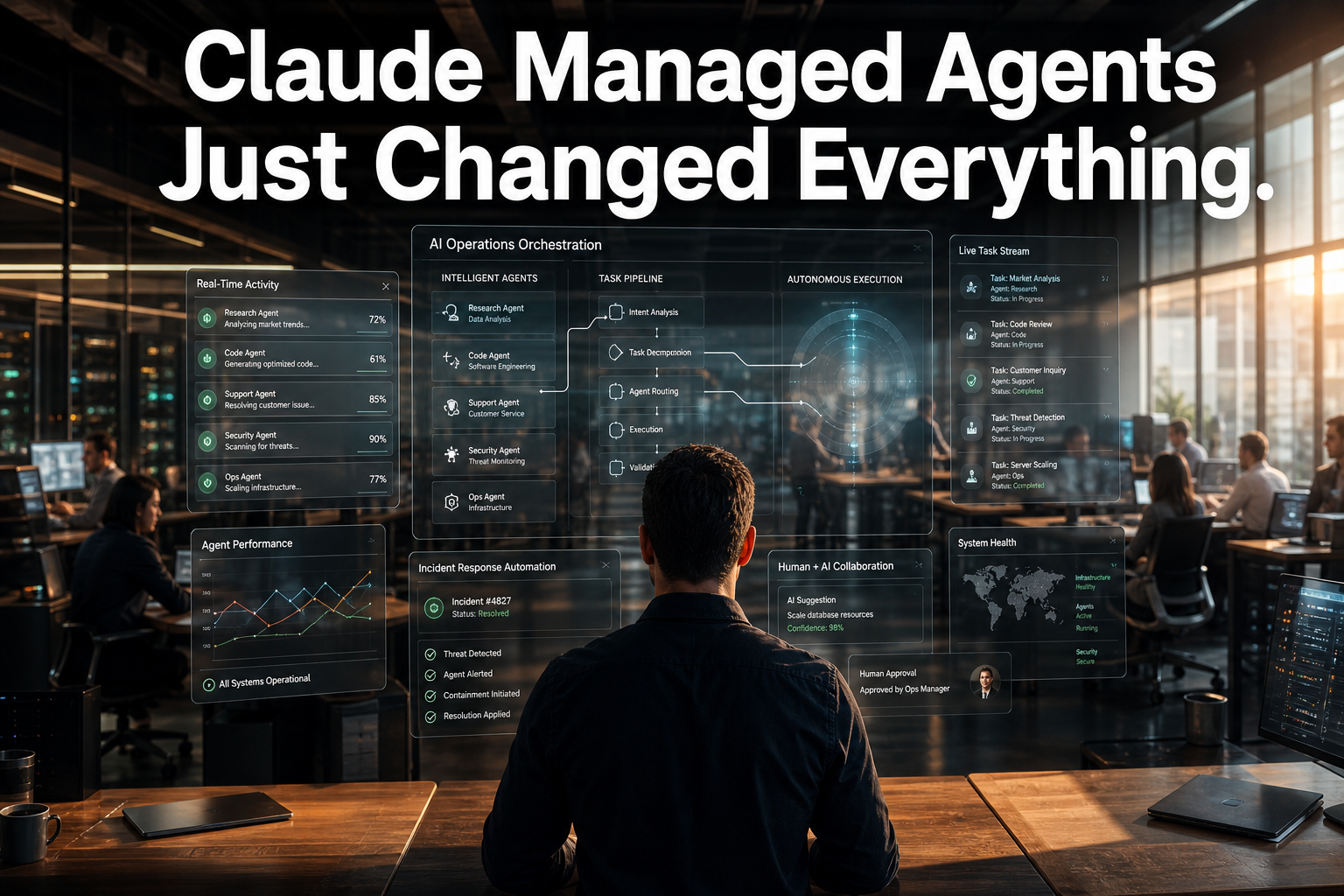
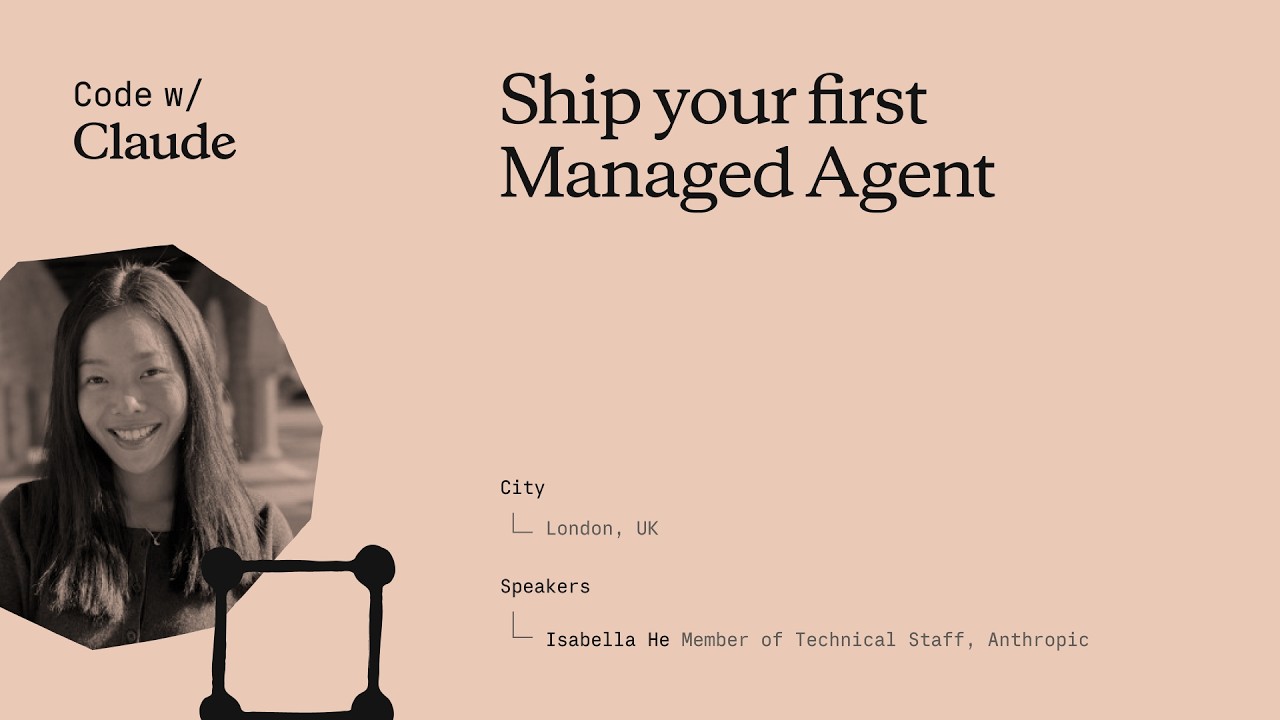
● Agent Ops Shift
The Flow for Deploying Your First Agent Immediately with Claude Managed Agents, and Why It Matters Now
The core point of this discussion is not simply “creating an agent.”
Looking at the key takeaways first
- Why agent development speed becomes 10 to 15 times faster
- How cloud-based AI agents can operate reliably
- How a structure that separates the brain and the hands changes security and latency
- How incident response AI actually analyzes logs, deployments, and metrics
- Where next-generation AI features such as memory, subagents, outcomes, and vaults are headed
- And the most important operational perspective that other articles often do not cover
This article is not just a summary of a developer workshop.
It focuses on understanding the moment when AI agents move from “experimentation” to “production”
The reason this matters from an economic and industrial perspective is also clear.AI agents are moving toward reshaping the markets for cloud computing, SaaS, SRE, Datadog, security, developer productivity, and productivity software.
News-Style Summary: The Direction of Managed Agents Shown by Anthropic
In this session, Anthropic described Claude Managed Agents not simply as a model-calling tool, but as
a complete agent infrastructure that also handles operations
Previously, developers had to do many things themselves.They had to directly build context management, compaction, tool-calling loops, hosting, scaling, reliability, session persistence, and observability.
But Managed Agents changes this structure.
The core point is not the “model,” but the “execution system”
In other words,
- models become smarter
- agents take on more complex tasks
- operations become more sophisticated
- but developers no longer have to bear all of that complexity themselves
This has significant meaning in the AI industry.Because the industry is moving beyond simply having a “good model” and into a stage where
the ability to mass-produce good agents
becomes the competitive advantage.
Why Claude Managed Agents Is Different from Previous Approaches
1. The Messages API Era
When Claude was first released, the structure was based on putting tokens into the model and receiving tokens back.Developers had to build the agent loop themselves.They also had to implement memory, context, tool management, and failure handling on their own.
2. The Agent SDK Phase
The next stage was the Agent SDK connected to Claude Code.From this point, agents became able to perform file system and computer tasks.However, hosting and scaling were still the developer’s responsibility.
3. The Managed Agents Stage
This is the core point of this session.Anthropic now provides
- purpose-built harnesses
- sandboxing
- observability
- tool runtime
- managed infrastructureso developers can focus on business logic and domain knowledge.
This structure is extremely important in the AI agent market.Because future competitiveness will shift away from “model calling” and toward
who can deploy agents faster, more safely, and in a more operationally reliable way
.
What Was Actually Built in This Session: An Incident Response Agent
In this workshop, an agent with the role of an SRE, or site reliability engineer, was built.Simply put, it is
an AI that enters the system on your behalf at 3 a.m. when an outage occurs and finds the cause
.
The tasks assigned to this agent were as follows.
- Checking metrics
- Checking recent deployments
- Analyzing diffs
- Reviewing logs
- Tracing the root cause
- Suggesting recommended actions
From a real-world professional perspective, this is a highly meaningful capability.Incident response has traditionally required humans to step in directly, but now AI can take on the first round of analysis.
Why This Matters
Incident response is not merely a technical issue.
It is directly connected to cost, trust, uptime, and customer experience
.Whether response time improves by 5 minutes or 30 minutes can directly affect revenue and brand trust.
The Core Point for Understanding the Agent Architecture: Separation of Brain and Hands
One of the most important design points in this presentation was
the separation of the agent’s brain and hands
.
To put it simply,
- Agent endpoint = brain
- Environment = hands
- Session = the execution unit that connects the two
This separation is not just a structural improvement.
It is a design that affects security, latency, reliability, and scalability at the same time
.
Why Were They Separated?
- To handle credentials and security more safely
- To flexibly divide tool execution inside or outside the sandbox
- To reduce the overhead of restarting containers for every session
- To significantly reduce TTFT, meaning time to first token
The presentation mentioned that, thanks to this structure,
P95 TTFT was reduced by more than 90%
.This is a very powerful number from a user experience perspective.
For AI services, response quality is important, but
“how quickly the first response appears”
has a major impact on perceived quality.
The Three Core Components of Managed Agents
1. Agent Endpoint
This defines the agent’s persona, capability, system prompt, model, MCP servers, and skills.In other words, it defines who this agent is and what it can do.
2. Environment
This is the space where the agent actually performs work.It includes files, networks, sandboxes, and permission policies.
3. Session
This is the execution unit that connects the Agent and the Environment.Through the session, streaming events flow, state is maintained, and execution can be resumed.
Although this structure looks simple in documentation,
in practice, it is close to a standard form for designing production agents
.
The Flow Implemented in the Workshop: How the Agent Was Completed
Step 1. Defining the Agent
An agent with the role of an SRE was created,and it was configured to use a Claude Opus-series model.The system prompt included a simple but clear role.
- It is an SRE agent
- It debugs incidents
- It accesses metrics, recent deployments, diffs, and logs
The important point here is
to make the role and tools clear rather than making the prompt overly complex
.An agent also works well only when “what it should do” is clearly defined.
Step 2. Defining the Environment
The working environment for the agent was configured.Network allowlists can also be configured,and private MCP servers can be run if necessary.
This is extremely important from a security perspective.One of the biggest obstacles to enterprise AI adoption is
external connectivity and data control
.
Step 3. Injecting Data and Context
Materials such as logs, metrics, and deployment information were inserted in file form.The performance of an AI agent ultimately depends on
how good the context provided to it is
.
This is a point many people miss.A smart model alone is not enough.
Context engineering determines agent quality
.
Step 4. Connecting the Session
A session was created to connect the Agent and the Environment so the system could actually run.Now the agent can exchange streaming events with the userand continue incident analysis.
Step 5. Connecting Local Tools
Local tools such as metric lookup, deployment lookup, diff lookup, and deletion functions were connected.The important point here is that
the agent loop and tool execution are separated
.
Thanks to this structure, tools based on local JSON files can later be easily replaced with Datadog, internal APIs, or cloud systems.
What the Agent Actually Achieved: Tracing the Cause of an Incident
The agent reviewed logs and recent deploymentsand eventually inferred the problem as follows.
- P99 latency was 10 times higher than the baseline
- One of the recent commits caused database pool exhaustion
- A specific refactoring made queries heavier
- As a result, pool resources were exhausted
This is a very common pattern in real-world operations.Even when an incident looks simple, the root cause is often a combination of
deployments, queries, resources, cache, and connection pools
.
The reason the agent is valuable here is not simply that it “gives an answer.”It is valuable because it automates
the process of forming hypotheses, checking logs, and narrowing down the root cause
.
The Most Important Point That Other YouTube Videos or News Articles Often Do Not Cover
1. Agent Competition Is Shifting from Model Competition to Operations Competition
Many people still focus only on “which model is smarter.”However, in real production environments,
session persistence, observability, restarts, security, permissions, and recoverability
are more important.
In other words, the future winner may not be the company with the best model,but rather
the company with the best agent operating system
.
2. TTFT and Event Streaming Change the User Experience
For AI services, speed is as important as answer quality.Especially in incident response, customer support, and automated workflows,if the first response is delayed, users immediately become anxious.This is why Managed Agents emphasizes event-based streaming.
3. Memory and Dreaming Are the Beginning of “AI That Remembers”
Most AI products are conversational, but their memory is weak.This is where the dreaming feature becomes quite important.The fact that an agent can review memory logs on its ownand decide what to store means it is taking the first step toward
self-improving agents
.
4. Security Must Be the Default, Not an Option
Vaults, session deletion, permission policies, and sandbox separationare core elements from the perspective of enterprise adoption.In practice, before verifying how smart an AI is,companies first verify
how safely it handles sensitive information
.
5. The True Value of an Agent Is Not “Recommendation,” but “Execution”
Many AI tools stop at analysis.But real productivity emerges when the workflow extends to
- suggesting fixes
- creating pull requests
- redeploying
- recovering from incidents
This session ultimately showed that direction.In other words, agents are becoming not report writers, but
work executors
.
The Meaning from an Economic and Industrial Perspective
This trend is not merely a story about developer tools.It affects the entire landscape of
AI infrastructure, cloud, security, DevOps, and SaaS productivity tools
.
The following keywords are especially important.
- Expansion of AI infrastructure investment from the perspective of the global economic outlook
- Potential revaluation of growth stocks and the AI sector as expectations for interest rate cuts grow
- Increased demand for semiconductors and cloud services
- Expansion of cloud computing and enterprise automation
- AI agents moving to the center of workflow automation
Companies now want to adopt not just simple chatbots,but
agents that actually perform work on their behalf
.This means
a restructuring of the productivity software market
.
Checkpoints Practitioners Must Remember
1. For Agents, Structure Matters More Than the Model
More than one good model,the structure of sessions, environments, permissions, events, and logs may matter more.
2. Context Engineering Is the Decisive Battleground
The key is how well logs, metrics, deployment history, runbooks, and postmortems are provided.
3. Security and Deletion Features Are Essential
Session deletion, vaults, and permission control are prerequisites for real enterprise adoption.
4. Agents Can Generate ROI First in Incident Response
SRE, customer support, and repetitive workflow automation are areas where ROI can appear quickly.
5. Multi-Agent Systems and Memory Will Become Mainstream
Subagents, memory, and outcomes-based design are likely to become more important than single-agent systems.
Features to Watch Next: Subagents, Memory, Outcomes, Vaults
Subagents
The main agent manages multiple assistant agents at the same time.This is advantageous for parallel processing and context distribution.
Memory
The system remembers user preferences, feedback, and repeated patterns.This provides the foundation for agents that become smarter the more they are used.
Outcomes
Rather than simple tool calls,
they enable outcome-centered agent operations
.
Vaults
Credentials and sensitive information are stored separately and securely.This is a core security mechanism for enterprise AI.
In Summary
This presentation showed
not “how to create an agent,” but “how to operate an agent”
.
There are three core points.
- Agents are now moving beyond the experimental stage and into the production stage
- The center of operations is not the model, but sessions, events, security, and observability
- Agents that remember, divide work, and take responsibility for outcomes will become the standard
Summary
- Claude Managed Agents is not model calling, but production-grade agent infrastructure.
- The core structure is the separation of Agent endpoint, Environment, and Session.
- The most important point is the separation of brain and hands, which improves security, speed, and reliability at the same time.
- This workshop was about actually building an SRE incident response agent.
- Future core features include Subagents, Memory, Outcomes, and Vaults.
- From an industrial perspective, this trend will significantly affect the markets for AI agents, cloud computing, DevOps, security, and productivity software.
[Related Articles…]
How AI Agents Are Reshaping Enterprise Automation
Why Memory Is Becoming the Core of Next-Generation AI Productivity
*Source: Claude
Leave a Reply