
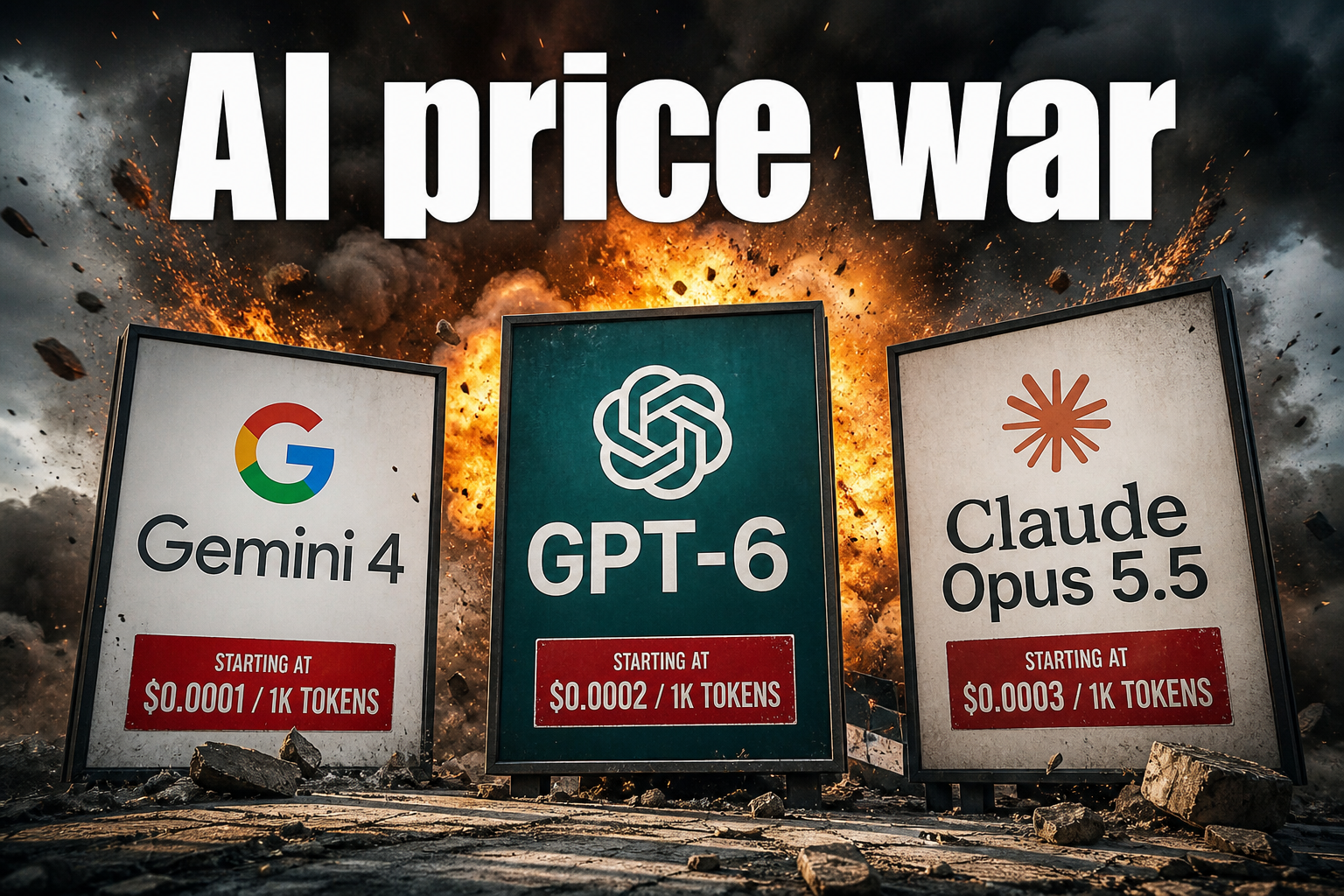
● AI price war heats up
Gemini 4 Goes Head-to-Head with GPT-6 Astra but Falls Behind Claude Opus 5.5: In Today’s AI Market, What Really Matters Is Cost More Than Performance
Key Takeaways at a Glance
- Google’s Gemini 4 Argon has reached nearly the same level as OpenAI’s GPT-6 Astra in benchmark results.
- However, it still lags behind Anthropic’s Claude Opus 5.5.
- What the market is paying more attention to, though, is price rather than scores.
- Gemini 4 Argon is much cheaper than competing models with similar output quality, which could significantly reduce enterprise AI adoption costs.
- This issue is important because it is not simply about “model rankings,” but about a broader trend connected to global AI competition, cloud costs, enterprise productivity, and demand for AI semiconductors.
What Happened: Google Unveils Its New Flagship Gemini 4 Argon
- Google described Gemini 4 Argon as “next-generation frontier intelligence.”
- The company said it delivers strong performance in coding, knowledge work, and cybersecurity defense.
- In particular, Google emphasized that it can process up to 1 million tokens at once.
- According to Google’s internal materials, it ranked first in 13 out of 19 benchmarks.
- However, the independent evaluation firm Artificial Analysis took a more cautious view.
- In conclusion, Gemini 4 is clearly a strong model, but it is difficult to call it the overwhelming No. 1.
Benchmark Results: On Par with GPT-6 Astra, One Step Behind Claude Opus 5.5
- In Artificial Analysis’s Intelligence Index, Gemini 4 Argon scored around 53 points.
- Under the tested High setting, it scored 52.6 points.
- OpenAI’s GPT-6 Astra scored 52.7 points, making it practically similar.
- By contrast, Anthropic’s Claude Opus 5.5 scored 57.6 points, about 5 points ahead.
- Anthropic’s smaller Sonnet 5.5 model also surpassed Argon with a score of 56.
- In the overall ranking, Gemini 4 placed eighth.
- The top ranks were occupied by Anthropic models and GPT-6 Astra.
Results by Detailed Test: Winning in Some Areas, Falling Behind in Others
- More important than a single metric is performance by real-world task.
- Looking at these tests, Gemini 4 Argon clearly has distinct strengths and weaknesses.
1) Terminal-Bench 4.0: Quite Strong in Coding Tasks
- In the terminal coding evaluation, Argon recorded 57.1%.
- GPT-6 Astra scored 59.1%.
- Claude Opus 5.5 led with 59.6%.
- The fact that Google’s own figures and independent measurements came out almost the same is meaningful in terms of reliability.
2) Humanity’s Last Exam: Competitive in Knowledge and Reasoning
- In this highly difficult knowledge and reasoning test, Argon recorded 57.1%.
- This was higher than GPT-6 Astra’s 54.7%.
- However, it fell short of Claude Opus 5.5’s 61.4%.
- In other words, Google’s model has strong “thinking ability,” but Anthropic still has the edge in top-tier reasoning power.
3) GDPval-AA: Real-World Work Capability Is Quite Solid
- In a test reflecting real-world tasks across 44 occupations, Argon recorded an Elo score of 1,611.
- GPT-6 Astra scored 1,542.
- Claude Opus 5.5 was far ahead with 1,846.
- This result means Gemini 4 is fairly practical in terms of productivity that enterprises can actually feel.
4) SciCode: Still a Gap with the Top Tier in Scientific Coding
- In the scientific coding test, Argon recorded 61.8%.
- Claude Opus 5.5 scored 66.9%.
- GPT-6 Astra scored 56.5%.
- In other words, Argon is strong in scientific problem-solving as well, but it is not yet at the very top level.
The Most Important Point: AI Model Competition Is Shifting Toward “Performance + Cost”
- The real key takeaway in this article is not a simple performance comparison.
- Enterprise customers today care less about “who scores 1 point higher” and more about “who can deliver good enough results at a lower cost.”
- That is why the AI market is increasingly shifting from traditional specification competition to total cost of ownership competition.
- This trend is directly connected to cloud costs, API pricing, large-scale workflow automation, and AI infrastructure investment.
- Simply put, the real battleground for AI is not the benchmark leaderboard, but the enterprise monthly bill.
Price Competitiveness: Gemini 4 Argon’s Strongest Advantage
- Gemini 4 Argon’s biggest weapon is price.
- It costs $2 per 1 million input tokens and $10 per 1 million output tokens.
- Claude Opus 5.5 costs $4 and $20, respectively.
- GPT-6 Astra costs $10 and $50, respectively.
- Based on token pricing, Argon is half the price of Opus 5.5 and one-fifth the price of GPT-6 Astra.
- From an enterprise perspective, this difference can feel quite significant.
The Difference Becomes Even Clearer When Looking at Cost per Real-World Task
- Artificial Analysis also calculated the average cost per task for each model.
- Gemini 4 Argon cost $1.99 per task.
- GPT-6 Astra cost $3.26, about 64% more expensive than Argon.
- Claude Opus 5.5 cost $5.98, about three times the cost of Argon.
- In other words, if GPT-6 Astra-level performance is needed, Google may be much more economical.
- On the other hand, Opus 5.5 offers strong performance, but its cost burden is considerable.
But Here Is Something That Must Not Be Overlooked: Argon’s Low Price May Be an Early Launch Price
- Google has only stated that the current pricing has a promotional nature.
- In other words, it remains uncertain how long this price will be maintained.
- This is very important for enterprise adoption strategies.
- That is because an initial low-price policy may be intended to secure market share, and prices could rise later.
- So the question now is not just “Is it cheap?” but “How long will it stay cheap?”
Competition in the Lower-Cost Segment Is Already Intense
- Google is not the only company using a low-price strategy.
- OpenAI’s GPT-6.1 Sol is also in the same token pricing range as Argon.
- However, its actual cost per task was even lower at $0.72.
- The reason is that it uses tokens more efficiently.
- Anthropic’s Claude Sonnet 5.5 is also in a similar price range, but because it consumes more tokens, its cost per task rises to $7.62.
- In other words, AI models should not be judged only by their “price tag”; actual usage patterns must also be considered.
Another Characteristic of Argon: A Fairly Verbose Model Relative to Its Performance
- Artificial Analysis assessed that Argon tends to be somewhat verbose.
- It generated 110 million tokens across the full index, which was higher than the median of 82 million tokens.
- This means the model uses a relatively large number of tokens to produce an answer.
- For enterprises, this characteristic is directly connected to cost.
- So even if models appear to deliver similar performance, actual billing costs can differ quite substantially from model to model.
It Is Not Yet Open to All Customers
- Gemini 4 Argon is not yet fully available.
- It is currently being provided first to select cybersecurity teams.
- After that, it will be gradually opened to paid API customers and Google AI Ultra subscribers.
- In other words, even before it is fully released to the market, the competitive landscape and pricing strategy are already being tested.
Reading This News from an Economic Perspective: AI Is No Longer Just a “High-Performance Digital Product,” but a “Productivity Infrastructure”
- This announcement shows that the AI industry has moved beyond the stage of simple technological showmanship.
- Cost reduction effects for enterprise operations are now becoming more important than model performance alone.
- This also has major significance for the global economic outlook.
- As AI adoption increases, companies expect benefits such as labor cost reduction, faster development cycles, automated customer support, and stronger security response.
- Conversely, if API costs are high, large-scale adoption is blocked, ultimately slowing the pace of market expansion.
- That is why “adequate performance + low cost + stable supply” is likely to matter more than the “highest-performance model” going forward.
Next Points to Watch from an AI Trend Perspective
- First, the gap between frontier models is gradually narrowing.
- Second, as price competition intensifies, the enterprise AI market could become mainstream more quickly.
- Third, cybersecurity and coding remain the first areas where AI is penetrating most rapidly.
- Fourth, models with strong token efficiency may achieve greater profitability over the long term.
- Fifth, as model performance becomes more similar, ecosystem, deployment speed, and tool integration will ultimately determine the winner.
The Core Point Often Missed by Other News Coverage
- Most coverage ends with a simple question of whether “Gemini 4 beat GPT or lost to it.”
- But what truly matters is “who can handle the same level of work at a lower cost.”
- The AI market is now being reshaped not by 1- or 2-point differences in benchmarks, but by differences in cost per actual work task.
- Even more importantly, Google is not immediately making this model widely available to the public, but is first supplying it in a limited way to select security teams.
- This can be interpreted as a signal that Google wants to verify deployment strategy and demand before focusing only on performance.
- The possibility that the price may be promotional is also very important.
- That is because a model that looks cheap now could show a completely different cost structure later.
- Ultimately, enterprises must look not only at model performance, but also at supply stability, pricing durability, token efficiency, and security.
Conclusion: What This Announcement Means
- Gemini 4 Argon is clearly a strong model.
- However, it is not the absolute No. 1, and it especially falls behind Anthropic’s top-tier model.
- Instead, its price competitiveness is very strong.
- Therefore, this news should be read less as “Google has caught up in the AI performance race” and more as a signal that “the AI price war has begun in earnest.”
- Enterprise AI adoption could accelerate from here, and cost-efficiency comparisons between models will become much more important.
Summary
- Gemini 4 Argon is almost on par with GPT-6 Astra, but falls behind Claude Opus 5.5.
- However, its pricing is very strong, which could significantly lower enterprise AI adoption costs.
- The key takeaway is that the market is shifting from performance competition to competition over “actual cost per task.”
- Google’s low-cost strategy could accelerate the mainstream adoption of AI.
- However, the current pricing may be an early launch policy, so its durability needs to be watched.
[Related Articles…]
- Gemini and the New AI Price War Reshaping Enterprise Adoption
- OpenAI, Anthropic, and the Future of AI Cost Competition
*Source: https://www.trendingtopics.eu/gemini-4-artificial-analysis-en/
Leave a Reply