
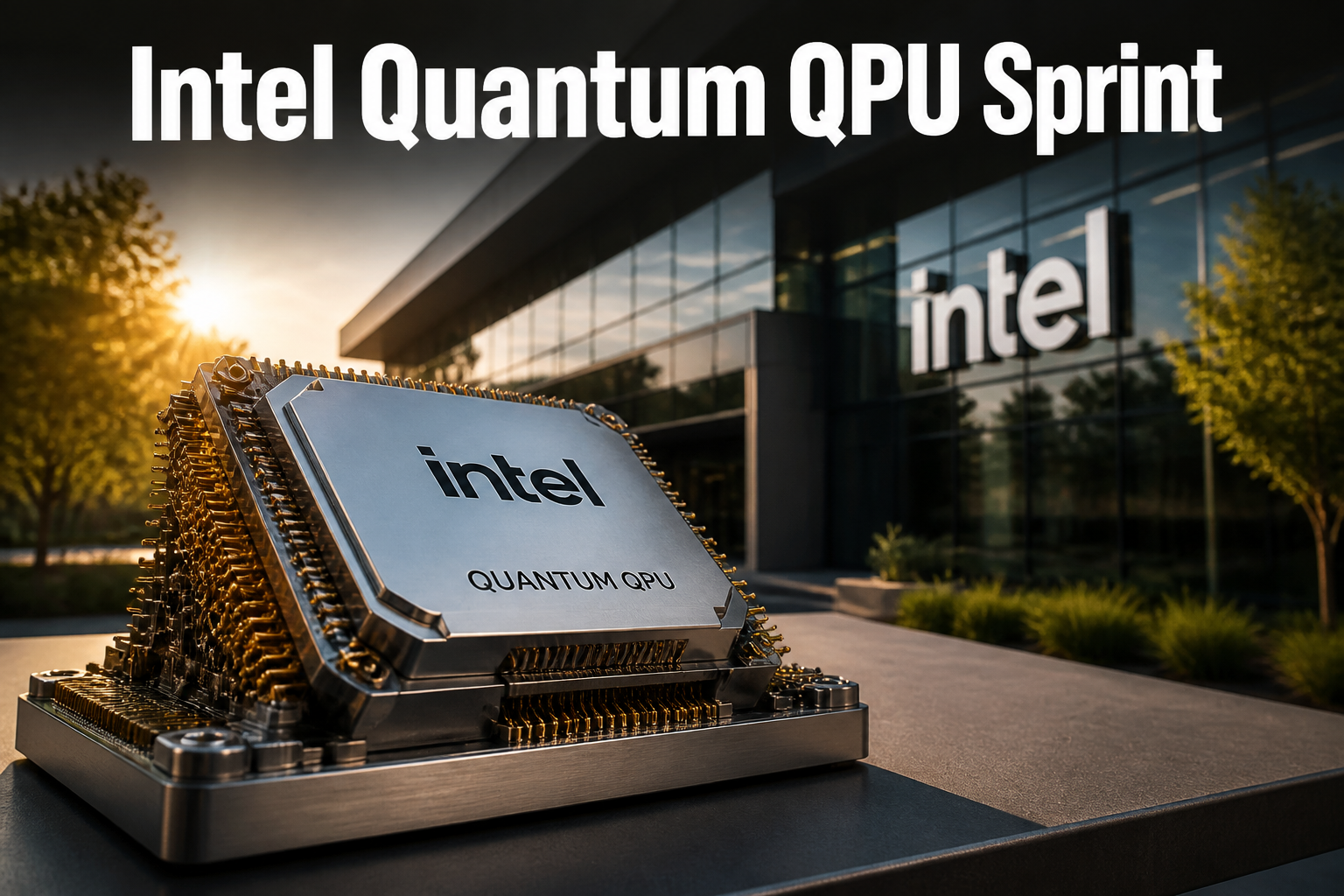
● Intel’s Quantum QPU Sprint
Intel Accelerates “Quantum Computing Commercialization” with Classiq Acquisition… The Next Battlefield in Semiconductor Competition Is the QPU
Looking at the Key Takeaways First
Intel is acquiring the quantum computing software company Classiq.This deal is important because it is not simply the acquisition of a startup, but a platform integration strategy aimed at turning quantum computing into a real business.In particular, as Intel’s silicon-based qubit technology combines with Classiq’s quantum synthesis software, the competition for full-stack quantum computing, which integrates hardware and software, is likely to begin in earnest.With AI agent-based quantum app generation technology added to the mix, the competitive focus may shift from “who can build the more powerful chip” to “who can make it easier to use.”This news should be seen as an issue that simultaneously reflects the global economic outlook, semiconductor investment, AI innovation, and the race for next-generation computing dominance.
Why Is Intel Acquiring Classiq?
Intel announced that it had signed a definitive agreement with Classiq on the 26th local time.Classiq is a quantum computing startup founded in Tel Aviv, Israel, in 2020.The company’s core strength is its synthesis platform, which allows developers to design the algorithms they want without having to worry about qubit implementation methods or hardware types one by one.
In other words, it plays a role in simplifying one of the most difficult parts of quantum computing: the complex development process.This is technically important, but from a market perspective, it carries even greater significance.For quantum computing to enter real industries, high-performance hardware alone is not enough; developer usability and standardization are essential.
Why This Acquisition Matters: Hardware Alone Is Not Enough
Until now, quantum computing has often been described as “technologically impressive, but difficult to use in practice.”The reason is simple.Qubits are unstable, error-prone, and each hardware architecture is different, making it difficult to port the same program across different systems.
Intel is trying to tackle this problem head-on.By adding Classiq’s software to Intel’s silicon-based qubit manufacturing capabilities, which it has been developing since 2015, the company could eventually build a single integrated platform.In other words, Intel is signaling that it intends to become not just a company that sells chips, but a company that provides the entire quantum computing ecosystem.
This point is extremely important.Going forward, the semiconductor industry is likely to expand its portfolio beyond CPUs, GPUs, and ASICs to include QPUs, or quantum processing units.Intel appears to be trying to get ahead of that trend.
Intel’s Strategy: CPUs, GPUs, ASICs, and Now QPUs
Intel stated in this announcement that it would add quantum processing units to its existing computing assets.Simply put, Intel intends to broaden its computing product lineup.
To summarize:
- CPUs are the center of general-purpose computing.
- GPUs are strong in AI and parallel processing.
- ASICs are customized semiconductors optimized for specific tasks.
- QPUs are next-generation devices responsible for quantum computation.
This combination matters because future data centers and AI infrastructure will not be operated with a single chip alone.In the future, it is likely to become more natural for different engines to divide responsibilities across AI model training, high-performance simulation, and complex optimization problems.In that context, Intel’s latest move is closer to a redesign of the next-generation computing platform than a simple merger and acquisition.
What Kind of Company Is Classiq?
Classiq is a quantum computing startup founded in 2020.There are two reasons this company stands out.
First, it has strong hardware independence.It is designed to be usable across various environments without being tied to a specific qubit method.
Second, it is moving quickly in its integration with AI.In April of this year, it unveiled an AI agent that automatically generates quantum applications based on natural-language sentences.
This is a fairly significant shift.Quantum computing has usually been regarded as a field for specialists, but if natural-language-based automatic generation is introduced, the barrier to entry could fall sharply.In other words, not only researchers but also general developers and enterprise customers may be able to handle quantum apps more easily in the future.
What Lip-Bu Tan’s Remarks Suggest
Intel CEO Lip-Bu Tan said that Intel has made progress in developing silicon spin qubit technology over the past decade and that this acquisition will help the company transition into a full-stack quantum computing business.
There are two key points in this statement.
First, Intel does not see quantum computing merely as a laboratory technology.It means the company wants to turn it into a structure that can actually be commercialized.
Second, Intel does not view its existing semiconductor business and quantum business as separate.In other words, its direction is to combine AI chips, high-performance server chips, customized semiconductors, and quantum processing units into one portfolio.
This is a fairly aggressive strategy in the semiconductor market.From the perspective of competitors, they now need to prepare not only for AI GPUs, but also for the next generation of computing platforms.
The Most Important News Point: “The Real Competition in Quantum Computing Is Software”
Other news coverage mainly focuses on the fact that “Intel acquired Classiq,” but the more important point lies elsewhere.It is that the commercialization battleground for quantum computing is shifting from hardware to software.
Why does this matter?
- Even if quantum chip performance improves, the market will not open if developers find it difficult to use.
- If hardware types are fragmented, enterprise customers will hesitate to adopt them.
- In the end, the winner may not be the one with “the better chip,” but the one with “the easier-to-use platform.”
In other words, this acquisition is not just about Intel securing technology. It is a signal that Intel wants to become a player that lowers the barriers to entry in the quantum computing market.This is a core point that must be watched in future quantum-related investment and industry analysis.
What Does This Mean from an Economic and Industrial Perspective?
This acquisition is also quite meaningful from the perspective of the global economic outlook.The global semiconductor industry is now moving beyond competition in simple memory or logic chips and into a race over AI infrastructure and advanced computing paradigms.
The connected keywords are as follows:
- Global economic outlook: Technology supremacy competition influences investment flows.
- Semiconductor industry: The combination of advanced manufacturing capabilities and design capabilities becomes increasingly important.
- AI innovation: AI is changing the very way software is developed.
- Digital transformation: Companies want faster and more efficient computing infrastructure.
- Next-generation computing: A new competitive stage after cloud computing is opening up.
Quantum computing, in particular, has greater mid- to long-term strategic value than short-term revenue value.That is why it is natural for major semiconductor companies to begin securing ecosystems now.
Scenarios to Watch Going Forward
There are three major scenarios to watch following this acquisition.
1. Intel’s Speed in Commercializing Quantum Computing
The key question is how well Classiq’s platform integrates with Intel’s silicon qubits.If the technical integration proceeds smoothly, Intel could quickly evolve into a quantum computing platform company.
2. Expanded Integration of AI and Quantum Computing
Since Classiq has already unveiled an AI agent, natural-language-based design and automation are likely to become stronger going forward.This is also a positive signal for the AI industry.That is because AI is now expanding beyond simple content generation into a tool for solving complex engineering problems.
3. Competitors’ Response
Other semiconductor companies may also consider quantum-related technology investment and mergers and acquisitions more actively.Going forward, what matters may not be “who built an AI chip first,” but “who first combined AI, quantum computing, and data centers into one integrated strategy.”
In Summary, the Essence of This News Is This
Intel’s acquisition of Classiq is not simply the acquisition of a startup.It is closer to the starting point of a trend in which semiconductors, AI, and quantum computing converge into one.And what the market should really focus on is not the chip itself, but the software platform that makes that chip easy to use.
In the future, the outcome in quantum computing is likely to be determined not by “who has the more complex technology,” but by “who makes it more practical as a service.”Intel has stepped directly into that fight.
Summary
Intel has entered the full-stack quantum computing race in earnest by acquiring the quantum computing software company Classiq.The core point is the combination of silicon-based qubits and a software platform.The most important takeaway is that the competitive focus in quantum computing is shifting from hardware to software and usability.As AI agents, semiconductors, and QPUs become connected, the restructuring of the next-generation computing market may accelerate.
[Related Articles…]
Quantum computing software becomes the next key battleground
Semiconductor competition shifts toward next-generation computing platforms
*Source: https://zdnet.co.kr/view/?no=20261027103002
Leave a Reply