

● NotebookLM Disrupts Workflows, Revolutionizes Productivity, Reshapes Digital Economy
NotebookLM Replaced Half of the Work Toolkits — Impact on Productivity, Digital Economy, Labor Market, and Practical Implementation Guide
Covered here: How NotebookLM replaces existing PKM (Personal Knowledge Management) and collaboration tools,Four workflow case studies in mind mapping, YouTube learning, progress tracking, and document organization,Economic impacts on companies, labor markets, and the digital economy (cost structure, market competition, labor productivity),And key risks (data portability, economies of scale, measurement traps) and practical recommended actions that other media do not adequately address.By reading this, you can quickly grasp the essentials and achieve an actionable checklist.
Key News Summary (News Format)
NotebookLM goes beyond simple summarization and reading tools, offering core functions of traditional productivity tools such as mind map creation, video (YouTube) knowledge base building, progress table generation, and document classification in one place, greatly simplifying the tool stack of individuals and small teams.This change triggers issues of competition, pricing policy, and data governance in the SaaS market, with expectations of labor productivity enhancements due to AI adoption.
Key Points:
- Mind Map: Immediate idea expansion and connection search with interactive maps instead of static diagrams.
- YouTube Learning: Processes video subtitles as documents for simultaneous summarization, Q&A, and note-taking, drastically enhancing learning efficiency.
- Progress Tracking: Although timeline functionality is reduced, progress and performance analysis in tabular form is auto-generated based on sources.
- Document Organization: Reduces the time for naming and organizing by importing and classifying large volumes of documents and outputting tables.
Detailed Analysis by Group — Features, Practical Benefits, Economic Impact
1) Mind Map (Visual Thinking) — Immediate Utilization in Work Design and Product Planning
Feature Summary:
- NotebookLM’s mind map is an automatically generated and interactively expanding structure via clicks.
- Deep inquiries can be conducted via a chat panel by clicking on links.
Practical Benefits:
- Reduces time in gathering ideas, designing user journeys, and summarizing research.
- Saves on costs and transition expenses of using separate diagram tools (e.g., Mermaid, Miro).
Economic Impact:
- Small and medium enterprises and startups experience subscription cost reduction, leading to a fall in fixed costs.
- Automation in mind maps shortens product development cycles, reducing time-to-market and creating competitive advantage.
Policy/Risk Points:
- Verification processes are necessary to prevent automatically generated errors from leading to project design issues.
- Security and compliance checks are essential if internal corporate data is stored on external clouds.
2) YouTube Learning (Video→Documentation) — Paradigm Shift in Knowledge Accumulation
Feature Summary:
- Processes video subtitles as documents for summarization, key point extraction, and interactive note writing.
- Optimized learning flow with the video on the left, AI chat in the center, and note editing on the right.
Practical Benefits:
- Improves learning efficiency in corporate training and onboarding.
- Re-evaluates the value of outsourced lectures and content by yielding more learning effects from a single piece of content.
Economic Impact:
- Returns on investment (ROI) in corporate education costs increase, changing the structure of human capital investment.
- Consolidated competition pressure in the online lecture platform and education tool market.
Policy/Risk Points:
- Potential copyright and content ownership issues with unauthorized subtitle use.
- A redefinition of learning performance measurement methods (exams and practical applications) is necessary.
3) Progress Tracking (Project & Time Management) — Evolution in Data-based Productivity Measurement
Feature Summary:
- While the timeline feature is removed, progress analysis in table form is generated from various sources (e.g., toggled logs, document history).
Practical Benefits:
- Reduces the need for manual dashboard creation.
- AI can improve operational efficiency by suggesting bottlenecks and improvement points.
Economic Impact:
- Increased labor productivity leads to higher value relative to labor costs.
- However, automated performance analysis poses risks of employee surveillance or scientific KPI overuse.
Policy/Risk Points:
- A need for data usage policies based on privacy and employee consent.
- Misinterpretation of productivity metrics can distort HR decisions.
4) Document Organization/Classification (Knowledge Management) — Shift in Search and Organization Paradigm
Feature Summary:
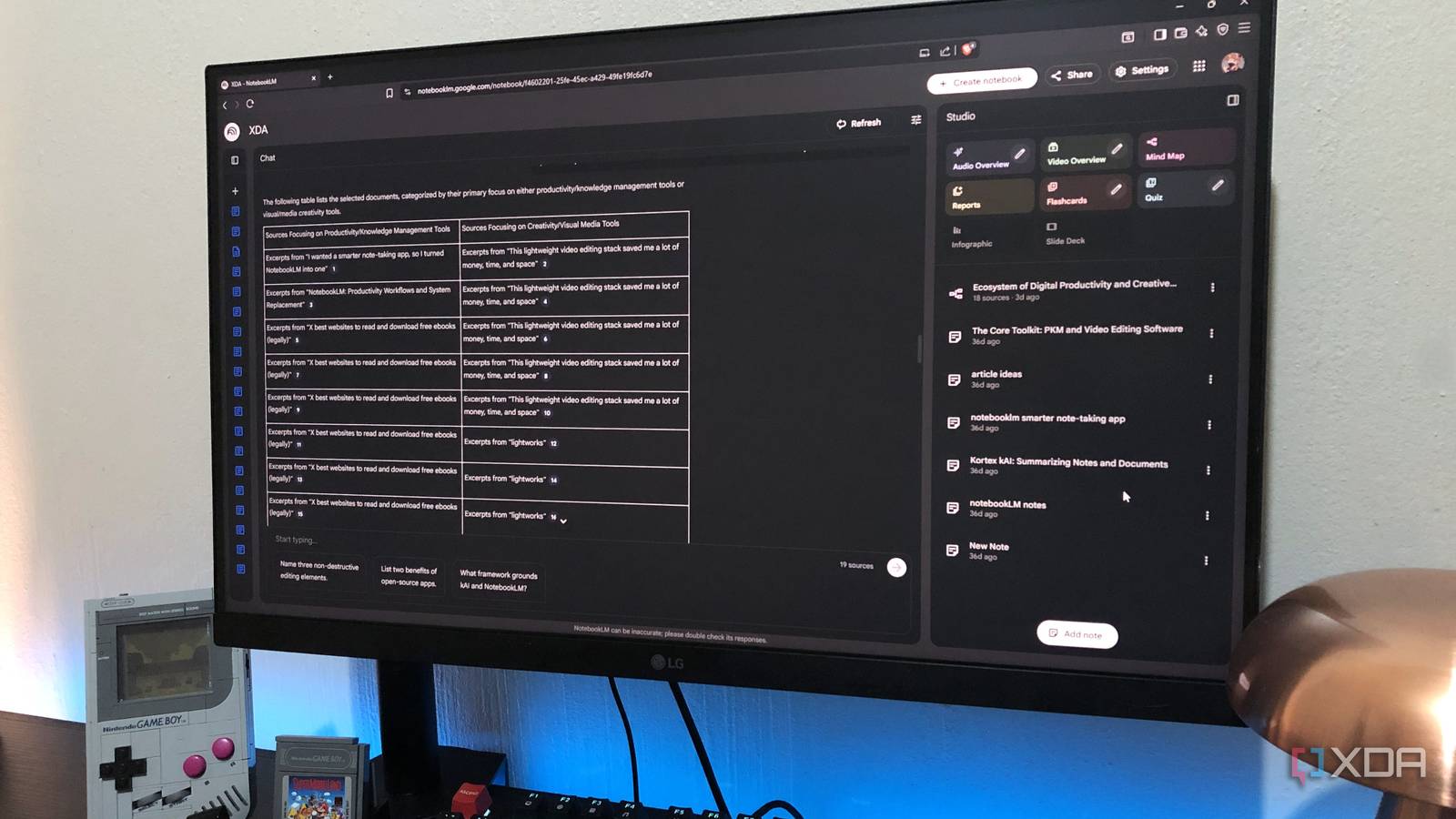
- Upload documents to a notebook, and request AI for classification, tabulation, and summarization for quickly structured outputs.
Practical Benefits:
- Reduces manual work in file naming and classification.
- Improves the reuse and integrated searchability of dispersed documents.
Economic Impact:
- Reduces information search costs (time and labor).
- Re-evaluation of the value of specialized document management and DB tools, potentially shrinking some SaaS categories.
Policy/Risk Points:
- Risks of compliance violation with incorrect classification or exposure of sensitive information.
- Increasing demand for data portability (exporting/backup).
Corporate/Market Perspective: Changes in Market Structure and Competition
Key Observations:
- The growth of integrated AI tools (as seen in the NotebookLM case) simplifies the ‘tool chain,’ reducing customer transition costs, and applying price and demand pressure on existing niche tools (diagrams, note DBs, tracking tools).
- Platform effects (smarter as data accumulates) reinforce economies of scale, increasing the likelihood of market domination by a few big players.
Economic Implications:
- From an investor’s perspective: Accelerated reallocation to integrated AI SaaS — focus on M&A and integration strategies.
- Labor Market: Automation of simple repetitive knowledge work necessitates job redesign, increasing demand for advanced AI utilization capabilities.
Policy/Regulation Perspective:
- Data governance, fair competition regulation (monopoly concerns), and copyright regulation updates are required.
- It is crucial to include AI-based productivity tools in national digital economy strategies.
Most Important Insights Not Widely Addressed by Other Media
- A bigger issue than cost reduction: ‘A shift in perception’ — When people’s tool usage changes, work processes themselves are redesigned.It is not simply about tool replacement but also about transforming organizational decision-making, knowledge flow, and performance metrics.This results in a long-term redistribution of productivity and organizational capabilities beyond short-term cost savings.
- Data portability is a competitive advantage:For integrated tools like NotebookLM to succeed, the practical ease of ‘importing/exporting’ user data is crucial.Failure to meet this condition can strengthen customer lock-in and conversely subject the tool to regulation.
- The shadow of productivity increase: ‘Measurement Blind Spots’ — The table shown by AI may be biased.For example, time reduction is shown, but qualitative output (creativity, user satisfaction) might deteriorate.Thus, when adopting AI-based productivity metrics, it is essential to implement a multimetric (quantitative + qualitative) system.
- The disappearance of intermediary roles and specialization:While services and freelancers offering simple document preprocessing and summarization may decrease,demand increases for experts who can use AI adeptly to provide high value-added analysis, strategy, and verification.
Practical Recommended Actions (Checklists by Company, Individual, and Policy)
Company Executives:
- Pilot Implementation: Apply tools similar to NotebookLM in specific teams (education, product planning) for three months and analyze the ROI.
- Data Governance: Establish data ownership, backup, and export policies.
- Performance Metric Redesign: Apply multidimensional KPIs incorporating quality, customer impact, in addition to time and cost.
Practitioners (Employees):
- Personal Tool Stack Organization: Remove duplicate subscriptions and experiment with replacing major tasks with NotebookLM for a month.
- Skill Up: Enhance abilities in AI query design (prompt engineering) and data verification.
- Establish Recording Habits: Develop the habit of creating metadata (tags, one-line summaries) that AI can easily process.
Policymakers/Regulators:
- Encourage and strengthen data portability and monitor fair competition.
- Mitigate labor market transitions with tax incentives for corporate education and retraining support.
- Update copyright and content usage guidelines.
Investor/Venture Perspective: Opportunities and Risks
Investment Opportunities:
- The initial investment point for integrated AI productivity platforms is the presence of ‘data network effects’ and ‘enterprise integration.’
- Consider strategic investment in startups that link educational and corporate onboarding solutions.
Risks:
- Regulatory risks (data, copyright) and high-speed technological changes in the market.
- Legacy user base of niche tools — full replacement may take time.
Summary Action Plan (Priority of Execution)
1) Immediate 30-day Pilot: Test with three cases in educational content, document organization, and progress tracking.2) Governance Establishment (60 days): Prepare a checklist for data portability, security, and copyright.3) Performance Measurement Redesign (90 days): Introduce mixed quantitative and qualitative KPIs for effective measurement and supplementation.
*Source: https://www.xda-developers.com/workflows-tasks-that-notebooklm-handles-better-than-productivity-stack/
[Related Articles…]How NotebookLM Changed the Workflow: Practical Implementation CasesDigital Economy and Productivity Strategies Restructured by AI
Leave a Reply