
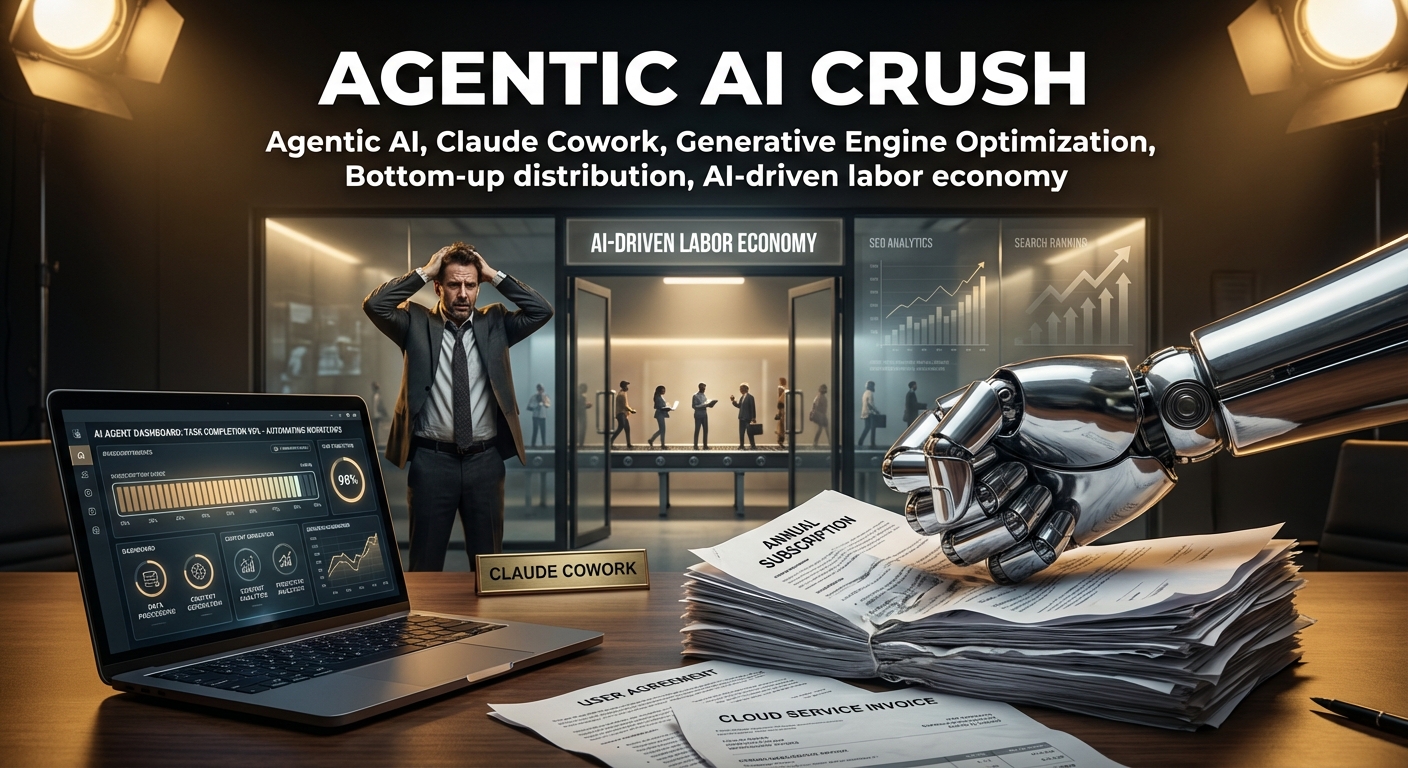
● Agentic AI Shatters SaaS, Results Economy Takes Over
Before reading this, let me clarify something first. What I’m about to talk about marks the end of the Generative AI era, where AI simply draws pictures and writes text.
I’ve organized in specific detail why Anthropic’s ‘Claude Cowork’ is overturning the market landscape, how companies will be divided into those selling ‘tools’ and those selling ‘results’, and what kind of disruptive innovation will hit your job. With this one article, you will perfectly grasp the context of AI trends post-2026.
[Special Feature] The End of Generative AI and the Invasion of ‘Agentic AI’: Will You Sell Tools or Results?
1. News Briefing: Now AI Doesn’t Just ‘Speak’, It ‘Acts’
Okay, let me organize the core points concisely like the news. Up until now, the AIs we knew, like ChatGPT or Midjourney, focused on ‘Generation’—producing results when you said “draw this” or “write this.” But it’s safe to say that this era is officially over.
① Opening of the Agentic AI EraNow the market interest isn’t “How smart is the AI (what is its IQ).” It has completely shifted to “So, what can the AI ‘execute’ on its own.” We call this Agentic AI. It’s the stage where it judges, plans, and moves the mouse cursor to complete tasks independently.
② Launch of Anthropic’s ‘Claude Cowork’This is the real deal. This feature released by Anthropic doesn’t need complex API integrations like existing AIs.
- How does it work? It uses pixel counting technology to recognize the screen just like a human looking at a monitor.
- What is possible? Even very old legacy software (like old internal company systems) that lacks APIs can be operated by AI looking at the screen and clicking directly.
- Meaning: The excuse “Our company has old systems, so we can’t adopt AI” no longer works. A world has arrived where you just sit the AI in front of a monitor and it’s done.
2. In-depth Analysis: The Real Key Takeaways and Impact Others Don’t Talk About
This is where it gets really important. While other news or YouTube channels might just say “Wow, the technology is amazing,” I will break down how the essence of ‘task automation’ is changing from the perspective of economic and industrial structure.
① It’s Not a Problem of ‘Technology’, But a Problem of ‘Decision’In the past, adopting AI required hiring developers, coding, and overhauling systems, costing a lot of money and time. That was the barrier to entry. But with technologies like Claude Cowork, the technical barrier has vanished.Now, the structure is such that if a CEO just decides, “Hey, have the AI do this,” it can be deployed the next day. In other words, corporate competitiveness will now be determined not by technical prowess but by the speed of the leader’s decision-making.
② The End of SaaS (Software as a Service) and the Start of ‘Labor’ SalesThis is the biggest change in future promising technology trends that I see. Until now, we paid subscription fees to use ‘good tools (SaaS)’ like Salesforce or Slack, right?In the future, we will move towards an era where we don’t rent tools, but buy the “result (labor) produced using those tools.”
- Past: Paying a subscription fee for accounting software. (A human has to input data)
- Future: Purchasing the result “Finish this month’s settlement.” (Agentic AI runs the program and finishes it)The market will now divide into ‘tool sellers’ and ‘result sellers’, and companies selling results will hold the hegemony.
③ The Winner is the One Who Controls the Bottleneck of Control-Data-ExecutionSimply adopting AI isn’t the core point. For Agentic AI to perform tasks perfectly without mistakes, ‘Control’ is key.How well internal company data is refined and fed to the AI, and setting guidelines so the AI doesn’t cause trouble, will be the core point and keyword for digital transformation regarding corporate survival post-2026.
3. Survival Strategies You Need to Prepare
What should we do amidst this massive flow?Ultimately, the competence of the ‘manager’ becomes important. If AI does all the work, humans must play the role of monitoring whether the AI is doing something stupid and designing more efficient Workflows.You must assume simple repetitive tasks will be 100% replaced and go all-in on planning capabilities to design the entire board to survive.
< Summary >
- Era Change: Generative AI (Text/Image Generation) era ends → Agentic AI (Direct Action/Execution) era arrives.
- Tech Innovation: The emergence of Anthropic’s ‘Claude Cowork’ signifies human-level manipulation capabilities (pixel counting) that directly view screens and click without APIs.
- Industry Reshuffling: Disappearance of technical barriers to entry. AI adoption is no longer a technical issue but a management decision-making issue.
- Market Structure: Shifting from an economy subscribing to ‘software (tools)’ to an economy purchasing ‘labor (results)’ performed by AI.
- Core Strategy: How precisely one controls AI execution and manages data determines the survival of companies and individuals.
[Related Posts…]
*Source: https://themiilk.com/articles/a5b9e744b?utm_source=Viewsletter&utm_campaign=74dd6bcd8e-EMAIL_CAMPAIGN_2026_02_15_12_32&utm_medium=email&utm_term=0_-74dd6bcd8e-385751177
● Y Combinator Hails Claude Code, AI Coding Agent Sparks Wealth Shift
The Real Reason Y Combinator Is Obsessed with Claude Code: How Wealth Flow Will Change with AI Coding Agents
Hello. Today, I want to talk about ‘Claude Code’, the hottest potato in Silicon Valley, and the resulting tectonic shifts in the AI ecosystem.
It’s not just on the level of “a new coding tool has been released.”This change, which made Y Combinator head Gary Tan start coding again after 10 years and received high praise from an OpenAI alumni founder, is a crucial signal that will completely shake up future business strategies and the future of SaaS.
In this post, I will summarize only the core points that other news outlets don’t cover deeply, such as ‘Generative Engine Optimization (GEO)’, the ‘Bottom-up Distribution Revolution’, and the ‘Future of Personalized SaaS’.Even if you are not a developer, if you are curious about where the money is flowing in the AI era, please read until the end.
1. The Splendid Resurrection of CLI, a 20-Year-Old Technology That Beat the IDE
The most shocking thing is that the Command Line Interface (CLI), a 20-year-old technology, has resurrected in the cutting-edge AI era.The Integrated Development Environments (IDEs) like Visual Studio that we commonly use were tools for human eyes to ‘read’ code and identify file locations.
But Claude Code is different.Without the user needing to read code one by one, AI flies over the code like an airplane, identifying structures and making modifications.It means that the text-based terminal (CLI) environment actually offers much higher degrees of freedom for AI to penetrate deep into the system (DB, test environments, etc.) and work autonomously.
Key takeaway:Now, the initiative of tools has shifted from ‘human readability’ to ‘AI execution power’.Rather than a flashy UI, a text environment where AI can run freely has become the core of productivity.
2. The Era of Google SEO Is Gone, Now It’s GEO (Generative Engine Optimization)
If you are a marketer or entrepreneur, you need to underline this part.Until now, we risked our lives on SEO (Search Engine Optimization) to get exposed at the top of Google search, right?However, now developers or users ask AI (ChatGPT, Claude) “Which tool is good to use?” instead of Googling.
At this point, the strategy to make AI recommend my product, specifically GEO (Generative Engine Optimization), has emerged.According to an interview with Calvin French-Owen, AI doesn’t just look at ads but learns from well-documented open source and social proof from communities (like Reddit) to determine recommendation rankings.
Key takeaway:Future marketing will not be a battle against search engine robots, but a battle to make Large Language Models (LLMs) learn our brand as ‘trustworthy knowledge’.It is a point in time when open-source strategies and high-quality tech blogs become more important than ever.
3. “It’s Easier to Ask for Forgiveness than Permission”: The Victory of Bottom-up Distribution
In the past, enterprise software came down from top to bottom (Top-down) after receiving approval from the CTO or security team.However, AI agents like Claude Code are encroaching on the market through a Bottom-up approach.
Developers download it individually to try it out, say “Wow, this is amazing,” and already apply it to their work.While management reviews security for a few months, the working-level staff is already producing results with AI.Just as Netscape did, the strategy of releasing it for free to gain market share and then monetizing with corporate licenses is becoming valid again.
Key takeaway:If you are preparing a B2B business, a strategy to captivate the ‘actual users’ rather than the decision-makers first is essential.You must make them spread the virus inside the company on their own.
4. The Future of SaaS: “Every User Gets Their Own App”
This content is a truly goosebump-inducing future prospect.Right now, we use the exact same functions provided by Notion or Slack.However, in the future, SaaS will become extremely personalized.
For example, if you subscribe to a tool, an AI agent ‘forks (duplicates)’ that code to create your own version.If you just say “Change the button location” or “Remove this function,” the AI modifies your dedicated app in real-time.This means that rather than giant SaaS companies providing average functions, tens of thousands of small AI agent companies that cater to individual needs could emerge.
Key takeaway:It is now difficult to survive with simple integration alone.Because AI can do that with just a few lines of code.Only high-level services that create direct business impact for customers will survive.
5. In the AI Era, Human Competitiveness Is ‘Design’ and ‘Verification’
Then, what should office workers like us prepare?Paradoxically, senior-level people, meaning those who can see the big picture, receive the greatest leverage from AI.AI is good at doing what it’s told, but it’s also good at digging in the wrong direction.
The ability to design the correct ‘Mental Model’ in the early stages before the code written by AI exceeds 100,000 lines.And the ability to test and verify whether the output created by AI is correct.Finally, the ability to understand the basic principles of the system like Git and HTTP is essential.
Key takeaway:Memorizing coding syntax is now meaningless.Instead, the era has come where a fundamental understanding of “How does this system operate?” and the planning ability to define “What to build?” become real skills.
< Summary >
- Resurrection of CLI: AI coding agents demonstrate more powerful performance in the text-based terminal (CLI) where they can operate autonomously, rather than in IDEs that are good for humans to look at.
- Rise of GEO: Beyond Google SEO, ‘Generative Engine Optimization’ that makes AI recommend my product is the core keyword of next-generation marketing.
- Bottom-up Revolution: The bottom-up distribution method, where working-level staff try it first and spread it rather than waiting for management approval, is dominating the market.
- Personalization of SaaS: Future software will evolve into a form where every user uses ‘my own version’ tailored specifically to them through AI.
- Role of Humans: Since AI replaces simple coding, the ability to understand basic system principles, design the overall structure, and verify it becomes important.
[Related Posts…]The Future of SaaS and AI Monetization StrategiesSearch Optimization (GEO) Methods in the Generative AI Era
*Source: https://eopla.net/magazines/39272
● Y Combinator Hails Claude Code, AI Coding Agent Sparks Wealth Shift
The Real Reason Y Combinator Is Obsessed with Claude Code: How Wealth Flow Will Change with AI Coding Agents
Hello. Today, I want to talk about ‘Claude Code’, the hottest potato in Silicon Valley, and the resulting tectonic shifts in the AI ecosystem.
It’s not just on the level of “a new coding tool has been released.”This change, which made Y Combinator head Gary Tan start coding again after 10 years and received high praise from an OpenAI alumni founder, is a crucial signal that will completely shake up future business strategies and the future of SaaS.
In this post, I will summarize only the core points that other news outlets don’t cover deeply, such as ‘Generative Engine Optimization (GEO)’, the ‘Bottom-up Distribution Revolution’, and the ‘Future of Personalized SaaS’.Even if you are not a developer, if you are curious about where the money is flowing in the AI era, please read until the end.
1. The Splendid Resurrection of CLI, a 20-Year-Old Technology That Beat the IDE
The most shocking thing is that the Command Line Interface (CLI), a 20-year-old technology, has resurrected in the cutting-edge AI era.The Integrated Development Environments (IDEs) like Visual Studio that we commonly use were tools for human eyes to ‘read’ code and identify file locations.
But Claude Code is different.Without the user needing to read code one by one, AI flies over the code like an airplane, identifying structures and making modifications.It means that the text-based terminal (CLI) environment actually offers much higher degrees of freedom for AI to penetrate deep into the system (DB, test environments, etc.) and work autonomously.
Key takeaway:Now, the initiative of tools has shifted from ‘human readability’ to ‘AI execution power’.Rather than a flashy UI, a text environment where AI can run freely has become the core of productivity.
2. The Era of Google SEO Is Gone, Now It’s GEO (Generative Engine Optimization)
If you are a marketer or entrepreneur, you need to underline this part.Until now, we risked our lives on SEO (Search Engine Optimization) to get exposed at the top of Google search, right?However, now developers or users ask AI (ChatGPT, Claude) “Which tool is good to use?” instead of Googling.
At this point, the strategy to make AI recommend my product, specifically GEO (Generative Engine Optimization), has emerged.According to an interview with Calvin French-Owen, AI doesn’t just look at ads but learns from well-documented open source and social proof from communities (like Reddit) to determine recommendation rankings.
Key takeaway:Future marketing will not be a battle against search engine robots, but a battle to make Large Language Models (LLMs) learn our brand as ‘trustworthy knowledge’.It is a point in time when open-source strategies and high-quality tech blogs become more important than ever.
3. “It’s Easier to Ask for Forgiveness than Permission”: The Victory of Bottom-up Distribution
In the past, enterprise software came down from top to bottom (Top-down) after receiving approval from the CTO or security team.However, AI agents like Claude Code are encroaching on the market through a Bottom-up approach.
Developers download it individually to try it out, say “Wow, this is amazing,” and already apply it to their work.While management reviews security for a few months, the working-level staff is already producing results with AI.Just as Netscape did, the strategy of releasing it for free to gain market share and then monetizing with corporate licenses is becoming valid again.
Key takeaway:If you are preparing a B2B business, a strategy to captivate the ‘actual users’ rather than the decision-makers first is essential.You must make them spread the virus inside the company on their own.
4. The Future of SaaS: “Every User Gets Their Own App”
This content is a truly goosebump-inducing future prospect.Right now, we use the exact same functions provided by Notion or Slack.However, in the future, SaaS will become extremely personalized.
For example, if you subscribe to a tool, an AI agent ‘forks (duplicates)’ that code to create your own version.If you just say “Change the button location” or “Remove this function,” the AI modifies your dedicated app in real-time.This means that rather than giant SaaS companies providing average functions, tens of thousands of small AI agent companies that cater to individual needs could emerge.
Key takeaway:It is now difficult to survive with simple integration alone.Because AI can do that with just a few lines of code.Only high-level services that create direct business impact for customers will survive.
5. In the AI Era, Human Competitiveness Is ‘Design’ and ‘Verification’
Then, what should office workers like us prepare?Paradoxically, senior-level people, meaning those who can see the big picture, receive the greatest leverage from AI.AI is good at doing what it’s told, but it’s also good at digging in the wrong direction.
The ability to design the correct ‘Mental Model’ in the early stages before the code written by AI exceeds 100,000 lines.And the ability to test and verify whether the output created by AI is correct.Finally, the ability to understand the basic principles of the system like Git and HTTP is essential.
Key takeaway:Memorizing coding syntax is now meaningless.Instead, the era has come where a fundamental understanding of “How does this system operate?” and the planning ability to define “What to build?” become real skills.
< Summary >
- Resurrection of CLI: AI coding agents demonstrate more powerful performance in the text-based terminal (CLI) where they can operate autonomously, rather than in IDEs that are good for humans to look at.
- Rise of GEO: Beyond Google SEO, ‘Generative Engine Optimization’ that makes AI recommend my product is the core keyword of next-generation marketing.
- Bottom-up Revolution: The bottom-up distribution method, where working-level staff try it first and spread it rather than waiting for management approval, is dominating the market.
- Personalization of SaaS: Future software will evolve into a form where every user uses ‘my own version’ tailored specifically to them through AI.
- Role of Humans: Since AI replaces simple coding, the ability to understand basic system principles, design the overall structure, and verify it becomes important.
[Related Posts…]The Future of SaaS and AI Monetization StrategiesSearch Optimization (GEO) Methods in the Generative AI Era
*Source: https://eopla.net/magazines/39272
Leave a Reply