
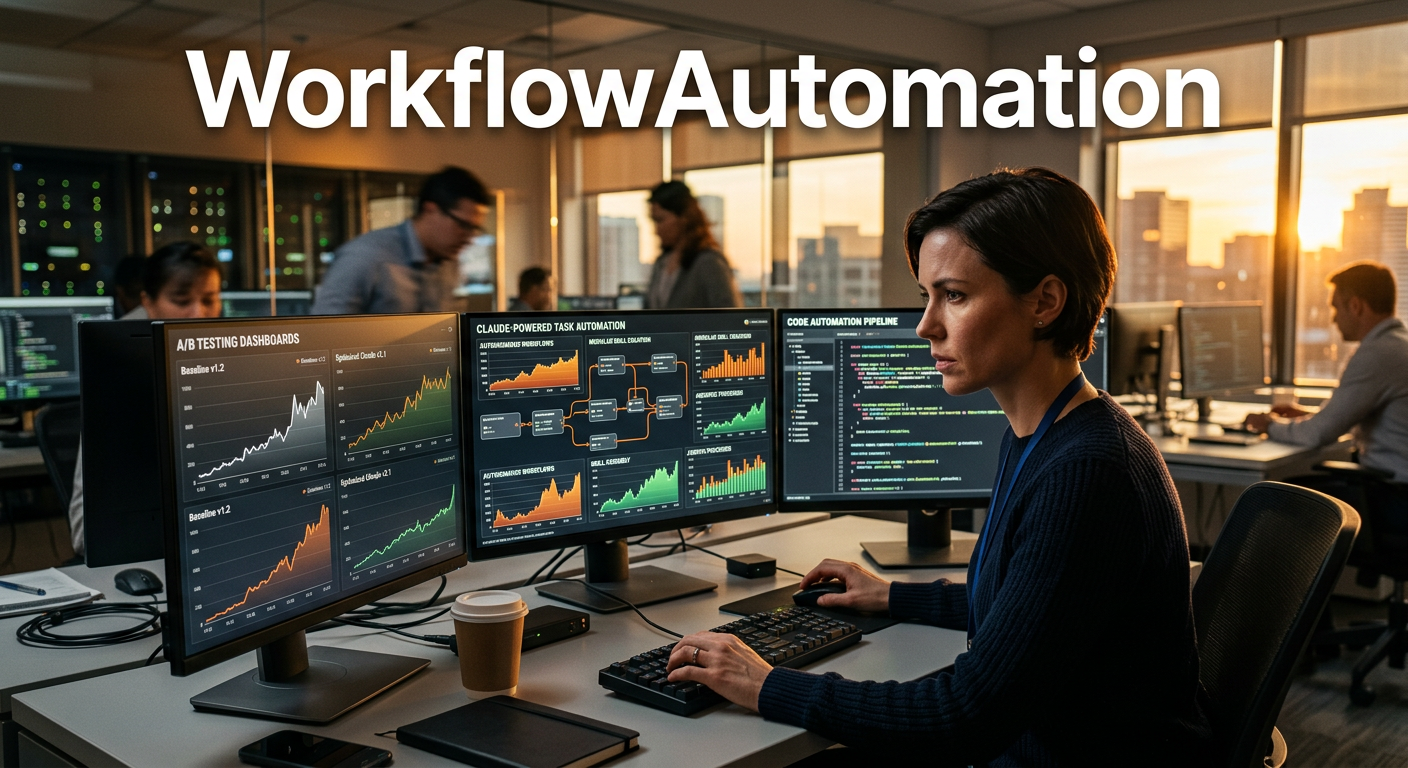
● Anthropic AI Bombshell, Claude Skills 2-0 Crushes Obsolescence, Supercharges Business Automation
What we are covering today is not just simple tech update news.
It contains the key takeaway strategy on how your business can survive and how you can innovate your way of working in a rapidly changing market.
Especially while other media simply say ‘a feature has been added’, in this article today, we will dig very deeply and multi-dimensionally into “why this update becomes a weapon that determines a company’s survival”, and “what kind of overwhelming difference it makes in actual work”.
If you read to the end, you will be able to take away powerful insights that you will want to apply to your work tomorrow morning right away.
Most media only focus on the technical features themselves, such as ‘Skill Creator’ or ‘A/B Testing’.
However, the truly important essence lies elsewhere.
It is exactly the ‘prevention of AI skill obsolescence’.
As AI models become smarter on their own, the existing AI commands (skills) we have painstakingly put together quickly become useless.
Anthropic has pinpointed exactly this problem.
The real core point of this announcement is that Claude Code Skills 2.0 is not simply a tool for ‘creating’ skills, but a ‘sustainable AI ecosystem management tool’ that defends and optimizes our company’s system from collapsing even as AI evolves.
Anthropic’s Winning Move, The Emergence of Claude Code Skills 2.0
Breaking the Chronic Limitations of AI Skill Development
Looking at the hottest artificial intelligence trends these days, how smartly you make AI work determines the success or failure of a company.
However, the biggest stress experienced by developers and planners is precisely ‘maintenance’.
Even if you create an AI skill with difficulty, there are too many cases where the existing skill stops working or becomes unnecessary when the AI model itself is updated.
Moreover, there was no proper way to objectively evaluate whether the AI skill I modified actually improved performance.
Anthropic has brought out a powerful weapon called ‘Skill Creator’ to solve such difficulties in the field.
Now developers can design, test, and optimize skills through a systematic evaluation (Evals) system.
What and How Has It Changed? 3 Core Point Innovative Features
Clear Data-Driven Performance Measurement, Introduction of A/B Testing
Now the era of setting up AI by gut feeling is over.
Through the newly introduced A/B testing feature, you can accurately compare the performance of when a specific skill is turned on versus when it is turned off.
This is an absolutely necessary feature to realize perfect work automation.
Because you can improve it while visually confirming clear data on which commands show a higher success rate.
Evolution of Skill Optimization Tools
Previously, if the AI did not move according to my intentions, I had to waste time changing the prompt around.
But in version 2.0, it provides an advanced optimization tool that elaborately refines the skill description.
It makes the AI exactly ‘trigger’ the skill in specific situations, helping to reduce malfunctions and produce results perfectly suited for practical work.
This structured optimization process will bring true productivity innovation to companies.
2 Skill Categories You Can Immediately Apply to Your Company
‘Capability Uplift Skills’ That Break Through Model Limitations
There are complex tasks that AI is still fundamentally not good at.
For example, tasks like processing complex PDF forms or generating detailed PowerPoint presentations.
Capability Uplift Skills play the role of filling exactly these gaps.
Of course, when AI models absorb these features on their own in the future, these skills will ‘retire’, but they are the core point driver that perfectly fills the immediate business void.
‘Workflow/Preference Skills’ That End Boring Daily Repetitive Tasks
I want to tell office workers to pay the most attention to this feature.
Tasks like generating NDA (Non-Disclosure Agreement) checklists, gathering scattered data to write an outline, and managing code review procedures are really annoying and take a long time.
This skill handles repetitive tasks while thoroughly complying with regulations.
It will become the top contributor to lowering employee fatigue and making them focus on high-value-added work during a successful digital transformation process.
Overwhelming Performance and Long-Term Benefits Proven in Practice
From SEO to Insurance Claims, Utility Across All Industries
The true value of Claude Code Skills 2.0 is already being confirmed in various industrial fields.
The Audit skill, which quickly and efficiently diagnoses technical issues on websites, is receiving high praise from marketers.
Furthermore, it was applied to the insurance claim triage task, which was a headache for insurance companies, and drastically reduced processing time.
Tasks such as complex document management or extracting data from PDF forms have also been improved to an incomparable level in terms of success rate and speed.
A Toolkit Responsible for the Technological Competitiveness of Developers and Organizations
Ultimately, what this framework aims for is clear.
It is to provide sustainability so that the system built by our company remains valid at all times even as AI models continue to evolve.
Highly reliable AI skills reduce manual work, optimize resources, and allow the organization to focus on larger, more strategic goals.
As a result, this will be the most certain way for companies to secure long-term technological competitiveness in the market.
< Summary >
- Solving the Core Point Problem: Claude Code Skills 2.0 was launched to solve the ‘obsolescence’ problem where existing AI skills become useless when models are updated.
- Introduction of Skill Creator: Through A/B testing and structured evaluation (Evals), you can develop and test AI skills based on data rather than gut feeling.
- Customized Skill Classification: Strategic approaches are possible by dividing them into ‘Capability Uplift Skills’ that fill the gaps in the model and ‘workflow skills’ that automate repetitive tasks.
- Destructive Power of Practical Application: It has exponentially increased task completion speed and success rate in SEO audits, insurance claim classification, PDF document processing, and more.
- Final Expected Effect: It maximizes corporate innovation and productivity by reducing the burden of continuous AI maintenance and optimizing resources.
[Related Articles…]
- The Core Point Guide to Building AI Agent Workflows that Will Save Companies in 2026
- Why Procedural Workflows Replace Long Prompts and How to Apply Them in Business
*Source: https://www.geeky-gadgets.com/anthropic-skill-creator/
Leave a Reply