

● AI Tokens Outrage Shows the True Competitive Edge
The real direction of AI development shown by Garry Tan: What it means that “not burning tokens is more expensive”
What Garry Tan showed by getting back to coding after 13 years was not simply a return.
This case can be read all at once as a signal about AI investment strategy, generative AI, agentic workflows, global economic outlook, and the personal AI revolution.
The core point is clear.
In the AI era, what matters more than “how fast you write code” is “how much context you feed it to produce better judgment.”
And this trend is not just a story for developers; it is likely to change digital transformation, productivity innovation, and corporate competitiveness itself.
Below, I’ll organize this in a news format, by group, in a systematic way.
1) News in one line: Garry Tan, back after 13 years, reconstructs the work of “400 engineers” with AI
Garry Tan had not been actively coding for 13 years before sitting back down at the keyboard.
The result was shocking.
In the past, a service that once required about $4 million, a year and a half, and a team of multiple people was reportedly rebuilt this time in about $200 and 5 days.
What matters here is not simply that it was “cheap and fast.”
The important part is that AI operated not just as a support tool, but as an operating system connecting the entire process of research-planning-development-QA-deployment.
In other words, AI is now evolving from a tool that merely writes text into an execution system that builds and validates products.
2) The most important point: “token maxing” is not a luxury but a competitive edge
The key keyword in this interview is token maxing.
Simply put, it means putting in as much context and material as possible into AI to get a more complete answer.
Many people think “token costs are a waste,” but Garry Tan’s view is the opposite.
He argues that not burning tokens can actually be more expensive.
Why? Because results made with too little information often bring larger revision costs and failure costs later.
From a company perspective, this is a very important implication.
Going forward, AI budgets are likely to be evaluated not by “how much you save,” but by “how accurately and quickly you obtain the right judgment and results.”
3) What Garry’s List tells us: AI now even plays the role of a journalist
Garry Tan’s Garry’s List is not just a blog.
More precisely, it functions as both a blog platform and a journalist.
This site deeply researches issues in California, San Francisco, and LA, gathers materials from both sides of the debate, and produces long-form articles with sources every day.
What matters here is that it has moved beyond being a mere assistive tool for human writing.
AI now finds materials on its own, compares them, organizes them, and produces article drafts.
This has major implications for the content industry as well.
Going forward, the value of evidence-based research content and automated in-depth analysis is likely to increase more than that of simple summary content.
4) The development style of the AI agent era: thin harness, fat skills
Another core philosophy Garry Tan emphasized is Thin Harness, Fat Skills.
In plain terms, it means keeping the harness thin and concentrating actual judgment and work into the skills.
In other words, instead of continuously adding complex frameworks, you put important task instructions and judgment criteria into a lightweight structure like Markdown and prompts.
This perspective applies not only to developers, but also to planners, PMs, and marketers.
Going forward, the decisive point in AI usage may not be “how many tools you attach,” but “how well you document your core judgments.”
5) QA automation and browser agents: the era of clicking for people
To solve QA issues, Garry Tan attached browser automation tools like Playwright.
This is not just a convenience feature.
AI now goes beyond writing code and enters the stage of actually opening web pages, clicking, testing, and finding errors.
This trend could greatly expand the QA automation, browser agent, and work automation markets.
The effect is especially large for organizations with many repetitive tests and manual verification steps.
It is evolving beyond saving people’s time into reducing error costs themselves.
6) Codex and Claude Code: AI also needs role division
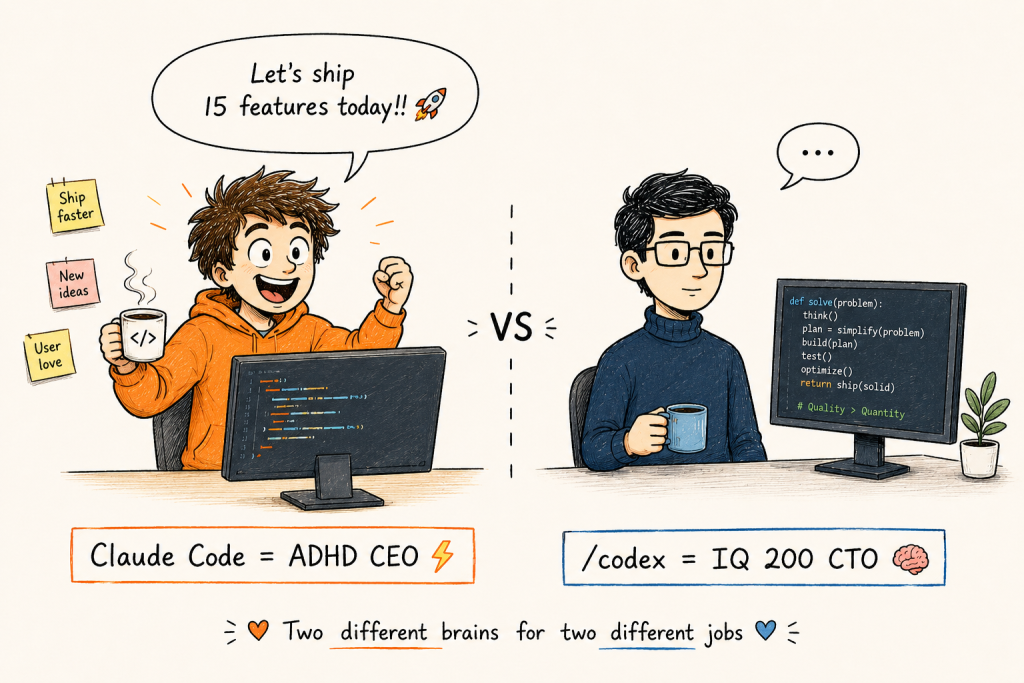
One interesting part of this piece is that AI was not viewed as a single tool.
Garry Tan described Claude Code as a “fast, energetic ADHD CEO” and Codex as a “quiet but accurate IQ 200 CTO.”
This expression is extremely important.
In real-world work, AI models differ in temperament, and the roles they are suited for differ as well.
Some tools are strong at rapid execution and idea expansion,
while others are strong at bug finding and precise verification.
In other words, productivity in the AI era may be determined more by role-design architecture than by the performance of a single model.
7) The personal AI revolution: who controls the tools is the key
The essence of personal AI, as Garry Tan described it, is very clear.
Going forward, the gap may open between “people who use AI provided by a company” and “people who have their own data, their own prompts, and their own integrated tools.”
This is not simply a technical choice; it is a matter of control.
A structure in which individuals directly set up AI and decide what information to see and by what criteria to judge it may become more powerful.
This trend could eventually change not only personal work styles, but also corporate structures and platform ecosystems.
In the future, the people who build their own AI environment may gain a greater advantage than those who merely know how to use AI well.
8) From a global economic outlook perspective: AI is not cost cutting, but a productivity jump
If you interpret this interview economically, the conclusion is clear.
AI is not simply a means to cut labor costs, but a productivity engine that dramatically increases throughput for high-value work.
That also means the way companies compete will change.
In the past, the companies that grew were the ones that hired more people.
Going forward, we should watch which companies can best combine tokens and automation.
In particular, software, media, research, legal, strategy, and operations are likely to feel the AI shock most strongly and earliest.
So in the global economic outlook, AI should be seen not as a simple theme, but as a key variable that creates productivity gaps.
9) The core point that other news and YouTube often miss: “using AI” and “operating AI” are different
This part is really important.
Most content ends at the level of “what you can do with AI.”
But Garry Tan’s case is completely different.
He did not use AI as a single tool; he turned it into an operating system for work.
In other words, it was not just about using a few prompts well;
it connected research,
documentation,
planning review,
development,
QA,
reusable skill storage,
and browser automation
into one continuous flow.
This difference is enormous.
Going forward, the difference between AI experts and ordinary users is likely to emerge not from “which model they use,” but from “what system they operate AI with.”
10) Practical takeaway: points worth applying right now
- AI is stronger as a deeply used system than as a tool used only moderately.
- Token costs may not be something to minimize, but rather an investment to improve result quality.
- Markdown, prompts, and skill documentation are far more important than people think.
- QA and browser testing are key expansion areas for AI automation.
- The gap between people who can build personal AI and those who cannot may widen.
- For companies, how they design AI operating structures will matter more than simply whether they adopt AI.
11) Conclusion: now is not the time to “try AI,” but to design an operating system
Garry Tan’s case delivers a very clear message.
The competitiveness of the AI era is not about asking questions faster, but about building context more deeply and automating more broadly.
And at the center of that is not the habit of saving tokens, but the attitude of strategically burning tokens.
The productivity revolution ahead is not just a matter of tools,
but a competition over
who designs better systems,
who documents more accurate judgments,
and who can move the execution-validation-revision loop faster.
This is a story about developers, but also about executives and investors.
< Summary >
Garry Tan returned to coding after 13 years and expanded AI from a simple tool into a work operating system.
The key takeaways are token maxing, personal AI, browser automation, and role-based AI usage.
AI should be seen as a variable that creates a productivity jump rather than merely cuts costs,
and in the future, those who “operate” AI may have greater competitive power than those who merely “use” it.
[Related posts…]
- Why the Claude Code team can ship products faster than anyone in the world
- What humans will do after AI takes over all human work
*Source: https://maily.so/josh/posts/2qzp1gkez4x?from=email&mid=pzlq3932mrk
Leave a Reply