
● Agentic Automation Shock
OpenAI Unveils ‘ChatGPT Work’… The Era of Workplace AI Agents Begins in Earnest, Along with the End of the Atlas Browser
Key Takeaways You Must Watch in This News
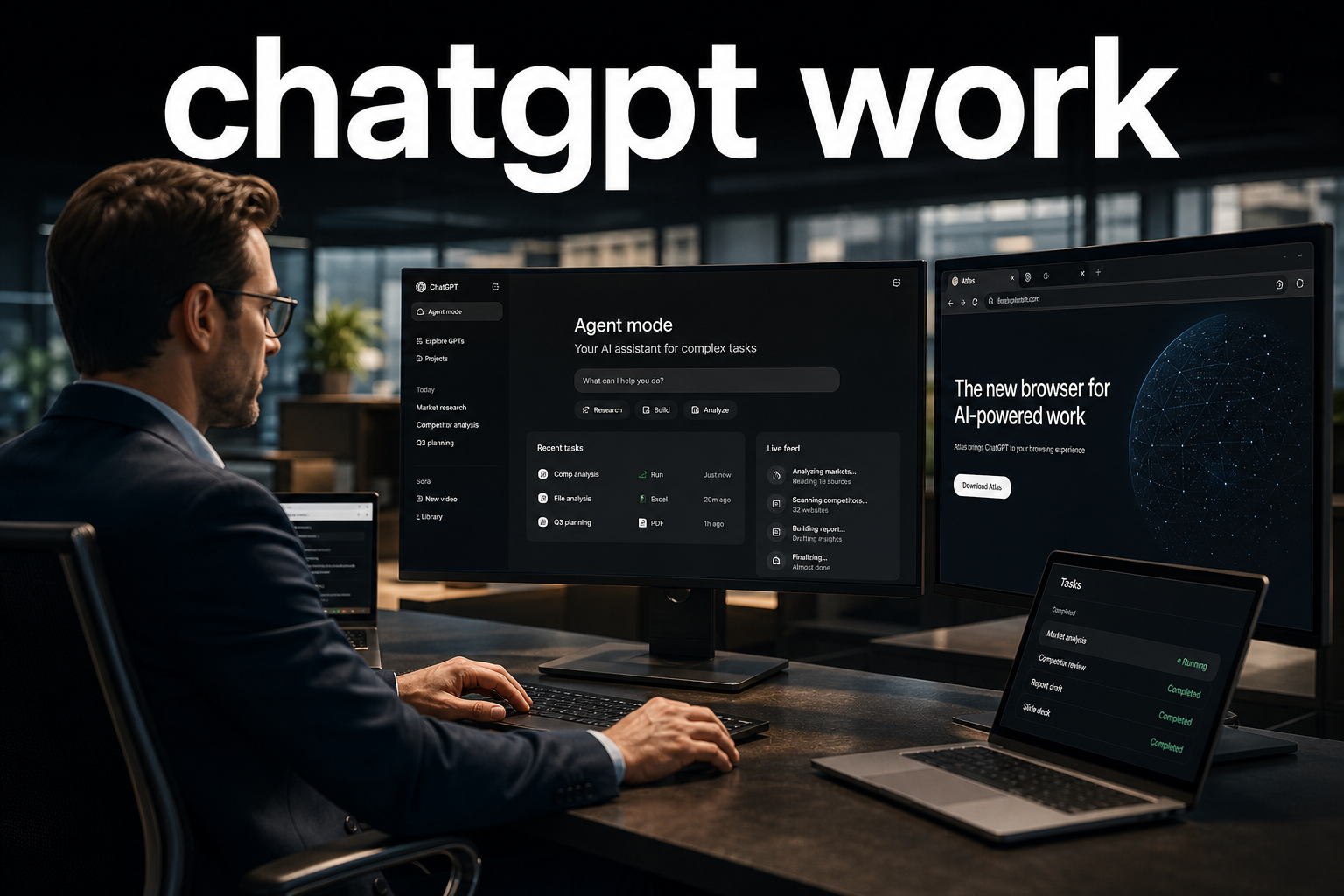
OpenAI has moved beyond a chatbot that simply answers questions and has introduced ChatGPT Work, a workplace AI system that actually “performs” tasks.
This is a bigger shift than it may seem.
It is moving toward automatically creating reports, spreadsheets, presentations, dashboards, and web apps by connecting apps, files, websites, and internal company services.
On top of that, OpenAI announced that it will discontinue its existing AI browser, Atlas, and shift its focus to a new integrated desktop app.
In other words, the era in which “AI only gives answers” may give way more quickly to an era in which “AI actually handles work.”
This change could directly affect the entire market for AI agents, workflow automation, productivity innovation, enterprise software, and generative AI.
1. What Makes OpenAI’s ChatGPT Work Different?
ChatGPT Work is not a tool that “only has conversations” like the existing ChatGPT.
It is an agentic system that plans multiple steps based on user instructions, finds the necessary information, and actually carries out tasks to completion.
The core point is not “generating answers” but “completing work.”
For example, it can pull materials from places such as Slack, Microsoft Teams, Google Drive, SharePoint, email, calendars, CRM systems, and project trackers.
It then organizes that data and turns it into outputs that match the company’s format.
In other words, AI takes over repetitive tasks such as meeting note summaries, sales report writing, internal document organization, customer response history analysis, and project status reports.
2. What ChatGPT Work Can Actually Do
The most important part of this announcement is not “which model was used,” but “how much work it can do on your behalf.”
ChatGPT Work can perform tasks such as the following:
- Collecting information from multiple apps and files
- Running automatically based on schedules
- Running automatically when specific events occur
- Monitoring changes
- Performing multi-step tasks under limited supervision
- Creating documents, reports, presentations, and dashboards
- Supporting the creation of web apps and internal portals
Simply put, AI is moving toward connecting and handling tasks that people previously had to complete by moving back and forth between different tools.
This function can feel especially meaningful for office workers who spend long hours at work.
That is because it is not merely about “saving time,” but about potentially changing the entire workflow itself.
3. Why This News Also Matters for the Global Economic Outlook
This announcement is not just the addition of another AI feature.
Rather, it is a signal that labor productivity, corporate operating cost reduction, the pace of digital transformation, and software spending structures could change across the global economy.
From a company’s perspective, automating repetitive work previously done by humans can improve operational efficiency.
Conversely, the workplace SaaS market may face pressure to reorganize as AI enters not as an “assistive tool” but as an “execution主体.”
The following areas are especially likely to be affected:
- Internal collaboration tool market
- Document creation and office software market
- CRM and project management solutions
- BI dashboard market
- Workplace browser and agent-based interface market
In other words, this news is both AI news and digital productivity revolution news.
4. What the End of the Atlas Browser Means
OpenAI also announced that it will discontinue the standalone AI browser Atlas.
Instead, it will integrate browser functions and Computer Use capabilities into a newly redesigned desktop app.
This decision is quite meaningful.
At first glance, it may look like the company is simply shutting down one browser product.
But in reality, it is closer to a strategy of shifting the center of AI from a “browser app” to a “work execution platform.”
In other words, OpenAI is pushing an AI user experience centered on tasks rather than search.
This direction is closer to AI OS competition than AI browser competition.
5. Why the New Desktop App Matters
OpenAI is preparing a new “super ChatGPT desktop app” that even integrates Codex.
This app will bring coding, research, and productivity functions into one place.
It will also include a built-in browser and Computer Use capabilities that can interact with local files, applications, and websites.
This means AI is no longer confined inside a web service and is moving toward handling the entire PC environment.
The important point here is not that “a chatbot is being attached to the PC,” but that “the entire PC workflow is being reorganized around AI.”
6. Who Will Use ChatGPT Work First?
For now, it will be rolled out gradually to Pro, Enterprise, and Edu users first.
This structure is very typical.
The company first distributes it to enterprises and high-value users, gathers real-world usage data, and then expands it to a broader market.
In other words, it begins as an enterprise productivity tool, but in the long run, it could change even the way individuals work.
It is especially likely to be adopted quickly by large companies, educational institutions, knowledge workers, consulting firms, financial organizations, marketing teams, and development teams.
7. The Biggest Shift Is from ‘AI That Answers’ to ‘AI That Finishes the Work’
There is one core point you should not miss in this announcement.
What OpenAI is aiming for is not “good answers,” but “work completion.”
This difference is bigger than it may seem.
Existing generative AI has mainly played the role of generating ideas and creating drafts.
But ChatGPT Work is closer to moving across multiple systems, actually producing outputs, and finishing them in the required format.
Now, AI competitiveness is shifting from how well it writes sentences to how well it can complete work with minimal human intervention.
8. The Truly Important Points That Other News Often Misses
There are parts here that many media outlets overlook.
First, this announcement is not simply a feature addition, but a battle for AI interface dominance.
In other words, a platform power struggle is unfolding over where people will spend the most time in the future: the search box, the browser, the chat window, or the desktop app.
Second, the end of Atlas should not be viewed only as a “failure.”
Rather, it should be seen as OpenAI choosing to absorb the browser into its work execution functions instead of growing it as a standalone product, thereby tying the core experience together more tightly.
Third, this trend has a structure in which AI becomes more useful as it connects with internal company data.
That is why, going forward, what matters will not only be whose model is smarter, but who is connected to more workplace data.
Fourth, as AI agents spread, people are likely to move into the role of “supervisors” rather than simply doing more work.
In other words, the center of work shifts from execution to review.
This will also affect organizational structures.
9. Changes Global Companies and Investors Should Watch
The keywords that will matter in the market going forward are clear.
- AI agents
- Workflow automation
- Enterprise AI
- Productivity software
- SaaS restructuring based on generative AI
Companies will no longer simply say that they have “adopted AI.”
They will start measuring how many percent of work hours AI has reduced, how many repetitive tasks it has replaced, and whether it has produced real cost-saving effects.
From an investor’s perspective, when looking at AI-related stocks, it is no longer enough to look only at model performance.
It is also necessary to examine how deeply AI is entering real workplaces.
In particular, office software, collaboration tools, search, browsers, cloud services, and workflow automation platforms may experience both benefits and pressure as AI spreads.
10. Key Points to Watch Going Forward
Going forward, you should pay close attention to the following:
- The actual pace of enterprise adoption of ChatGPT Work
- The competitive landscape with Office, collaboration tools, and CRM markets
- The completeness of the integrated desktop app experience
- The stability of Computer Use capabilities
- Data connection permissions and security issues
- Malfunction risks of AI agents
- The pace of workplace process changes
Security and permission issues are especially important.
The moment AI can access email, calendars, files, and CRM systems, convenience increases, but companies become much more sensitive about control and accountability.
That is why this market is not only a technology competition, but also a competition over trust and governance.
Closing Interpretation
If you view this OpenAI announcement merely as the launch of a “new chatbot,” you will miss the core point.
In reality, it is a signal that AI is moving into the stage of executing work, the boundaries between browsers and desktop apps are collapsing, and the competitive structure of the enterprise software market is beginning to be redrawn.
To summarize it in one sentence, the AI of the future is evolving from a tool that answers questions into a system that finishes work on your behalf.
The first thing this change will transform is not the technology industry, but the way we work every day.
< Summary >
With the unveiling of ChatGPT Work, OpenAI has pushed AI from an answer-centered model toward a work-execution-centered model.
By connecting with Slack, Google Drive, email, CRM systems, and more, it can automatically create reports, documents, dashboards, and web apps.
The Atlas browser will be discontinued and integrated into a new desktop app.
The core point is a structural shift in the markets for AI agents, workflow automation, enterprise AI, productivity software, and generative AI.
[Related Articles…]
How AI Agents Are Reshaping the Future of Workplace Automation
Enterprise AI Trends Driving the Next Wave of Productivity Innovation
*Source: https://alternativeto.net/news/2026/7/openai-launches-new-chatgpt-work-tool-and-announces-the-shutdown-of-its-ai-browser-atlas/
Leave a Reply