
● Agented Rush
Claude Graph Engineering: Why It Has Become the Center of AI Engineering Right Now
From prompt engineering to context engineering, loop engineering, and graph engineering.
The change happening in the AI industry right now is not just a passing trend. It is a shift from AI answering questions to AI designing and verifying work on its own.
In today’s article, we will organize why this change matters,
the limitations of reflecting the latest data,
the pros and cons of agent automation,
why graph-based workflows are receiving more attention,
and what to watch from the perspectives of investment, industry, and AI trends.
In particular, instead of briefly passing over points often treated superficially in other news or YouTube content,
we will focus on the core reasons why graph engineering goes beyond the limitations of the single-agent era,
why it fits well with multi-market data automation such as Korea, the United States, and crypto,
and how AI workflow automation is likely to be reorganized in the future.
1. Prompt Engineering: The Era When “Writing Good Questions” Was Everything
Key Takeaway
Prompt engineering is a method of drawing out the desired answer from AI as effectively as possible with a single question.
You assign a role,
add examples,
instruct it to think step by step,
and improve the quality of the output.
Why This Method Was Powerful at First
At first, this method alone was impressive.
“You are a semiconductor analyst with 20 years of experience.”
“Analyze Samsung Electronics and suggest a target price.”
With just one sentence like this, it was possible to get fairly convincing results.
In other words, it was an era in which AI could generate a fairly good draft as long as humans asked the right questions.
But There Was a Critical Limitation
The problem was that it could not reflect the latest information after the model’s training cutoff point.
For example, because the model only knows information up to the last point at which it was trained,
earnings releases,
sharp stock price movements,
policy changes,
and industry events after that point are not immediately reflected.
So even when the latest stock price is 231,000 won,
the model may suggest a target price based on a much older standard.
This is the structural limitation of prompt engineering.
2. Context Engineering: The Stage of Adding “Latest Data” to the “Question”
Key Takeaway
Context engineering is not just about throwing a prompt at AI.
It is a method of connecting external data such as search results, financial data, disclosures, news, and research notes so that AI can make judgments based on them.
A Representative Flow: Why RAG Became Popular
At one point, RAG, or Retrieval-Augmented Generation, became extremely popular.
The core idea is simple.
Instead of making AI use only the knowledge it already has,
it first retrieves the necessary materials
and then answers based on those materials.
How It Works in Practice
For example, when analyzing Samsung Electronics,
financial data,
disclosures,
recent news,
analyst reports,
and industry trends are collected
and bundled with an instruction such as, “Analyze Samsung Electronics based on the above materials and suggest a target price.”
This significantly improves freshness.
It can also provide supporting evidence,
and domain knowledge can be injected.
But Problems Still Remained
Context engineering also had limitations.
AI was still close to a structure in which it is called once and produces an answer,
and humans still had to do much of the material selection.
In other words, data was attached, but the ability to judge and act autonomously was still insufficient.
3. Loop Engineering: The Era When AI Repeats and Improves on Its Own
Key Takeaway
Loop engineering is a method that does not stop after AI gives one answer.
Instead, it makes AI repeat the process of
action → observation → retry if insufficient → action again.
Why It Drew Attention
With the emergence of this method, it became possible to feel as if “AI is working alone 24 hours a day.”
This is because workflows such as building an app from a single prompt,
automated report writing,
repeated verification,
and self-correction became possible.
A Simple View of the Operating Structure
AI first runs a tool.
Then it observes the result.
It determines whether the data is sufficient or insufficient.
If it is insufficient, it tries again.
It repeats this process to complete the final result.
But Loops Also Had Major Risks
The biggest problem is runaway execution.
If it is unclear how long the repetition should continue, costs can grow endlessly.
In long tasks, it is also easy to lose direction.
In addition, a black-box problem emerges because the internal structure is difficult to see.
In other words, it is powerful when it works well,
but its weakness is that it is difficult to control and interpret.
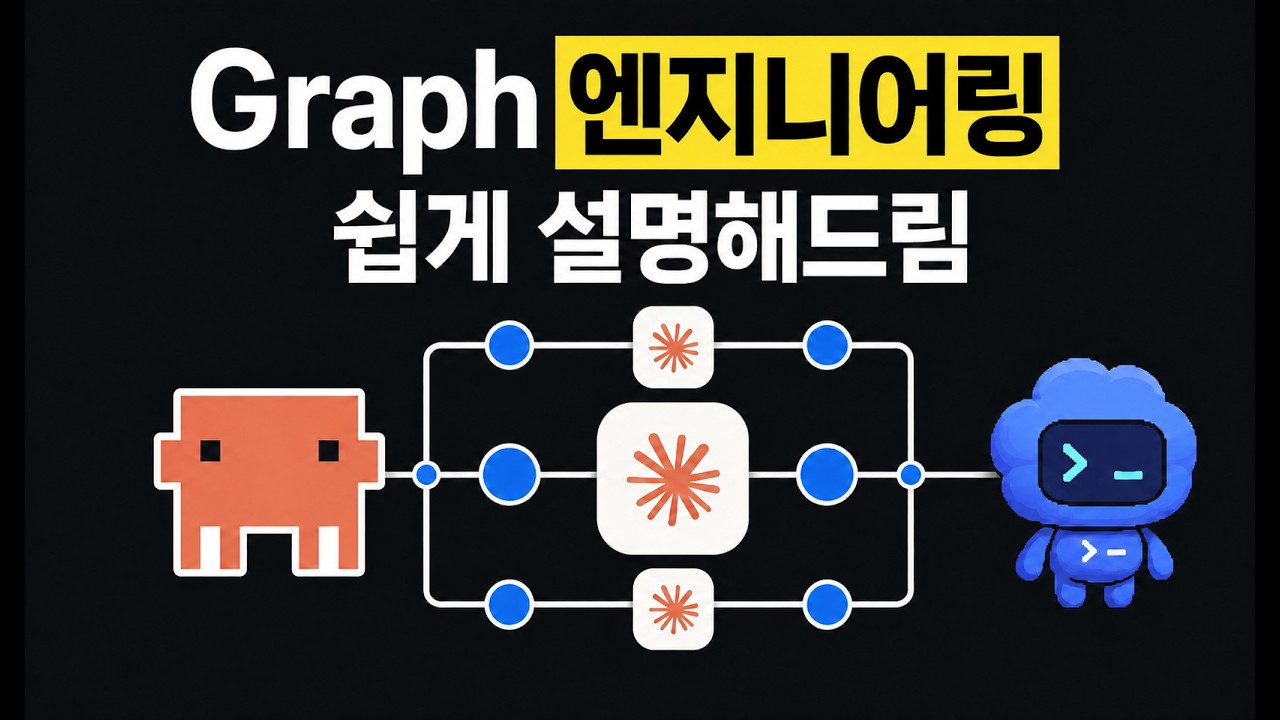
4. Graph Engineering: The Latest Paradigm That “Organizes” Loops
Key Takeaway
Graph engineering is not about endlessly running a single loop.
It is a method of breaking work into specialized nodes
and designing those nodes to be connected according to conditions.
Simply Put
In the past, AI did everything alone.
Now, roles are divided.
A financial analysis agent,
a news sentiment analysis agent,
a relationship analysis agent,
a comprehensive judgment agent,
and an approval gate can each take on specialized work.
The Advantages of the Graph Method
Parallel execution is possible.
Conditional branching is possible.
Human approval gates can be inserted.
Each stage becomes observable.
In other words, it becomes easier to trace where and how AI made each judgment.
If Summarized Like a News Workflow, It Looks Like This
Collect market prices,
analyze financials,
analyze news sentiment,
analyze correlations,
pass through a risk gate,
request human approval if an anomaly is detected,
and publish the final report.
This is the practical value of graph engineering.
Why This Matters Now
What matters more than AI “looking smart”
is whether it can run safely in real work environments.
Graph engineering is much stronger at this point.
It is especially powerful in areas such as finance, research, operations automation, content production, and risk checking.
5. Areas Where Graph Engineering Fits Especially Well
1. Financial Data Analysis
Fields with frequently changing data and many variables,
such as the Korean stock market,
the U.S. stock market,
and the crypto market,
fit well with graph structures.
This is because market prices,
financials,
disclosures,
news,
and risk judgments need to run separately.
2. Research Automation
When creating research notes,
steps such as collection, analysis, verification, approval, and distribution are also required.
This structure is far more stable as a graph than as a single prompt.
3. AI Agent-Based Workflow Automation
If the goal is not a simple chatbot,
but an actual workflow that divides tasks, uses tools,
reviews results,
and hands them over to humans,
then graphs become close to a practical standard.
6. Both the Advantages and Limitations of Graph Engineering Must Be Considered
Advantages
Task decomposition is clear.
Parallel processing is possible.
Intermediate results can be tracked.
Approval gates can be added to improve safety.
Specialized agents can be attached to improve quality.
Limitations
Design costs increase.
It can be excessive for simple tasks.
If the terminology becomes overheated, it may look like hype.
As the number of nodes increases, operational difficulty also rises.
So the Important Decision Criteria Are These
Graphs are not always the answer.
They are especially suitable when the task is complex,
repetitive,
requires verification,
and needs human intervention.
On the other hand, for simple summarization or simple question answering, they may be excessive.
7. The Core Point Rarely Discussed Elsewhere: The Real Change in the AI Paradigm Is Not “Questions” but “Operating Systems”
The Most Important Point
Many people only see it as good prompts, good models, or good agents.
But the essence lies elsewhere.
It is that the center of AI competition has shifted from model performance to workflow design.
Why This Matters
Going forward, the difference will depend less on “which model was used”
and more on
“what data goes in,”
“which nodes it is divided into,”
“under what conditions it stops,”
“by what criteria it is approved,”
and “how the learning loop is reactivated.”
In Other Words, This Is the Competitive Edge in the AI Era
More than the ability to write good prompts,
the ability to build good AI operating structures is becoming more important.
This is why graph engineering is receiving attention.
8. A Commonly Used Practical Structure: Connecting Korea, the United States, and Crypto into One Automation Loop
Core Flow
In recent real-world applications, it is often configured as follows.
A Korean market scheduler,
a U.S. market scheduler,
and a crypto scheduler are run separately.
Each market’s data is collected,
its status is checked,
intelligence analysis is performed,
and final verification is connected to publishing.
Why This Structure Is Effective
Each market has different time zones,
different speeds of issue occurrence,
and different key indicators.
Rather than having one AI handle everything,
a graph branched by market is far more practical.
If a Feedback Loop Is Added
Publishing-block conditions,
abnormal value detection,
Telegram alerts,
performance learning,
and reapplication loops can be attached.
At that point, it becomes not just simple automation,
but a learning automation system.
9. Future AI Trends: Graph Engineering Is Likely to Become the Basic Grammar of the Agent Era
Market Perspective
The terminology may still feel somewhat overheated right now.
However, the direction itself is clear.
AI is increasingly evolving into
search-oriented,
repetitive,
verification-based,
approval-based,
and distribution-oriented structures.
Investment Perspective
Promising future keywords are less about simple model competition
and more about
AI agents,
workflow automation,
RAG,
data orchestration,
risk gates,
and multi-agent collaboration.
Practical Perspective
Companies now need to focus less on “whether AI writes well”
and more on
“whether AI can safely complete work end to end.”
Graph engineering is the structure that answers this need.
Summary
Prompt engineering is the stage of optimizing questions,
context engineering is the stage of connecting the latest data,
loop engineering is the stage of repeated execution,
and graph engineering is the latest AI workflow that organizes these elements through specialized nodes and conditional branching.
The core point is not the model but the operating structure,
and the importance of graph-based methods is growing especially in finance, research, and AI agent automation.
[Related Articles…]
The Agent Era and How AI Workflow Automation Is Changing Economic Trends
Why Graph-Based AI Workflows Are Gaining Attention
*Source: Hodu’s AI Analysis Lab
Leave a Reply