
● CostCutting AI Production Pressure
The Next Step for AI Coding Agents: The Core Point Is Not “Adding More,” but “Accurately Finding What Already Exists First”
Key Takeaway News in One Line
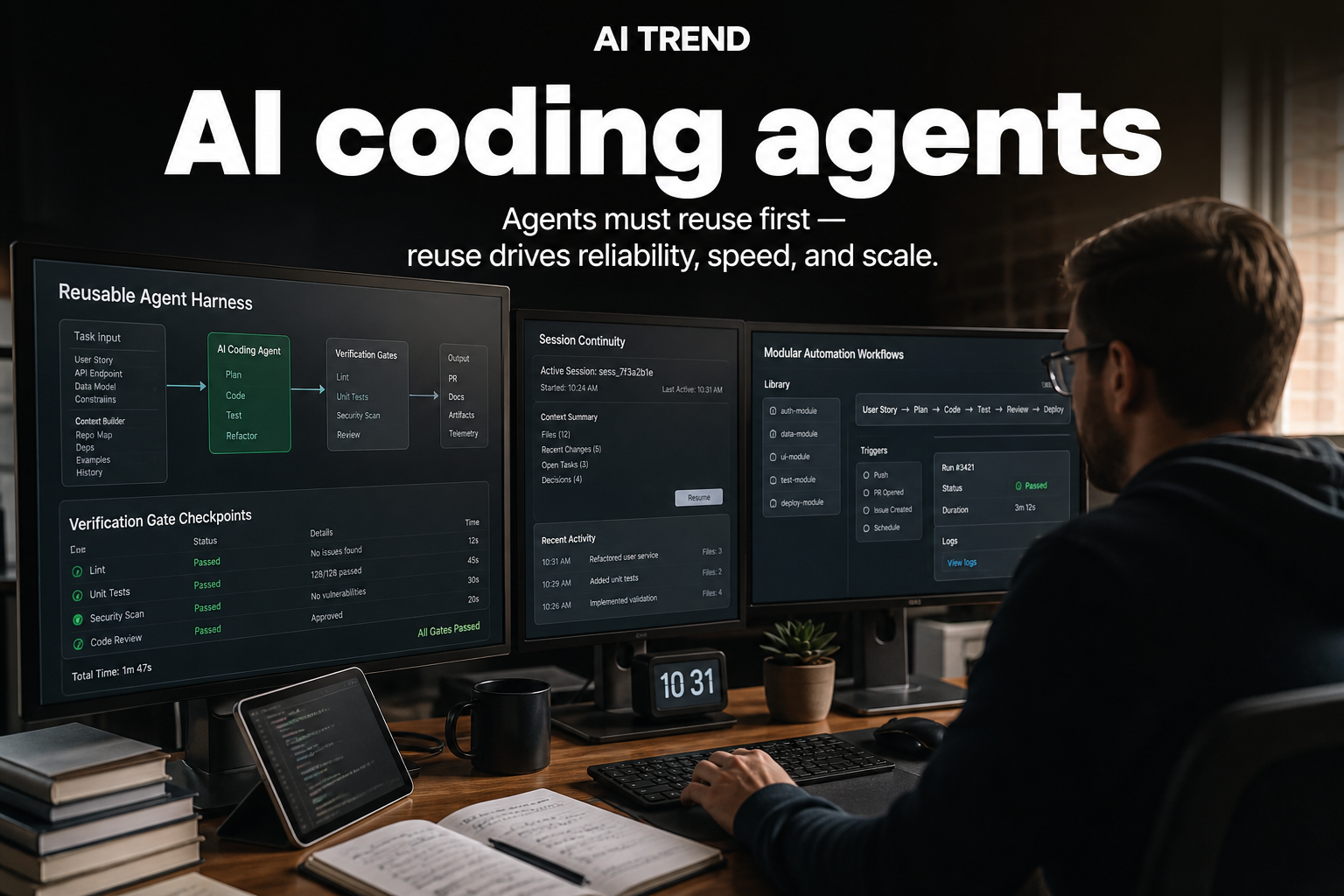
As AI coding agents become smarter, what matters is not continuously adding more features, but building a structure that first finds and reuses the rules, skills, plugins, and agents already inside the project, then supplements only the missing parts with minimal changes.
Key Takeaways to Watch in This Article
As project scale grows, AI development environments become increasingly complex.
Even as new skills and rules accumulate, agents often miss existing assets and repeat the same work.
This NULNUL harness directly addresses that problem.
It proposes a structure that improves the efficiency of AI agent operations by first discovering and reusing existing capabilities.
Another notable point is that when a failure occurs, it does not merely patch that specific task temporarily, but promotes the issue into a harness improvement proposal to prevent recurrence.
It also includes a design that allows work to continue across sessions by leaving short, verifiable checkpoints instead of storing long and messy state records.
Ultimately, this story is not simply an introduction to a development tool, but a case study that shows the future of AI productivity, software development automation, verification-based agent operations, and enterprise AI workflows.
What NULNUL Is Trying to Solve
NULNUL is a skills-only development harness for Codex and Claude Code.
The core point here is not “what more should we give the agent,” but “how can we make it properly find and use what already exists.”
In large projects, skills, agents, plugins, and rules continue to increase.
However, agents often fail to sufficiently use components that already exist inside the repository and begin creating similar things again.
This problem is not just duplicated work.
In real-world environments, it leads to the following costs.
- Increased development time
- Expansion of unnecessary complexity
- Higher maintenance difficulty
- Lower trust in AI agents
- Degradation of overall project quality
In other words, as the number of AI coding agents increases, architecture management capability becomes even more important.
How NULNUL Works at Its Core
When NULNUL receives a user request, it does not simply start executing immediately.
It first reads the repository and explores existing assets.
More specifically, the process follows this order.
- It checks the rules that already exist in the project.
- It looks for existing skills.
- It checks whether reusable plugins exist.
- It searches for agents with the same purpose.
- It reuses what is available as is.
- It supplements only the missing parts with minimal changes.
- It continues carrying out the originally requested task.
- Finally, it runs the actual repository’s test and verification commands.
The reason this structure matters is clear.
The competitiveness of AI development automation lies not in “how many tools have been added,” but in how much quality can be achieved with the fewest changes.
The Most Important Change: “Reuse First” Rather Than Adding New Features
The most impressive part of this case is that the agent is designed to first understand and use the existing structure rather than immediately creating something new.
This is also a highly important trend in today’s AI landscape.
As more people use AI, they expect more automation.
In reality, however, the more automation increases, the messier internal systems can become.
So what is needed now is not necessarily a bigger AI, but the following three things.
- Discovery capability
- Reuse capability
- Verification capability
Only when these three capabilities are in place can an AI agent move beyond being a “tool that does a lot of work” and become a “tool that organizes work well.”
A Structure That Improves the Harness Itself When Failure Occurs
The second core point of NULNUL is how it handles failure.
Usually, when an AI agent fails, it fixes the issue only in that moment and ends the process there.
But when NULNUL discovers a repeatable failure, it does not treat it as a simple bug and stop. Instead, it turns the issue into a harness improvement proposal.
This represents a meaningful shift in perspective.
It does not view failure as “a one-time issue this time,” but expands it into “a problem that may happen again in the future.”
However, there is an important point here.
The agent is not allowed to change its own rules however it wants.
Improvement proposals are verified through a separate Gate.
The flow is as follows.
- Proposal creation
- Verification
- Accept or reject decision
- Promotion or rollback
In other words, the entity that performs the work is separated from the entity that evaluates its capabilities.
This is also highly meaningful from an AI governance perspective.
Why This Structure Fits Enterprise AI Well
This approach is more powerful for teams and enterprises than for individual developers.
That is because, in enterprises, results created by AI are directly connected to operational costs.
It is especially effective in the following areas.
- AI development automation
- Software development efficiency improvement
- AI coding agent operations
- Internal development platform management
- Verification-centered workflow construction
From an enterprise perspective, “code created quickly” matters less than “code with fewer repeated failures.”
That is why a harness like NULNUL can be seen not merely as a productivity tool, but as an experiment in designing AI operational standards.
How Work Continues Even When Sessions Change
There is one common problem in long-running tasks.
When an agent session changes, the next session often spends a lot of time trying to understand the entire project again.
This is a bigger loss than it may seem.
To solve this problem, NULNUL leaves short, verifiable checkpoints instead of storing lengthy state records.
The advantages of this approach are clear.
- The next session can quickly restore context.
- The state does not become long and tangled.
- Verification criteria are clear.
- It becomes easier to continue work.
In other words, instead of forcing the AI agent’s memory to grow, this is a strategy of making the information that must be remembered small and accurate.
This is likely to become increasingly important in future multi-session AI workflows.
The Question This Article Raises: Should AI Become Smarter, or More Strict?
The most important question in the original message is this.
Is a good AI development environment one that gives agents more capabilities?
Or is it one that allows agents to find only the capabilities they need and leaves behind only what has been verified?
This question is not just a development philosophy.
It is a question that shows the future direction of the AI industry.
Today’s AI industry is used to “larger models,” “more features,” and “broader integrations.”
But in real-world environments, the opposite is often more important.
- Build less
- Find better
- Verify more strictly
- Promote only what has been verified
This flow ultimately creates operational stability and cost efficiency.
The Core Point Other Articles or Videos Often Miss
There is one especially important point in this content that is easy to miss.
It is the idea that AI agents should be allowed to “self-improve,” but should not be allowed to “make unlimited changes based on their own judgment”.
When many people hear about AI self-improvement, they imagine a system that automatically becomes smarter.
But in reality, self-improvement can also become self-amplification of errors.
That is why the following combination is needed.
- Self-improvement loop
- External verification Gate
- Separation of promotion and rollback
- Operation based on short checkpoints
- Reuse of existing assets first
Only with this combination can AI grow on its own without damaging the overall system.
This is the truly important point.
Meaning from the Perspective of the Global Economy and AI Trends
This case is not just technology news. It is also connected to global economic trends.
The current market is in a phase where high interest rates, cost reduction, and productivity pressure are operating at the same time.
In this environment, what companies are looking for is not necessarily flashy AI.
They are looking for AI that actually generates financial value.
In other words, the following keywords become more important.
- Global economic outlook
- AI investment
- Productivity innovation
- Enterprise AI
- AI automation
And in this environment, systems that create “greater results with fewer changes” become more competitive than simply “adding more personnel.”
An approach like NULNUL is directly aligned with that direction.
Conclusion: The Real Takeaway to Read from This Article
The message here is clear.
The future of AI coding agents is not about continuously adding more features.
It is about accurately finding and using existing rules and knowledge, connecting failures to system improvements, and designing work to continue even when sessions change.
In other words, the core points are as follows.
- Reuse first
- Minimal changes
- Structuring repeated failures
- Verification-based promotion
- Securing session continuity
This direction is likely to become a much stronger standard in future AI development environments.
Summary
NULNUL is a harness designed to make AI coding agents first find and reuse existing rules, skills, plugins, and agents instead of blindly increasing new features.
Failures are promoted into verifiable improvement proposals rather than simple fixes, and work continues across sessions through short checkpoints.
The core point is not “more AI,” but “an AI operational structure that finds better and verifies better.”
[Related Articles…]
- Claude Code and AI Development Automation Trends
- Verification-First Harnesses and AI Agent Operations Strategy
*Source: https://news.hada.io/topic?id=32632
Leave a Reply