
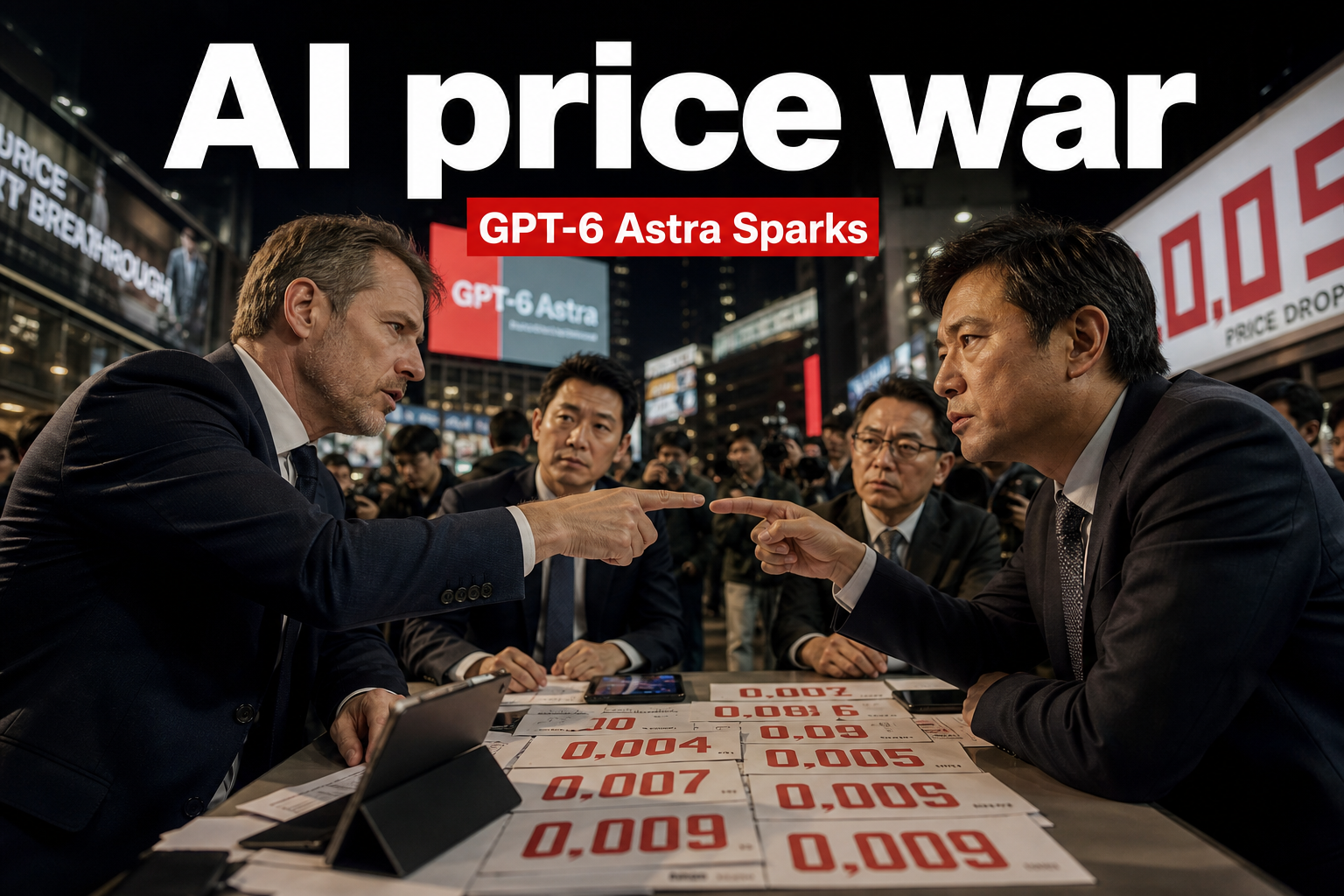

● GPT-6 Astra Sparks an Agent Automation Price War
GPT-6 Astra Public Release Imminent: Will It Shake Up the AI Market Again?
There are exactly five key takeaways to watch most closely right now.
First, GPT-6 Astra is highly likely to reset the standard not merely for performance improvements, but for AI agents and computer automation.
Second, the core point is that both cost efficiency and processing speed have improved compared with existing models.
Third, as it expands beyond browser automation into screen recognition, clicking, typing, and document work, the scope of business automation is widening.
Fourth, the fact that it has been released only to a small group before general users shows that AI platform competition will become even more intense going forward.
Fifth, this trend is not simply about a model release; it could affect the broader landscape of the productivity revolution, cloud AI, generative AI, and digital transformation.
Why the Market Is Stirring Around GPT-6 Astra Right Now
Starting with the core point, GPT-6 Astra has been drawing intense industry attention immediately after its release.
However, it is important to note that it is not yet at the stage where every user can access it right away.
At present, it is being rolled out first only to selected users, and general users are likely to gain access in a few days or sometime next week.
This approach can be interpreted not as a simple launch, but as a strategy to provide high-performance AI first to verified users.
In other words, rather than releasing AI quality all at once, the rollout is being expanded gradually while stability and user response are monitored.
The Real Meaning of the Benchmarks: Efficiency Matters More Than Performance
The most noticeable part of this announcement is the benchmark results.
Astra is showing strong performance across several indicators, including Terminal Bench, ArcAge-R, and ScreenSpot Pro.
What matters especially is that the difference is large in practical, work-oriented tasks rather than in simple answer accuracy.
For example, the mention that performance is nearly three times higher at the same price range is an extremely sensitive point for companies.
That is because AI is no longer evaluated only by the question of “Is it smarter?” but increasingly by “How cheaply and quickly can it be used?”
This is directly connected to the adoption rate of AI.
Companies will increasingly prefer models with lower cost per task and faster response speed over models that are only slightly more capable.
That is why Astra should be seen not as a simple model performance competition, but as a signal of innovation in the AI cost structure.
The Center of AI Agent Competition Is Now “Computer Use Capability”
The most important axis of this update is computer use capability.
The core point is not an AI that simply writes text or answers questions, but one that reads the screen, recognizes positions, moves the mouse, enters values, and completes tasks.
This means AI is moving into a stage where it can use a PC like a human.
There are many tasks that cannot be handled through browser automation alone.
Representative examples include messaging tasks in apps such as Telegram and KakaoTalk, work that requires actual screen captures, and cases where multiple tasks must be run simultaneously in a local environment.
What is needed in these cases is computer use.
The problem is that when this runs locally, the mouse keeps moving and the keyboard keeps typing, making it difficult for a person to do other work at the same time.
That is why methods that run faster and more reliably in remote environments will become a core point going forward.
The important news is that Astra is strongly pushing precisely this area.
Changes Felt in Real Work: The Stage for Automation Is Expanding
This announcement is not just a simple demo.
A considerable number of tasks frequently used in real workplaces are being mentioned.
Examples include form filling, document entry, data migration, Power BI automation, QA testing, Linear ticket creation, CAD model work, game simulation, and Blender work.
This goes beyond typical office automation.
In other words, AI is moving from being a simple assistant to becoming an actual work executor.
In particular, because form filling and QA account for a large share of repetitive work in companies, cost-saving effects could appear quickly.
In addition, Power BI and data-related tasks have high usability across finance, manufacturing, retail, and IT, so their industrial impact could be significant.
The Most Notable Change: Screen Recognition and Positional Accuracy
The core point emphasized by Astra is how accurately it understands the screen.
The ability to accurately identify a specific button, input field, or menu position on a work screen and then act at that exact location completely changes the quality of AI automation.
As this ability improves, AI can handle more complex tools.
In the past, humans had to intervene from time to time, but now AI can find positions on its own and continue the task.
This is not merely a convenience feature; it is a technology that changes the very structure of AI productivity.
Going forward, “what it says” will matter less than “where it looks and how it executes.”
How It Differs from Existing Models: Not Simple Intelligence, but Intent Alignment
One interesting part of this development is how it handles ambiguous situations.
Some existing models have tended to push forward until the end even when they do not know what to do.
By contrast, Astra appears to be designed to check the user’s intent more often and ask about points that need clarification along the way.
This is a fairly significant difference from the user’s perspective.
That is because, in ambiguous situations, it is far more practical for AI to ask questions and improve the quality of the result than to pretend it knows everything on its own.
Ultimately, future AI is likely to become stronger as a “collaborative model” rather than as an “independent model.”
This point is extremely important for AI used in real work.
As more users want to get the results they want quickly with short prompts, this kind of interaction capability will become an even greater competitive advantage.
The Real News from an AI Market Perspective: The War Over Price and Speed Has Begun
The Astra announcement is both a technology announcement and a market strategy announcement.
AI competition can no longer be won through high performance alone.
AI semiconductors, cloud AI, generative AI, AI agents, and business automation are now moving together as a single ecosystem.
What matters here is not who is smarter, but who can perform a wider range of tasks more cheaply, more quickly, and more reliably.
That is why this Astra announcement can be seen as both a technical upgrade and an event that creates pricing pressure across the entire market.
Competing models must now prove not only benchmark scores, but also actual usage cost and response speed at the same time.
This trend is ultimately likely to accelerate competition in enterprise AI adoption.
What Korean Companies and Practitioners Must Watch Closely
This change is even more important from the perspective of domestic Korean companies.
That is because Korea has a relatively high share of messenger-based work, document processing, dashboard management, and repetitive office tasks.
There are many tasks that require direct screen interaction, such as KakaoTalk, Telegram, various web-based administrative tasks, and internal approval processes.
In other words, AI with improved computer use capability is highly likely to fit directly into the Korean work environment.
In particular, marketing, operations, data analysis, customer support, finance, and planning departments could feel the effects quickly.
This is not simply a “convenient feature,” but a change that can transform workforce efficiency and organizational productivity.
The Core Point That Many Others Miss: The Real Battleground Is Not the Model, but the Execution Environment
Many people may interpret this announcement simply as “performance has improved.”
However, the most important point lies elsewhere.
Going forward, competition is likely to be decided not by the model itself, but by the execution environment in which the model runs, the harness, speed optimization, and remote control architecture.
In other words, the winner will not be determined by who has the superior language model, but by who can complete real work more reliably.
This means AI is moving from research-lab technology to an enterprise operations tool.
That is why the meaning of Astra is closer to “the moment when the standard for business automation changes” than to “the release of a new model.”
Investment and Industry Points to Watch Going Forward
The following industries should be watched together going forward.
First, cloud infrastructure and AI platform companies.
Second, business automation, RPA, and agent solution companies.
Third, companies related to semiconductors and AI inference optimization.
Fourth, companies focused on data analytics, BI, and document automation tools.
Fifth, companies that provide security and remote execution environments.
That is because as computer-using AI grows, security and execution stability will become core infrastructure.
Ultimately, the AI trend is shifting from “conversational chatbots” to “task-executing agents.”
GPT-6 Astra is not simply a new model, but an announcement that raises the standard for AI agents and computer automation.
The core point is the simultaneous improvement of performance, cost, speed, and screen recognition capability.
It is especially important that it is directly connected to real business automation, including form filling, QA, Power BI, document processing, CAD, and game development.
General release is still limited, but its market impact is expected to be significant as access is likely to expand within a few days.
Going forward, AI competition is likely to be determined less by “smarter models” and more by “systems that execute faster, cheaper, and more accurately.”
[Related Articles…]
GPT-6 Astra and the Next Wave of AI Agents
AI Automation Trends Reshaping Enterprise Productivity
*Source: 코드팩토리
Leave a Reply