
● AI Labor Market Shock
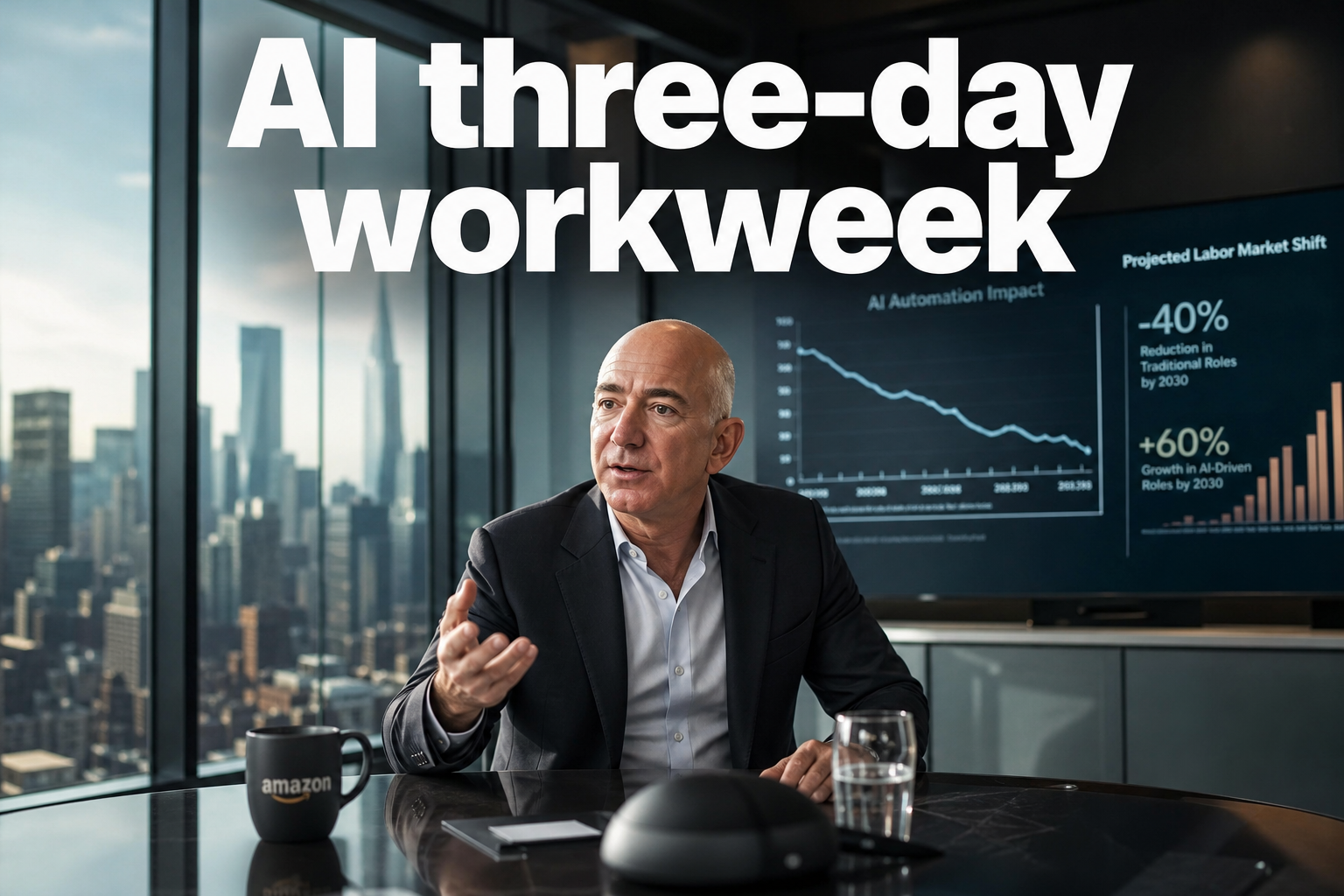
Title: Jeff Bezos’s AI Labor Market Warning: “A Three-Day Workweek and Single-Income Households Could Become Reality”
Core Points First
What stands out most is that cracks in the five-day workweek may appear sooner than expected.
Jeff Bezos believes that as AI boosts productivity, some households may be able to support themselves by working only three days a week, and single-income households may rise again instead of dual-income households.
This is not just a simple future prediction, but a signal that requires reading the global economic outlook and AI trends at the same time.
Going forward, the labor market, wage structures, corporate hiring methods, and stock market investment strategies could all change together.
What matters especially is that the AI investment bubble debate, data center expansion, large-scale restructuring, productivity innovation, and labor market reshaping are all connected at once.
News-Style Summary: Daily Life After AI as Bezos Sees It
Amazon founder Jeff Bezos recently said in an interview that AI could significantly increase economic productivity and reduce working hours themselves.
He explained that “some people will choose to work only three days a week to support their families,” describing this as what a highly productive economy could look like.
He also predicted that in the AI era, “a structure where two people must earn income may not necessarily be required,” and that households with only one working person could increase again.
Simply put, AI may go beyond replacing work and change lifestyles themselves.
This statement should be read not merely as technological optimism, but as a message that also considers labor supply shortages and changes in employment structures.
1. Why the Three-Day Workweek Discussion Emerged
If AI raises work efficiency, fewer people will be needed to produce the same results.
As a result, companies may be able to operate with fewer employees, and individuals may move toward a structure where they can earn the same income in less time.
In other words, productivity gains could lead directly to shorter working hours.
If this trend becomes reality, four-day workweeks, three-and-a-half-day workweeks, and flexible work arrangements may become competitive conditions rather than simple employee benefits.
Changes are likely to appear first in industries where AI automation is being adopted quickly, such as IT, finance, logistics, customer service, document processing, and marketing.
2. What an Increase in Single-Income Households Means
The second point Bezos raised is bigger than it may seem.
If AI raises productivity, a situation could emerge where one household no longer needs to depend on two incomes.
This could lead to changes in household structures.
Consumption patterns centered on dual-income households may weaken, and changes may also occur in childcare, caregiving, education, and housing choices.
In addition, labor force participation could decline, creating a “labor shortage” problem for companies that makes hiring more difficult.
In other words, AI may eliminate jobs while, paradoxically, creating a market where it becomes harder to find people.
3. The Real Shock from AI Is “Labor Reallocation” Rather Than “Unemployment”
When many people think about AI, they focus only on the idea that “jobs will disappear.”
But what matters more is that the form of work will change.
Repetitive tasks will decline, while roles involving judgment, coordination, communication, creative planning, and exception handling will grow.
In other words, job restructuring is likely to happen before total employment sharply declines.
In this process, highly skilled workers and workers who can use AI effectively may receive higher compensation, while workers in simple repetitive tasks may face pressure.
Ultimately, the core point is not just the unemployment rate, but wage polarization and gaps between job roles.
4. It Is Not Only Good News for Investors
Bezos acknowledged the technological reality of AI, but also said the path may be confusing for investors.
The reason is very simple.
During an AI boom, both good ideas and bad ideas attract funding at the same time.
Right now, market attention can rush in as long as the name “AI” is attached, but the number of companies that actually survive may be limited.
This is a point that must be checked when looking at AI-themed stocks and related infrastructure companies.
In the long run, the winners will become clear, but in the short term, bubble debates are likely to repeat.
5. Why Amazon Is Betting More Aggressively on AI
Amazon is planning more than $200 billion in capital expenditures this year.
The core focus is data centers and AI infrastructure.
This means AI is not just a chatbot trend, but a massive industrial cycle connected to electricity, semiconductors, servers, cloud computing, and communication networks.
At the same time, Amazon has also continued cutting tens of thousands of corporate roles recently.
This point is important.
Companies are trying to reduce costs and improve efficiency through AI, but in the process, they are choosing a structure that reduces existing jobs.
In other words, we are entering an era where AI investment expansion and employment reduction are happening at the same time.
6. The Next Stage of the AI Economy Connected to Blue Origin
Bezos’s perspective does not remain limited to the terrestrial economy.
His space company Blue Origin is also drawing a long-term picture that includes moving data centers into space and expanding lunar and space-based infrastructure.
This is not simply science fiction, but can be viewed as a long-term strategy to solve problems such as electricity costs, cooling, land limitations, and data explosion.
As AI grows, more data centers will be needed, and electricity, land, and cooling will eventually become major bottlenecks.
That is why the future AI economy should not be viewed only through semiconductors, but also through the power industry, space industry, and infrastructure industry.
7. How Other Big Tech Leaders View This
Bezos is not the only one talking about this.
Nvidia’s Jensen Huang has said AI could make a four-day workweek possible.
JPMorgan’s Jamie Dimon has said that, in the long run, even a three-and-a-half-day workweek could be possible.
Bill Gates has gone even further and mentioned a two-day workweek.
Elon Musk has said that if AI and robots are combined, an era could arrive in which “working becomes optional.”
In other words, among Big Tech leaders, there is broad agreement on the major direction that working hours will decrease.
However, they differ in how fast and how far this change will go.
8. The Most Economically Important Points in This Issue
First, AI is likely to increase growth rates.
If productivity rises, it is positive for corporate profits and a country’s potential growth rate.
Second, the labor market may become more flexible, but also more unstable.
This is because the gap between good jobs and poor jobs could widen.
Third, household structures may change.
The share of single-income households, freelancers, remote workers, and part-time workers could increase.
Fourth, investment strategies also need to change.
Instead of looking only at AI software, investors should also consider data centers, electricity, semiconductor equipment, cooling, networks, cloud computing, and automation solutions.
Fifth, AI could also affect interest rates and economic cycles.
If AI raises productivity, it could lower inflationary pressure in the long run, but in the short run, massive investment could increase demand for capital.
9. Keywords to Watch in the Current Market
Global economic outlook.
AI trends.
Four-day workweek and three-day workweek.
Productivity innovation.
Labor market restructuring.
Data center investment.
These five should not be viewed separately, but as one connected set.
This is because AI can create growth, growth can change employment, and employment changes can affect consumption, investment, real estate, and the stock market.
10. The Most Important Point Other News Often Misses
The key takeaway is not “Will AI reduce jobs?”
The truly important question is “Who will AI require to work, how much will they need to work, and what kind of household structure will it create?”
This change is not simply a technology issue, but closer to a redesign of the social system.
If working hours decrease while income is maintained, that would be ideal, but in reality, income inequality may widen.
In other words, the real winners of AI may not only be the companies that create the technology, but also the organizations and individuals that absorb AI-driven productivity the fastest.
Those who fall behind here may not simply lose their jobs, but lose their bargaining power in the market itself.
11. Practical Interpretation for Blog Readers
If you are an office worker, you should not view AI only as a replacement threat.
Instead, you should first use it as a tool that makes your work 30% faster.
Because companies are likely to spend money on automation before hiring, individuals also need to change their career strategies.
AI usage skills, data literacy, collaboration skills, and problem-definition skills will become more important going forward.
If you are an investor, when looking at AI themes, you should consider not only revenue but also electricity consumption, capital expenditures, cloud usage, and monetization structures.
From the perspective of real estate and consumption, it is also necessary to check the sensitivity of regions and industries where dependence on dual-income households may decline.
Summary
Jeff Bezos believes AI could boost productivity and lead to a three-day workweek and an increase in single-income households.
The core point is that AI may not simply eliminate jobs, but could also change working hours, hiring structures, household forms, and the investment landscape.
Now is the time to look not only at AI software, but also at data centers, electricity, semiconductors, and automation industries.
Ultimately, the winners of the AI era are likely to be the individuals and companies that integrate the technology into their work the fastest.
[Related Articles…]
- The AI Era: Industries Changing First and Key Investment Points
- Global Economic Outlook: How to Read Interest Rates and Growth Together
*Source: https://share.google/KfNayD7k1wCpnPzfL
Leave a Reply