
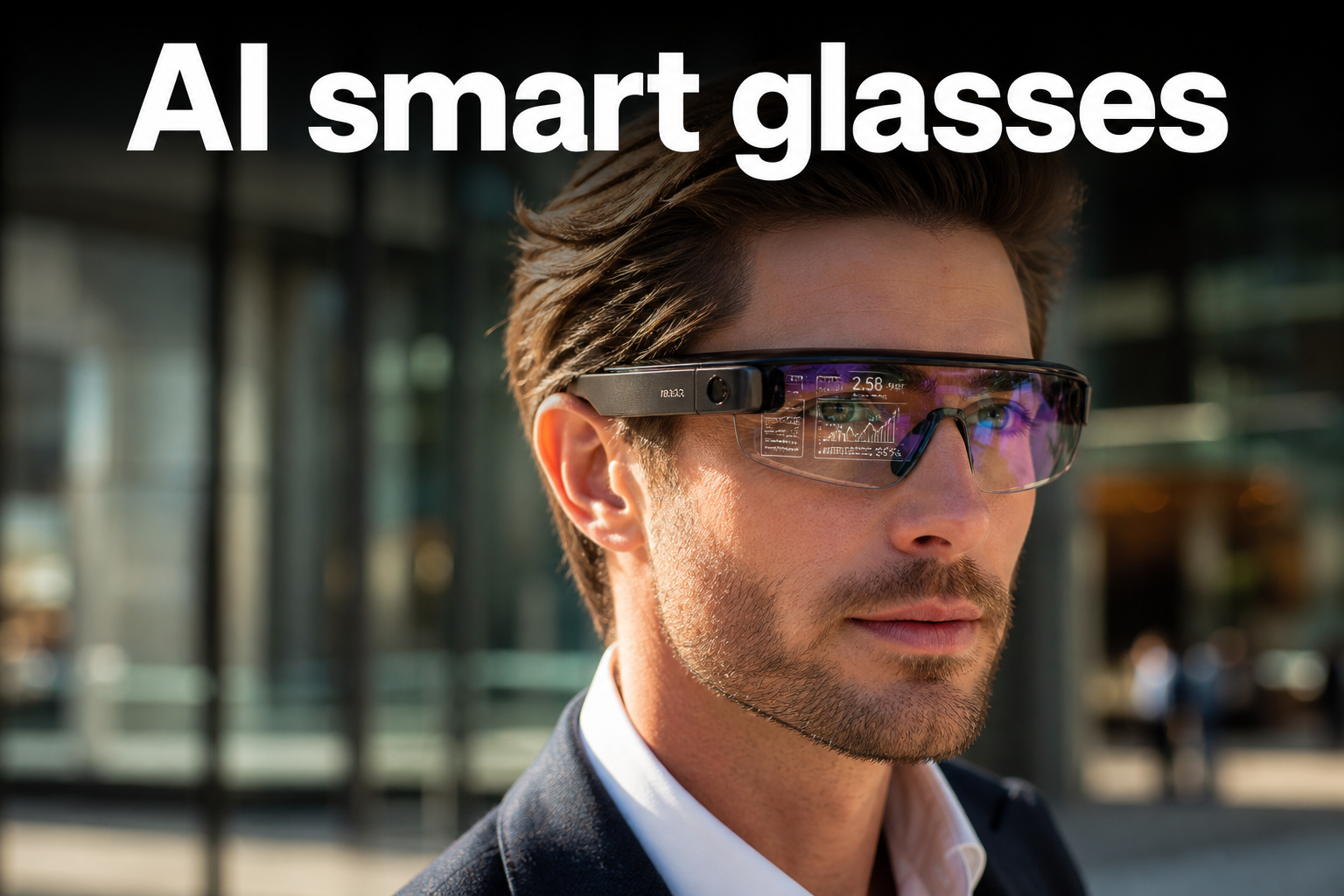
● AI Glasses Market Explosion
AI Glasses That Can Even Solve CSAT Questions: The Most Important Market Shift Is Somewhere Else
Photo capture and real-time translation are now close to basic features.
The real core point is that AI smart glasses are emerging as the next-generation interface after smartphones.
The products introduced this time are not just novelty glasses, but a compressed version of the global tech race connecting wearable AI, smart glasses, real-time translation, on-device AI, and metaverse-style displays.
Especially with social issues such as CSAT cheating controversies, this device is no longer a “future product” but a “current regulatory issue.”
Below, we will organize them into camera-type, audio-type, and display-type models,
and separately highlight the core points from a market structure and investment perspective that other news reports often miss.
Why AI Glasses Are Suddenly Gaining Attention
The biggest change in AI glasses is that users can receive information in front of their eyes as naturally as having a conversation.
Instead of taking out a smartphone and searching,
it is becoming more natural to wear glasses, ask a question immediately, and receive an answer right away.
This trend is not just a passing fad,
but the next stage of digital transformation, the Fourth Industrial Revolution, and the AI trend.
There are four main reasons why AI glasses are drawing attention.
First, they keep your hands free.
Second, they deliver information directly within your line of sight.
Third, voice AI, cameras, translation, and navigation are combined into one product.
Fourth, a new platform competition after smartphones has begun.
Simply put,
the market is no longer testing whether “glasses are merely tools for correcting vision,”
but whether “glasses can become personal assistants.”
Key Takeaways You Must Notice in This Article
All the products introduced this time are AI glasses, but their characteristics are completely different.
- Camera-type models are strong in photo and video capture and voice AI conversation.
- Audio-type models focus on calls, music, and AI question-and-answer functions without cameras.
- Display-type models show translation, directions, and presentation scripts in front of your eyes.
- Upcoming models show market scalability as major companies such as Samsung enter the field.
In other words, AI glasses are not a single product category.
They are being divided into completely different markets based on user purpose.
Ray-Ban Meta Gen 2 Headliner: The Most Mainstream Camera-Type AI Glasses
The second-generation smart glasses created through the collaboration between Ray-Ban and Meta
can be seen as a representative product in the AI glasses category.
The core features are as follows.
- 12-megapixel camera
- Photo capture support
- Up to 3K video recording
- Music playback support
- Voice-based AI questions
- Transition lenses
- Up to 8 hours of use
The key point of this product is not just its features, but its “mainstream appeal.”
Because its design is close to ordinary sunglasses,
it looks more like a fashion item than a tech product.
This is extremely important.
That is because wearable AI needs not only strong performance
but also low resistance to wearing it in order to succeed.
People are far more sensitive about devices worn on the face than devices worn on the wrist.
That is why collaboration with fashion brands is not just marketing,
but a core strategy for popularizing AI glasses.
Oakley Meta AI HSTN: A Sporty Model Strong in Exercise and Outdoor Activities
The Oakley model has a very clear target audience.
It is designed for people who spend a lot of time outdoors, such as exercising, running, cycling, or traveling.
Its main features are as follows.
- 12-megapixel camera
- Up to 3K video recording
- Voice AI function
- Open-ear speakers
- Transition lenses
- Up to 8 hours of battery life
This product combines the characteristics of an “everyday recording camera” and a “smart device for outdoor activities.”
In particular, the open-ear design, which does not block the ears,
is a strength in environments where users must remain aware of surrounding sounds.
The reason this product is meaningful is that
AI glasses are not staying limited to office devices
but are expanding into lifestyle devices.
In other words, as the market grows,
it is highly likely to connect with fashion, sports, healthcare, and travel categories as well.
Seerslab AInoonX: Reasonably Priced Audio and AI Glasses
AInoonX from the Korean company Seerslab
is a good product to consider as an entry-level AI glasses model.
The core point is that it “boldly removes unnecessary elements and includes only what is essential.”
- No camera
- No display
- Focused on voice AI
- Can call ChatGPT, Gemini, and Claude
- Call support
- Music playback support
- Interpretation and translation support
- Lightweight at about 30 grams
- Priced at around 289,000 won
- Style changes possible by replacing the front frame
What makes this product interesting is that
it shows that the essence of AI glasses is not necessarily the camera.
In fact, many people feel uncomfortable with products that have cameras attached to the face.
On the other hand, audio-focused models have relatively lower privacy concerns
and are easier to adapt to naturally in everyday life.
This product is especially important for understanding the flow of the
Korean AI market, practical wearable devices, and low-cost AI devices.
It clearly shows that high-end products open the market,
while mid- to low-priced products expand the market.
Even Realities G2: Display-Type AI Glasses Specialized in Translation and Navigation
Even’s G2 is a product with a very clear function.
It is a display-type AI glasses product that shows information in front of the eyes.
Its main features are as follows.
- Ultra-small display built into the lenses
- Real-time translation subtitles
- Direction guidance display
- Presentation script display
- Schedule and notification checking
- Lightweight at about 36 grams
- Up to 2 days of use
- Round and square frame options
The strength of this product is “AI that shows information.”
In other words, it is suited for people who need visual information more than audio information.
It can be highly practical in situations such as meetings, presentations, foreign-language communication, and navigation.
Display-type AI glasses are likely to attract more attention in the future
among global business users, office workers who frequently travel overseas,
and industries with interpretation and translation needs.
They are not merely new technology,
but tools that can directly improve work productivity.
Samsung Electronics Galaxy Glasses: The Most Important Future Variable
The company that deserves the most attention in this article is actually Samsung Electronics.
Even though the product has not yet been released,
Samsung’s entry could be an event that changes the market structure.
The expected points are as follows.
- Collaboration with Gentle Monster and Warby Parker
- Fashion-oriented design
- Expected 12-megapixel camera
- Possibility of up to 3K video recording
- Two open-type speakers
- Four microphones
- Expected battery life of up to 9 hours
- Possibility of various frame designs
Samsung’s significance is not limited to a single product.
When Samsung enters, components, ecosystems, Android connectivity, and global distribution networks move together.
Therefore, this product should be viewed less as a matter of “specifications”
and more as a “catalyst for expanding the market size.”
In particular, Samsung already controls the smartphone, earbuds, and Galaxy ecosystem,
so it has the power to prevent AI glasses from ending as a one-time trend.
This is the core point that other articles often fail to cover.
The Most Important Content Other News Reports Often Miss
The real point of AI glasses is not the product itself, but regulation and trust.
What the CSAT cheating controversy showed is not
“whether the technology is possible,”
but “how far society will allow that technology to be used.”
In other words, the AI glasses market must move forward while addressing issues such as:
- Standards for bringing devices into exam sites
- No-filming policies
- Rules on voice AI use
- Personal information protection issues
- Ethical concerns around facial recognition and recording
The reason this matters is that
no matter how good the product is, adoption can be blocked if social trust breaks down.
In the future, AI glasses will not simply be electronic products,
but an industry that includes security, personal information, and AI ethics.
Another important point is that
AI glasses will not completely replace smartphones.
For the time being, their more realistic role will be as a smartphone companion device,
or a “hands-free information terminal.”
If this is misunderstood, the market may be overestimated.
Rather, the early winners are more likely to be
products that are more convenient than smartphones in specific situations,
not products that replace phones entirely.
Why AI Glasses Matter from an Economic Perspective
AI glasses are not simply consumer goods.
They are a complex market combining components, optics, batteries, voice recognition, AI models, communications, and fashion.
The related keywords are very clear.
- Technology consumer goods demand within the global economic outlook
- Expansion of semiconductor and sensor demand
- Intensifying competition in wearable devices
- Rising demand for AI semiconductors and on-device processing
- Acceleration of digital transformation
In other words, AI glasses are not just one product.
They are a category that could drive the entire technology supply chain.
From an investor’s perspective,
camera modules, ultra-small displays, batteries, AI voice processing, and optical materials may become more important than brands themselves.
What Trends Should Be Watched Going Forward?
AI glasses are likely to evolve in the following order.
- Stage 1: Combination of cameras and voice AI
- Stage 2: Real-time translation and notification display
- Stage 3: Strengthening of personal assistant functions
- Stage 4: Transformation into work productivity tools
- Stage 5: Full settlement as fashion and everyday consumer goods
Ultimately, the competition comes down to three things.
First, how light and natural they feel.
Second, how long the battery lasts.
Third, how often users actually use them.
AI does not survive just because its functions are good.
It must feel natural even when used every day.
In that sense, AI glasses are still in their early stage,
but once they take hold, they could become a product category that changes everyday habits.
In Summary, the Key Takeaway from This AI Glasses Article
The most important point in this article is that
“AI glasses are not simply fascinating electronic devices, but a new category that is already shaking both real life and regulation.”
Ray-Ban Meta and Oakley demonstrate mainstream appeal and style,
Seerslab shows realistic pricing and usability,
and Even demonstrates the potential of work-focused displays.
Samsung Electronics is also a player that could greatly expand this market.
In other words, the future AI glasses market is likely to become a battle where
fashion, productivity, translation, recording, security, privacy, and AI ecosystem competition all converge at once.
< Summary >AI glasses are no longer just new technology, but are emerging as a candidate platform after smartphones.
They are being divided into camera-type, audio-type, and display-type models, with use cases becoming increasingly segmented.
The CSAT cheating controversy showed that regulation and trust are more important than technology itself.
Samsung Electronics’ entry is a key variable for market expansion.
Going forward, wearable AI, real-time translation, digital transformation, and AI semiconductor demand are likely to receive attention together.
[Related Articles…]
- How AI Glasses Will Change Daily Life and Work
- Real-Time Translation AI and the Future of Global Work
*Source: https://www.esquirekorea.co.kr/article/1911556
Leave a Reply