
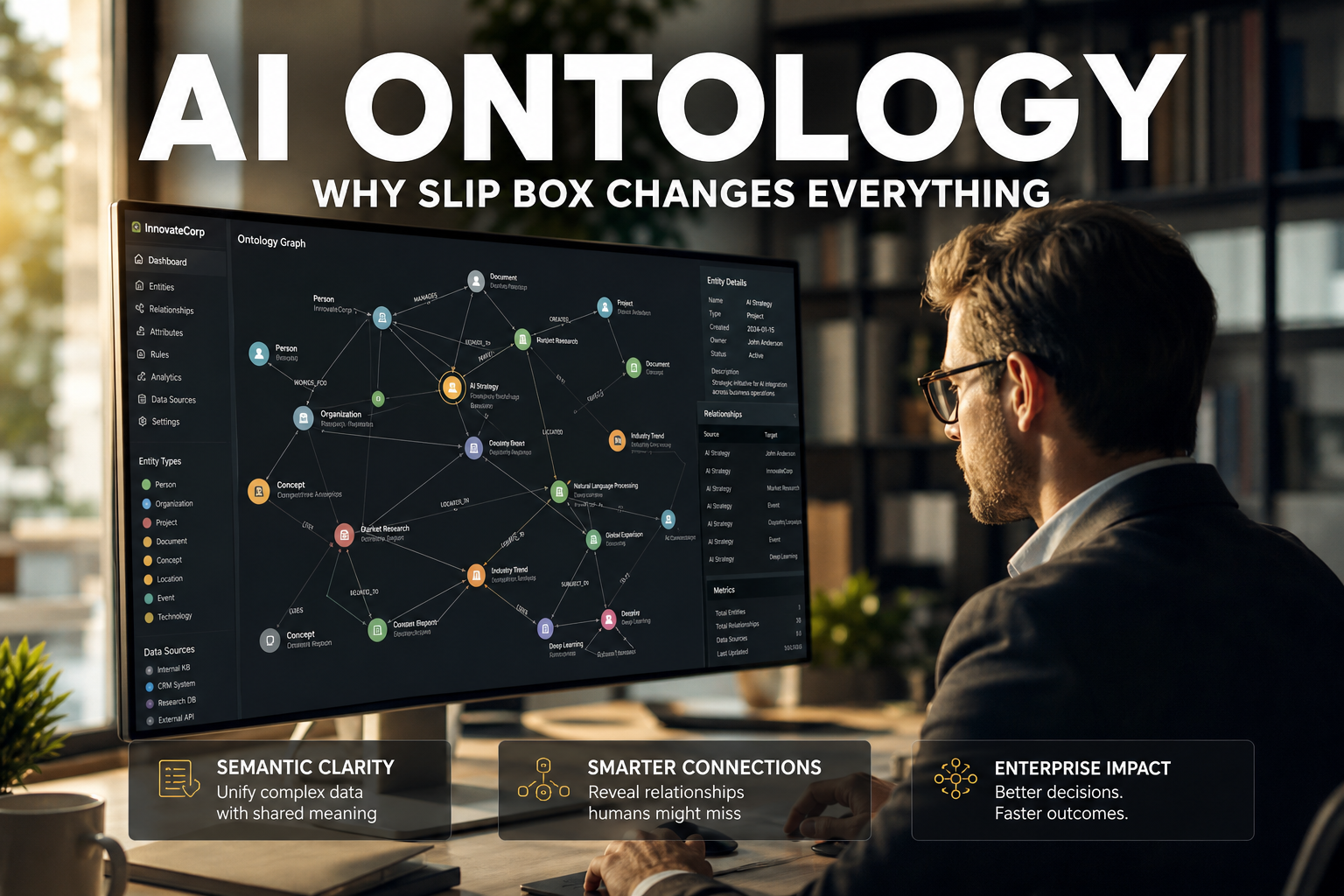

● AI Ontologies Go Beyond Search Slipbox Operationalizes Knowledge
“Ontologies Can Be Explained in Words” Why the Slip Box Created by Genesis Lab’s CTO Is Changing How AI Agents Are Operated
Key News Points at a Glance
- An emerging view argues that ontologies do not necessarily have to be built only in graph form, and that sentences and explanations alone can create a sufficiently operable structure.
- Based on 10 years of deep learning experience, Genesis Lab is building a general-purpose Agent Builder that connects its internal services into one system.
- The key takeaway is not “AI that only developers understand,” but an operational structure that domain experts in the field can directly view, modify, and validate.
- Slip Box is not just a simple knowledge repository, but closer to a practical ontology that connects AI-understandable term definitions, relationship definitions, execution flows, and validation.
- A trend is emerging in which RAG, vector databases, Text-to-SQL, AI agents, and data governance are combined into a single operational system.
- This is especially important because it directly addresses the issues that small and midsize companies struggle with most: “data sovereignty,” “operational stability,” “response to model changes,” and “ROI.”
- A point rarely discussed elsewhere is that, more than AI performance, a structure that can be updated and validated is the greater competitive advantage.
What Genesis Lab Is Doing Now: From a Deep Learning Company to an Agent Platform Company
- Genesis Lab originally developed various deep learning models, including recruitment interview analysis, speech recognition, speech synthesis, and AI humans.
- Its strength lies in the fact that it is not merely a team that has built one or two models, but a team that has directly handled more than 10 models.
- Now, based on that experience, it is developing an Agent Builder that connects multiple internal services into one system.
- The core goal is to quickly create AI agents for complex internal corporate tasks and allow business teams to immediately validate and modify them.
- In other words, the company is moving from “a company that builds AI” to “a company that builds AI operating systems.”
Why Ontology Should Be Revisited: More Important Than Graphs Is an “Explainable Relationship”
- In general, ontology is understood in terms of entities, relationships, triples, and graphs.
- However, in real-world operations, there is a problem with trying to turn everything into a complex graph structure.
- The perspective of Genesis Lab’s CTO is highly practical.
- What matters is not the shape of the graph, but whether an LLM can understand and reuse relationships that people explain in words.
- In other words, the approach is that statements such as “this term is used with this meaning,” “this data is on this page,” and “this relationship is connected in this way” can function as an ontology even when expressed in natural language.
- This method is much more familiar to practitioners in the field.
- Instead of learning a complex ontology schema from scratch, they can define and connect concepts using their own business language.
What Slip Box Really Is: Not a Knowledge Management Tool, but an “Executable Ontology”
- Slip Box is not just a simple wiki or document repository.
- It is a structure that manages documents, relationships, terms, prohibited rules, query rules, and agent execution flows together.
- In short, it is a “documented ontology” and an “operational knowledge system that AI can execute immediately.”
- What matters here is not simply stacking pages, but defining relationships between pages and enabling AI to explore along those relationships.
- Thanks to this structure, AI can better locate “where certain information exists” and execute the necessary tasks.
Why Slip Box Was Needed: The Limits of Traditional AI Development Methods
- Traditional AI service development usually involved creating a prototype, having the development team organize it, and then deploying it into the operating environment.
- However, AI has far more uncertainty than ordinary software.
- This is because users do not use it only in the ways that were predicted.
- In addition, when business teams, AI teams, and development teams operate separately, problems are discovered late.
- Errors become visible only after deployment, and the cycle of fixing them afterward repeats.
- This process takes longer than expected, and even issues that could be solved with just a few lines of prompt may take a day, a week, or sometimes even longer when viewed from an operational standard.
- That is why the solution became a “general-purpose Agent Builder that business teams can directly view and modify immediately.”
The Core Structure of Genesis Lab’s Approach: Abilities, Agent, and Data Layer
- This company does not simply call workflows workflows; it divides them into a concept called “Ability.”
- In other words, it separates functional units within a single flow like modules.
- These Abilities can then be attached to or detached from the Agent layer like tools.
- What matters here is “functional modularization” and “version management.”
- The system is designed so that even if the AI model or tools change, the entire system does not have to be rebuilt from scratch.
- Beneath that is the data layer.
- In this layer, vector databases, embeddings, document structures, metadata, and relationship information work together.
A Core Point Rarely Discussed Elsewhere: In AI, “Change Cost” Is Scarier Than Performance
- Most people talk only about AI performance, but in real-world business operations, what is scarier is the cost of model changes.
- If the embedding model changes, reindexing is required, and if the data changes, reprocessing is needed.
- If a structure built once changes every week or every month, operating with only a vector database becomes highly burdensome.
- For small and midsize companies in particular, operating GPU servers, replacing versions, and conducting regression tests are not easy.
- That is why this team chose a hybrid method: rather than “vectorizing everything,” static data is managed in a structured way, and AI supplements only the necessary parts.
- In practice, this is far more realistic.
Problem Solved by Slip Box 1: It Does Not “Just Store” Documents, but Also Builds Relationships
- Slip Box does not end with uploading files.
- It receives various inputs such as PDFs, Excel files, PowerPoint files, text, and database structures, then breaks them down and connects them into semantic units.
- The “Preserve Original Text” feature is especially important.
- In cases such as legal documents, where meaning can change if even one word is altered, the original text must be structured while preserving it as much as possible.
- At the same time, documents are reorganized by page, topic, and relationship into a form that AI can understand.
- In other words, people can feel confident by viewing the original text, while AI can work with structured information.
Problem Solved by Slip Box 2: Term Definition Is AI Performance
- In the field, the same word is often used with different meanings.
- For example, even the word “Paris” can be interpreted differently depending on context, such as a country, city, or region.
- Corporate data is the same.
- Even the same “business registration number” may have slightly different meanings depending on the table.
- Slip Box explicitly defines these terms.
- The LLM reads the definitions and interprets the terms according to those meanings from then on.
- This is far more important than it may seem.
- If AI learns an incorrect term definition, every subsequent query can become unstable.
Problem Solved by Slip Box 3: It Uses DB and MD Together to Achieve Both Speed and Consistency
- A simple document-based wiki is easy for people to understand, but it may be weak in search and consistency management.
- Conversely, if everything is managed only in a database, AI may find it difficult to understand immediately.
- This team combined the two.
- Consistency is managed in the database, and the necessary parts are rendered back into Markdown for AI to read.
- This makes it possible to achieve search speed, consistency, editing convenience, and explainability at the same time.
- This structure is highly practical.
- It creates not merely an “AI-friendly” environment, but “operable AI-friendliness.”
How Validation Works: Bulk Test and Zero Click Are the Core Points
- AI is not finished once it is built; validation is even more important.
- Genesis Lab uses a Bulk Test feature to validate whether an Ability matches the correct answers at scale.
- It also emphasizes the concept of Zero Click.
- This is a method that runs virtual tests and checks results based on input values without requiring users to manually configure complex settings one by one.
- Business teams can quickly see “whether this is correct,” and if there is a problem, they can fix it immediately.
- This is not simply QA, but closer to automation of AI operations.
Why Text-to-SQL and Explainable AI Have Become Important Again
- In the field, demand for Text-to-SQL is higher than many expect.
- It is not a feature used only by data teams; there are many situations in which business teams want to directly ask about data conditions.
- However, Text-to-SQL can be dangerous if built incorrectly.
- If it does not properly understand the table structure, it may generate the wrong query, which in real-world work directly leads to a loss of trust.
- That is why a structure like Slip Box is needed, where table definitions, prohibited rules, and query rules are managed together.
- Especially as AI regulation and demand for explainability increase, it has become important to have a structure that shows “why this result was produced.”
The Most Important Point for Companies: Turning AI into an Asset
- The biggest idea to take from this discussion is “how to turn AI from an individual capability into a corporate asset.”
- Many companies have adopted AI, but in practice, they often depend on the prompt skills of specific employees.
- In that case, if the employee leaves or transfers to another department, the asset disappears.
- Slip Box and Agent Builder aim to solve this problem directly.
- In other words, they systematize individual know-how and transform it into a structure that the entire company can reuse.
- This is the real way to create ROI.
Why This Is Especially Important for Small and Midsize Companies
- Large enterprises may be able to integrate data lakes or build company-wide platforms.
- But small and midsize companies are different.
- Data sovereignty, maintaining existing systems, costs, lack of personnel, and operational complexity are far more sensitive issues for them.
- That is why an approach that “replaces everything” is not realistic.
- Genesis Lab’s approach maximizes the use of existing systems while connecting only the necessary parts through ontology and agents.
- This strategy becomes even more effective for smaller organizations.
In Summary: Slip Box Is Not an AI Search Tool, but an Enterprise Operating System
- The essence of Slip Box is not search.
- Beyond being a tool for finding documents, it is an operating system that defines terms, creates relationships, validates, modifies, and connects execution.
- The core point is that ontology is not viewed only as a graph, but reinterpreted as page relationships that can be explained in words.
- This approach allows AI to work well while also allowing people to understand and control it.
- Ultimately, the future competitiveness of AI will depend less on “model performance” and more on an “updatable structure,” an “explainable structure,” and a “structure that business teams can directly handle.”
The Most Important Point Rarely Discussed in Other YouTube Videos or News Articles
- Most AI content ends at the level of “which model is good” or “performance has improved.”
- But in actual corporate environments, something more important exists.
- It is who can modify it, how much can be explained, and how quickly it can be recovered when things change.
- The reason the Genesis Lab case matters is that it does not simply present AI impressively, but turns it into an “operable system.”
- In other words, competitiveness in the AI era is not a smart answer, but “sustainable controllability.”
- This is something many companies are truly missing.
< Summary >
- Genesis Lab reinterpreted ontology as a structure that can be operated not only through graphs, but also through words and documents.
- Slip Box is not a document repository, but an AI operating system that combines terms, relationships, validation, and execution.
- Its core value lies in change cost, explainability, and business-led modifiability rather than performance.
- It is a hybrid AI assetization strategy that is especially advantageous for small and midsize companies.
[Related Articles…]
- Key Takeaways on How Agent Platforms Transform Enterprise Workflow Automation
- Practical Strategies for Connecting Data and AI Through Ontology
*Source: 빌더 조쉬 Builder Josh
Leave a Reply