
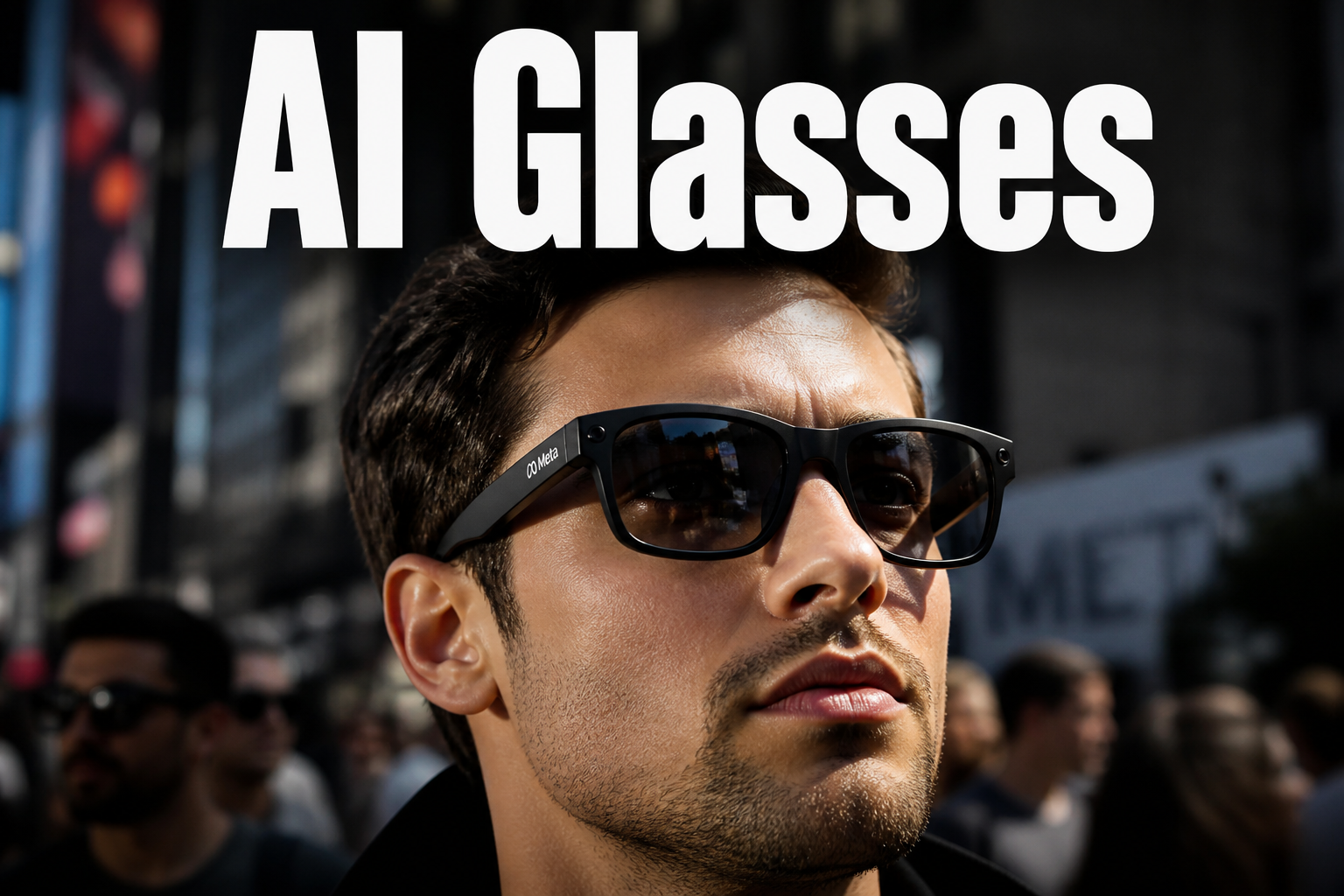
● Meta Signals the AI Glass Boom
Meta Connect 2026 Key Takeaways: AI Glasses Have Moved from “AI That Sees” to “AI That Acts on Your Behalf”
What Meta showed at Connect 2026 was not simply a product announcement, but the next stage of AI and wearable devices.
1. The core point of this announcement is that Meta has brought AI directly in front of our eyes
Meta announced that it will integrate Muse into AI glasses.AI is no longer a tool that requires users to open an app and enter commands; it is becoming a personal AI agent that users can talk to directly in everyday life.The key takeaway is not just that voice interaction has become more convenient, but that AI can now understand what the user is seeing by combining cameras with visual awareness.In other words, AI is evolving from “AI that explains” into “AI that understands the situation and handles tasks immediately.”This trend represents a major shift that brings together AI agents, generative AI, XR, smart glasses, and digital transformation.
2. The changes Meta unveiled can be understood in four main areas
First, Meta is pursuing a strategy of turning AI glasses into everyday AI assistants by integrating Muse.Second, through Meta VR Glasses, which change the VR experience, Meta is aiming to expand the market for ultra-light immersive devices.Third, with audio glasses and next-generation Ray-Ban Meta products, Meta is further expanding the mainstream wearable market.Fourth, by connecting health assistance, navigation, video calls, payments, and work integrations, Meta is turning AI glasses from a simple device into a lifestyle platform.
3. The real point of AI glasses is “reducing user actions”
The most important part of this announcement is not technical performance, but the user flow.Because AI understands what the user is looking at, users do not need to explain things at length.Products on shelves, flyers, schedules, and shopping lists can be handled immediately in front of the user’s eyes.This is meaningful because the competitive axis of the AI market is now shifting from “accuracy” alone to “how little effort it requires from the user.”In the future, the experience of being instantly connected the moment you put on glasses may become more important than the smartphone-like experience of opening a screen.
4. Why Muse goes beyond a simple voice assistant
Muse is not designed merely to receive voice commands, but to act as a personal AI agent that helps users achieve their goals first.In this announcement, a wider range of connectors was emphasized as a core point.By connecting shopping, travel, grocery purchasing, and work tools, Meta is making it possible for AI to lead to real actions.For example, in shopping, Muse connects not only with Shopify but also with partners such as Walmart, Best Buy, Sephora, Ulta, and Wayfair.On the work productivity side, it also connects with tools such as Notion, GitHub, and Box.This structure clearly shows the direction AI must take: from “conversational search” to an “execution-based assistant.”
5. The most notable point: AI glasses could become a direct consumer commerce channel
This announcement may look like hardware news, but in reality, the commerce strategy is even more significant.If AI glasses become shopping assistants, users will receive recommendations and make purchases directly based on what they are seeing, instead of using a search box.If payment methods are added to this experience, purchase conversion paths could become much shorter than they are today.This represents a fairly major change for e-commerce, retail, and the payments industry.In the future, there may be more consumers who purchase immediately through context-aware recommendations than consumers who enter a platform after seeing an advertisement.For domestic platforms such as Naver Shopping and Coupang, the important question will likely be how quickly they can add AI-based discovery experiences.
6. Meta VR Glasses address VR’s biggest weakness: wearing fatigue
The core point of Meta VR Glasses is an ultra-light form factor of around 100 grams.This is not simply a lightweight product; it addresses a barrier that VR had to overcome in order to become mainstream.Existing VR devices offer strong immersion, but they are difficult to use for long periods.This time, however, Meta has combined a personal movie theater, stadium experience, workspace, and game console into a single glasses-type device.In particular, IMAX Enhanced certification and expanded live sports broadcasts are points that could significantly change content consumption.In other words, VR is moving beyond gaming equipment and expanding into a media consumption platform.
7. Audio glasses combine “fashion + AI + hearing assistance”
Ray-Ban Meta Audio glasses and Gen 3 show a realistic entry point for the wearable market.Because glasses are already highly suitable for everyday wear, combining them with earbuds and AI functions is likely to increase usage frequency.Some models will also add hearing assistance features.This is not just an accessory; it is a point where health assistance technology and consumer electronics meet.In the future wearable market, “having a reason to use it every day” is likely to become more important than simply “looking stylish.”
8. What this announcement means for the global economy and industrial structure
First, competition in AI hardware has officially begun.AI is no longer only a story about cloud services and data centers.It has now moved into competition over devices that directly touch consumers.
Second, demand for semiconductors and components may become more sophisticated.The importance of cameras, sensors, batteries, audio chips, and low-power computing components will grow.This is also a positive signal for AI semiconductors, edge AI, and the sensor industry.
Third, the center of gravity in the content industry is shifting.Video, sports, education, and workplace collaboration content may be redesigned for glasses-type devices.Media platforms, streaming, sports broadcasting, and remote work solution markets will all be affected.
Fourth, payments and commerce will become more centered on immediacy.Consumers may use context-based recommendations more often than search.This will also change digital advertising, e-commerce, and subscription models.
9. The most important point that other news often misses
The most important point is that Meta is turning AI from an “app feature” into a “device default.”This has significant meaning.In the future, AI competition may shift from who builds the smartest model to who integrates AI most naturally into daily life.In other words, AI will not remain inside a chat window; it will become lifestyle infrastructure connected to vision, voice, payments, work, and healthcare.Once this trend is complete, consumers will use AI even without feeling that they are using AI.That is the real turning point.
10. Investment points to watch going forward
The expansion of the AI glasses supply chain should be watched closely.Battery, sensor, microphone, optical component, and low-power chip companies could benefit.Content partnership expansion is also important.As integrations with streaming, sports, education, and workplace software increase, the ecosystem’s value will grow.Another point is payment integration.If payment connections such as Shop Pay and PayPal expand further, wearable commerce is more likely to translate into real revenue.Lastly, the execution scope of AI agents matters.If AI expands beyond simple answers into reservations, purchases, document processing, and work automation, platform value could rise sharply.
11. In one sentence
Through AI glasses, Meta has clearly delivered the message that “the next stage for generative AI is not the screen, but glasses.”And those glasses are not merely a fashion item; they are moving toward becoming a next-generation platform that connects AI agents, commerce, content, work, and healthcare.
< Summary >
At Connect 2026, Meta expanded AI into an everyday agent by integrating Muse into AI glasses.It also broadened the wearable market by unveiling ultra-light VR glasses, audio glasses, and hearing assistance features.The core point is that AI is becoming a default function of the device itself, rather than remaining inside an app.Going forward, the combination of AI glasses, AI agents, XR, commerce, and content platforms is likely to accelerate.
[Related Articles…]
- Meta AI Glasses and the Next Generation of Wearable Strategy
- How AI Agents Are Changing the Global Industrial Landscape
*Source: https://about.fb.com/ko/news/2026/09/the-biggest-news-from-connect-2026/
Leave a Reply