
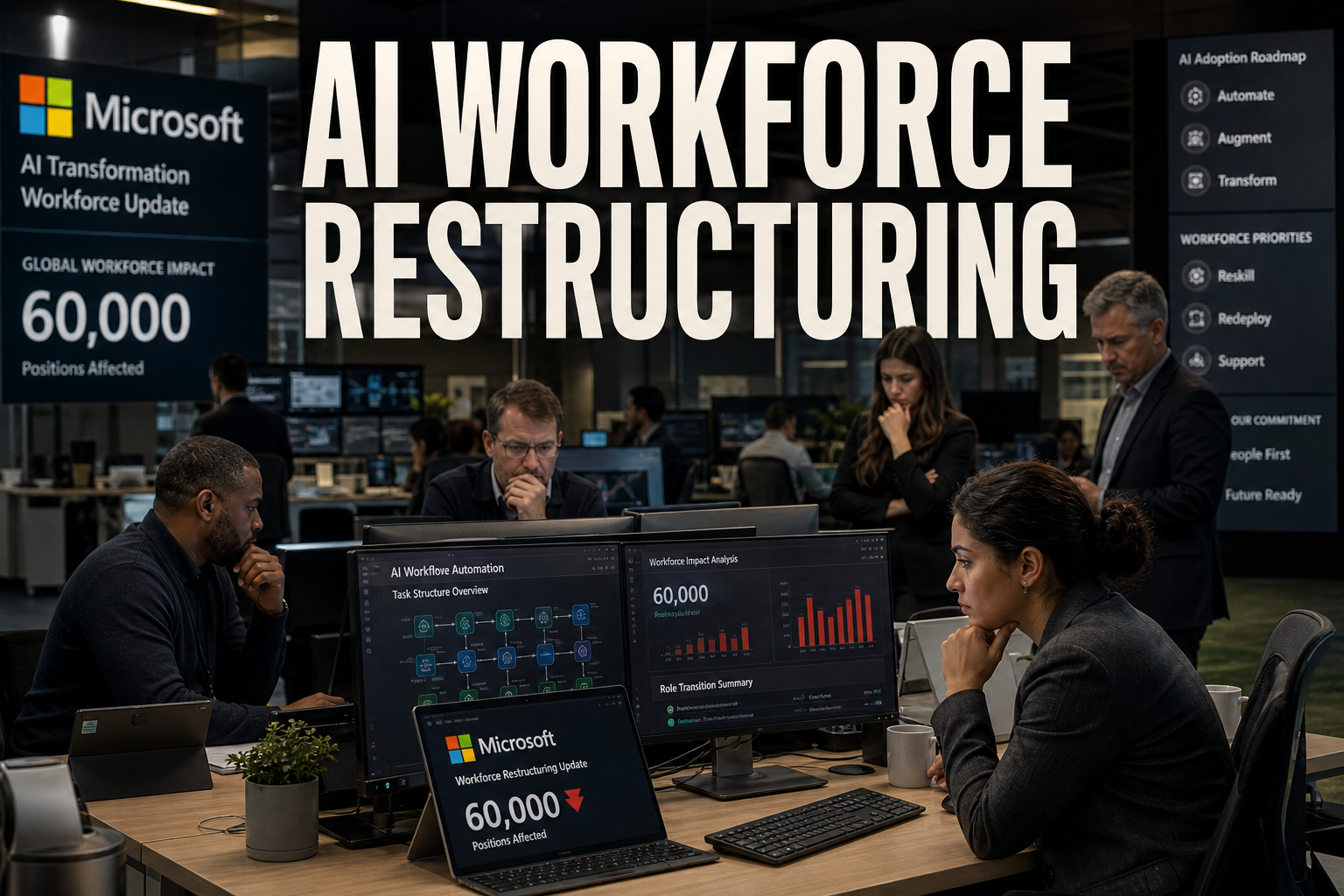
● AI Reshapes Jobs
The Core Point of Microsoft’s Voluntary Retirement Offer to 60,000 Employees: We Have Entered the Stage Where AI Is Not Replacing People, but Redesigning Work
The background behind Microsoft’s October voluntary retirement offer to roughly 60,000 employees is drawing attention again.
The core point is not simply a story about workforce reduction.
What matters is that this decision is closer to an organizational restructuring that redesigns every role around people who “use” AI, rather than a signal that AI is replacing humans.
In other words, it can be read as a message that future corporate competitiveness will depend less on how many people a company has and more on how efficiently it manages and utilizes AI.
This trend is an issue that simultaneously affects the global economic outlook, the labor market, productivity, and AI trends.
In particular, it must be understood by looking at digital transformation, artificial intelligence, productivity innovation, corporate restructuring, and the outlook for technology stocks together.
1. Viewed as News, the Message Microsoft Sent Is More About “Restructuring” Than “Layoffs”
Microsoft CEO Satya Nadella explained that the purpose of the workforce reduction was organizational realignment, not AI replacement.
The point he emphasized was clear.
Every role in the company must shift from simply using AI to managing and coordinating AI.
In other words, developers, sales teams, planners, operations staff, and managers are all moving toward “AI-collaborative work” structures.
This is not only a story about the technology industry.
Industries such as finance, retail, manufacturing, logistics, and media are also likely to move in the same direction.
For companies, something more important than labor cost reduction has emerged.
That is AI-based productivity innovation.
2. The Most Important Point: AI Is Not Eliminating People All at Once, but Changing the Standards of Jobs
The most important part of this statement is that it is not a simple frame of “AI replacing people.”
In reality, the following three changes are happening at the same time.
1) The Standard of Work Is Moving from “Execution” to “Management”
In the past, people spent a lot of time directly creating, analyzing, organizing, and reporting materials.
Now, AI performs those processes quickly.
As a result, the human role is shifting away from directly producing outputs and toward reviewing the results created by AI and adjusting their direction.
2) Organizations Are Shifting Toward Structures That Produce More Output with Fewer People
When companies adopt AI, the amount of work one person can handle increases.
In other words, the number of employees needed to generate the same revenue may decrease.
This structural change may put pressure on the labor market, but it can have a positive effect on corporate profit margins.
3) New Competitiveness Comes from an “AI-Proficient Organizational Culture”
Going forward, what matters more than whether a company adopts AI is how well the entire organization absorbs AI.
Even when using the same AI tools, some companies will see explosive productivity gains, while others will adopt the tools but fail to produce results.
In the end, the competition will be decided not by the technology itself, but by execution capability and organizational design.
3. From an Economic Perspective, This Message Affects Both Global Employment and Corporate Profitability
This issue is not just an IT news story; it is connected to the global economic outlook.
That is because when corporate workforce structures change, the labor market, consumption, investment, and wage trends all move in a chain reaction.
1) Pressure on the Labor Market May Increase
The faster AI spreads, the more demand may decline for middle managers, repetitive-task roles, and administrative support positions.
Large companies in particular may advance quickly with AI-powered work automation.
2) Corporate Profitability May Become Stronger
If the share of labor costs decreases while revenue remains the same, profit margins improve.
This also affects the valuation of technology stocks.
From an investor’s perspective, “margin improvement” may become just as important as “growth rate.”
3) Labor Productivity Indicators Will Become More Important
When assessing the economy going forward, how much productivity per worker improves will matter more than simple employment figures.
If AI actually boosts corporate performance, economic growth may have more resilience than expected.
On the other hand, if companies only reduce headcount without improving productivity, concerns over an economic slowdown may increase.
4. The Reason This Trend Matters in AI Is That AI Has Now Become Not Just a “Tool,” but a “Method of Running Organizations”
In the past, AI trends were often understood mainly as automation features.
But now, things are different.
AI is changing internal corporate work processes, decision-making structures, workforce allocation, and evaluation standards.
This change is likely to develop in the following directions.
1) Expansion of AI Agent-Centered Work Environments
A structure may become stronger in which AI agents perform tasks that people used to handle directly, while humans supervise them.
In this case, companies can operate a broader range of work with fewer people.
2) Redefinition of Roles
Simple execution-based roles will decrease, while the value of problem-solving, planning, and verification-based roles will rise.
The ability to handle AI itself is likely to become a basic competency.
3) Increased Demand for Education and Reskilling
Companies may spend more money on retraining existing employees than on new hiring.
In other words, the key issue will not be “who to hire,” but “how to transform existing employees into AI-ready talent.”
5. Key Checkpoints for Investors and Workers
This issue will not end as just one company’s workforce adjustment.
When looking at the market going forward, the following points must be considered together.
1) In the Earnings of Large Technology Companies, Labor Costs and Margins Must Be Viewed Together
Even if revenue grows, if labor costs decline quickly, profit margins can improve even faster.
Such companies may receive a premium in the stock market.
2) The Speed of AI Adoption Differs by Industry
Industries with large amounts of data, such as software, cloud, advertising, finance, and customer support, are likely to change quickly.
On the other hand, industries where field workers are important may change more slowly.
3) The Shock to the Labor Market May First Appear as “Job Reallocation” Rather Than “Unemployment”
At first, work restructuring and organizational streamlining will come before mass unemployment.
In the next stage, the shock may concentrate on workers who are slow to transition their roles.
6. The Most Important Point That Other Sources Often Do Not Mention
The real core point of this issue is not whether AI immediately replaces people.
The more fundamental issue is that companies are redesigning “the way people work” itself around AI.
This means that the value of “people who use AI well” and “people who can build systems that hand work over to AI” will rise sharply.
What matters here is not technology, but structure.
Competitiveness will be determined not by who has more employees, but by who builds an AI operating structure faster.
And this trend is a massive turning point that can change employment, wages, productivity, technology stocks, and the overall economic cycle all at once.
In other words, the spread of AI today should be viewed primarily not as simple automation, but as a “redesign of corporate operating models.”
<Summary>
Microsoft is not so much replacing people with AI as it is reorganizing every role around AI management.
This trend may lead to pressure on the labor market, improved corporate productivity, expanded technology stock margins, and the spread of AI agents.
The core point is that the companies that will lead the market going forward are not simply “companies that use AI,” but “companies that redesign their organizations with AI.”
[Related Articles…]
- How AI Agents Are Reshaping Corporate Workflows
- Key Productivity Trends Shaping the Global Economic Outlook
*Source: https://x.com/YahooFinance/status/2123808813232840963?a=TH-5Ru01d7aRG4a1bpU&s=19
Leave a Reply