

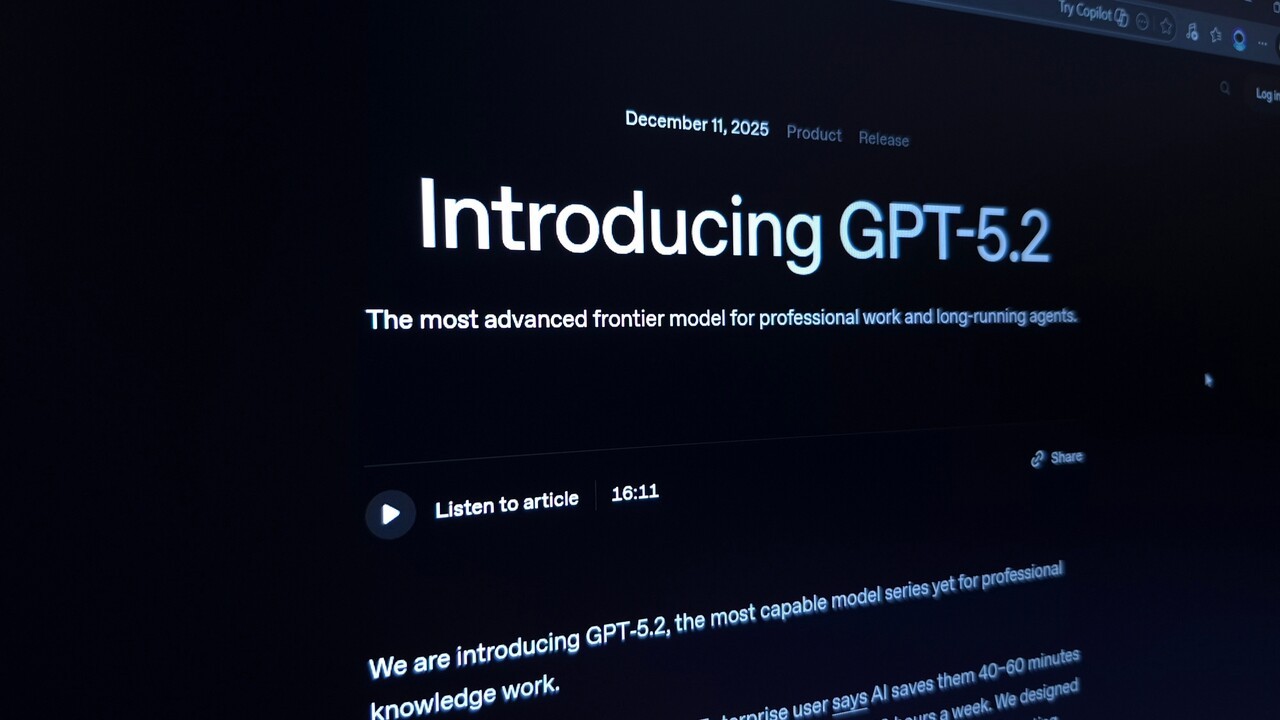
● Trillion-token frenzy, white-collar wipeout, agent-driven automation surge
The “1 Trillion Tokens” Illusion Shown by GPT-5.2: The Speed at Which Your Job Disappears Is Much Faster Than the Speed You Feel
The key takeaway is the number that it surpassed 1 trillion tokens on the API on the first day of release.
And what’s even more dangerous is the fact that even though everyday chat didn’t really get better, companies and developers rushed in explosively.
The reason you must read this right now is simple.
This update is a signal that AI has moved beyond a “fun chatbot” and become an engine that replaces real white-collar work.
Cause: OpenAI Went All-In on “Working AI” Rather Than “Friend-Like AI”
Early test reactions in the article are consistent.
GPT-5.2 is being rated as unprecedented not for writing flair or small talk, but for experts, developers, and enterprise work.
In particular, the phrase “it thinks for more than an hour” keeps coming up.
This is not performance bragging.
It means AI has finally entered long-horizon work flows (workflows).
Moreover, the codename “Garlic” is blunt in its message.
Coding + B2B specialization.
OpenAI values enterprise payments more than user amazement.
From a global economic outlook perspective, this is an extremely realistic choice.
AI goes toward where the money is, and where the power is.
Mechanism: The “Agent,” Not “Chat,” Becomes the Main Body
The real change in GPT-5.2 is not “speaking well.”
It is the ability to keep working for hours without losing the thread.
A case of running a 2-hour autonomous P&L analysis is symbolic.
What this means is simple.
AI is now moving from “question-answer” to
operating as an automation engine that breaks work down, executes it, verifies it, and produces deliverables.
The fact that developers feel it “generates complex code structures in one shot” is the same context.
What companies want is not impressive conversation.
It is work throughput.
From here on, this is not an AI revolution,
it is a labor market reshuffle.
Result: Productivity Goes Up. But Your “Market Value” Goes Down
Companies use models like GPT-5.2 like this.
They test and integrate “knowledge work” in areas like finance and life sciences.
The key point is where the Box CEO said it “performed faster in testing domain knowledge for financial services and life sciences work.”
This is not the “work assistance” stage.
It is the stage right before work replacement.
Corporate decision-making is brutally simple.
If they can produce the same deliverable cheaper and faster, they reduce headcount.
And after reducing headcount, they ask the remaining people, “Can you handle AI?”
That’s all.
This flow also affects asset markets.
Expectations of “AI productivity” create asset bubbles again.
But the fruits of that bubble do not fall to workers.
They concentrate only among AI infrastructure, cloud, data, and model owners.
Hidden Risk: Saying “I Don’t Feel It” Is the Most Dangerous Thing
The article said general users will feel “there’s no big change.”
This is the trap.
By the time the public feels it, it’s already too late.
Enterprise AI always moves like this.
1) It is introduced quietly inside.
2) Results show up as numbers.
3) Cost-cutting begins next quarter.
4) Then comes restructuring.
It is not the moment you feel, “ChatGPT got a bit nicer.”
It begins the moment your performance-review KPIs change.
Metrics like “document drafting speed,” “research throughput,” and “code review productivity” get quietly attached.
Then people’s value is recalculated.
And an even bigger problem.
This trend explodes when it merges with a debt crisis.
When the economy turns down, interest rates become a burden, and companies must cut costs,
the first lever they pull is “automation.”
AI is the blade of that automation.
The Most Important Content That Almost No One Else Talks About
The key takeaway of GPT-5.2 is not “performance,” but “duration.”
The ability to keep working for hours turns AI from a “tool” into a “replacement worker.”
This is not a simple upgrade.
It is an upgrade that breaks the employment structure of white-collar work.
And let’s say it even more definitively.
The conclusion is the fact that enterprise usage exploded even though everyday chat got worse.
The market does not spend money on “conversational AI.”
The market spends money on a labor-cost-cutting machine.
It is normal that you feel uncomfortable.
Options: Realistic Responses That Change the Next 5–10 Years
First, you must redefine “the core value of my work.”
If you remain at report writing, summarizing, organizing, and generating first drafts, you are at risk.
AI has eaten that zone.
Second, you must move from “using” AI to “operating” it.
People who just know a few prompts become oversupplied.
Instead, what remains is agent workflow design, verification, quality control, and data integration.
In other words, you must become an “AI manager.”
Third, you must also be cold-blooded from an investment perspective.
The AI theme is the core of future industry, but at the same time it is a target for asset bubbles.
The line “it goes up because it’s AI” is the classic pattern of getting in late and getting trapped.
You must look at cash flow and price together.
Fourth, the way you survive inside organizations changes.
The standard becomes not “working hard,” but “processing more with AI.”
This creates internal division.
Teams that use AI and teams that cannot use it—the productivity gap soon becomes a power gap.
< Summary >
GPT-5.2 is not a chat model.
It is an enterprise automation engine.
The 1 trillion tokens on the first day is not a fad; it is a structural shift.
Before the public feels it, companies are already preparing to reduce headcount.
The AI revolution is not an opportunity; for most people, it is a warning of employment collapse.
[Related Posts…]
*Source: https://www.aitimes.com/news/articleView.html?idxno=204780
Leave a Reply