
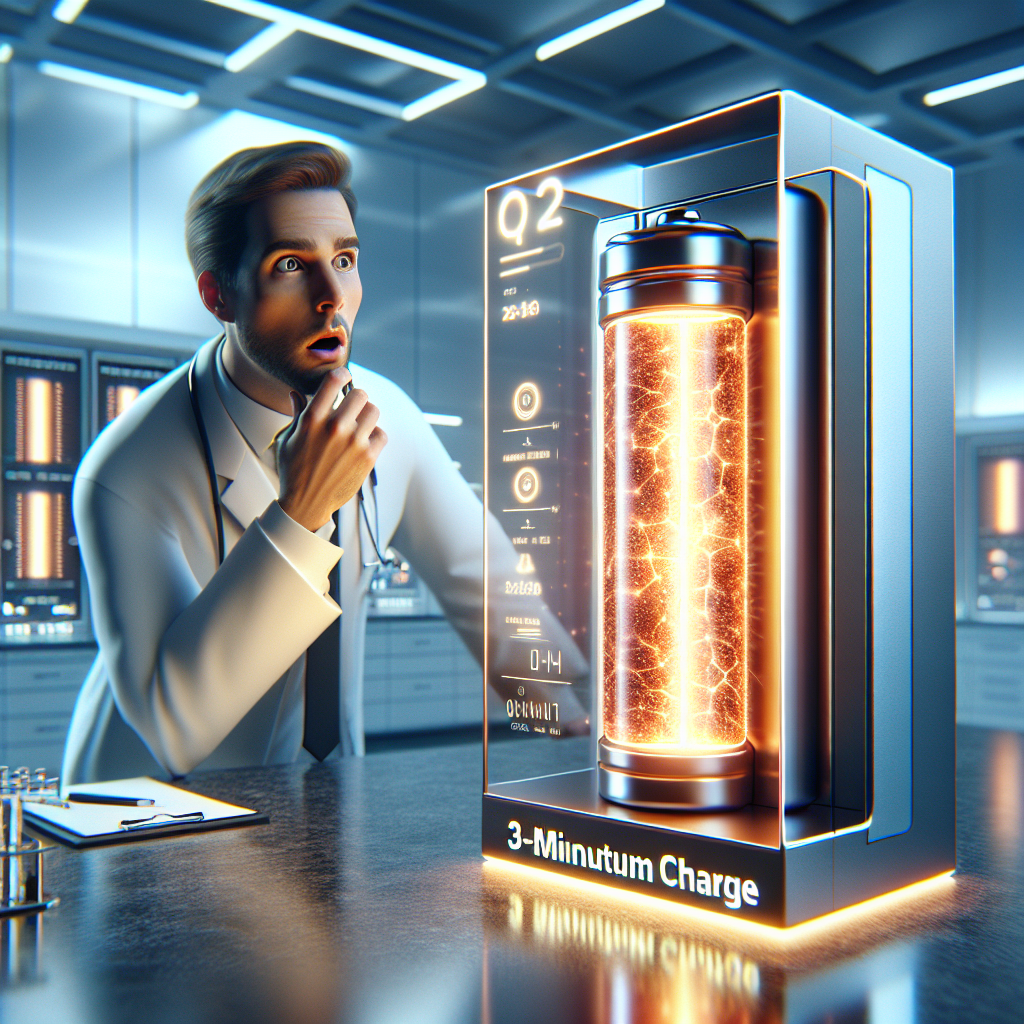
● Quantum Battery Revolution Shocks Market
Quantum Batteries and Electric Vehicle Charging Innovation: Unveiling the Future
The Emergence of Quantum Battery Concepts (Research Idea in 2013)
Explaining the concept of quantum batteries, first proposed by Polish and Belgian physicists in 2013.
Although still in the early stages compared to traditional battery technology, the research potential is immense.
Based on current theoretical and experimental research results, it suggests the possibility of significantly reducing electric vehicle charging times.
The Limitations of Electric Vehicle Charging and the Need for Innovation
Recognizing Electric Vehicle Charging Problems
Using plug-in hybrid vehicles as an example, pointing out that the existing electric charging time is too long and problematic.
Automobile and battery manufacturers are focusing on developing methods to enable rapid charging.
Limitations of Traditional Battery Charging Methods
The method of charging sequentially one by one is time-inefficient.
Analogously, it’s like one employee sequentially serving multiple tables, with clear speed limitations.
Quantum Batteries – The Core Principle of Innovative Technology
Quantum Battery Principles and Superposition Phenomenon
Quantum batteries utilize the concept of quantum superposition to activate multiple charging cells simultaneously.
For example, similar to a coin having both heads and tails simultaneously in a quantum superposition state, enabling simultaneous charging.
This method can provide charging speeds several times faster than traditional charging methods.
Relationship between Charging Speed and Number of Battery Cells
Research shows that the charging speed increases proportionally to the square of the number of battery cells.
For example, the theory suggests that a Tesla Model 3 battery with 3,000–4,500 cells could have charging speeds 9 million times faster.
However, there are still many engineering challenges to overcome in applying theoretical and experimental results to real-world applications.
Experimental Approaches and Various Charging Protocols
Multiple Charging vs. Single Charging
Researchers compare and analyze two charging methods (multiple charging and single charging).
• Multiple Charging: Enables faster charging by opening multiple faucets (charging channels) simultaneously, but the disadvantages are high cost and energy consumption.
• Single Charging: Charges by connecting multiple hoses to one faucet, which is efficient but lacks innovation in speed.
Actual Experiments and IBM-Supported Research
Recent research published in 2024 suggests improving charging efficiency and accuracy by applying qubits from quantum computers.
Experimental results using the IonQ process showed improved charging efficiency and speed, which is exciting news for investors.
This experiment, conducted with IBM-supported research, has the potential to be an important foundation for the commercialization of quantum batteries.
Future Prospects and Challenges
Potential of Quantum Battery Technology
Expected to be an innovative technology that can overcome the limitations of traditional battery technology.
However, quantum battery technology is still in its early and experimental stages, with many hurdles to overcome before commercialization.
Challenges and Real-World Application Issues
There are several limitations, including new engineering problems due to increased charging speed, energy transfer infrastructure construction, and the real-world application of high-dimensional mathematical models.
Researchers and real-world companies are collaborating to continue to challenge the practical application of this technology, and if successful, revolutionary changes can be expected in the energy industry, including electric vehicles.
Key Summary
• Quantum batteries, proposed since 2013, are a technology that can dramatically improve charging speed.
• They are attracting attention as an innovative alternative to overcome the existing limitations of electric vehicle charging.
• The core is a method of charging multiple battery cells simultaneously using the principle of quantum superposition.
• Comparative studies of multiple charging and single charging methods, and experimental research supported by IBM, are currently underway.
• Technical and infrastructural challenges remain to be overcome before commercialization.
< Summary >
Summary: Quantum Batteries and Electric Vehicle Charging Innovation
Key Technologies and Principles
Quantum batteries utilize the superposition principle similar to quantum computers, enabling simultaneous charging of multiple cells.
It is an innovative technology with a significantly faster charging speed than traditional batteries.
Experimental Results and Charging Protocols
Both multiple charging and single charging methods are compared and analyzed in actual research.
In particular, the results of IBM-supported research and experiments using the IonQ process are attracting attention.
Future Prospects and Challenges
There are technical limitations and challenges such as infrastructure construction that need to be resolved before commercialization.
Revolutionary changes are expected in the electric vehicle and energy industries by dramatically reducing charging times.
Keywords: Quantum Battery, Quantum Computer, Innovative Technology, Electric Vehicle, Energy Revolution
[Related Posts…]
Trends in Quantum Technology Innovation
Battery Market Outlook Analysis
*Source : [Softdragon SOD] 전기차 완충 3분 컷;; 머스크도 경악한 ‘양자배터리’ 등장, 주식시장 박살난 이유

Leave a Reply